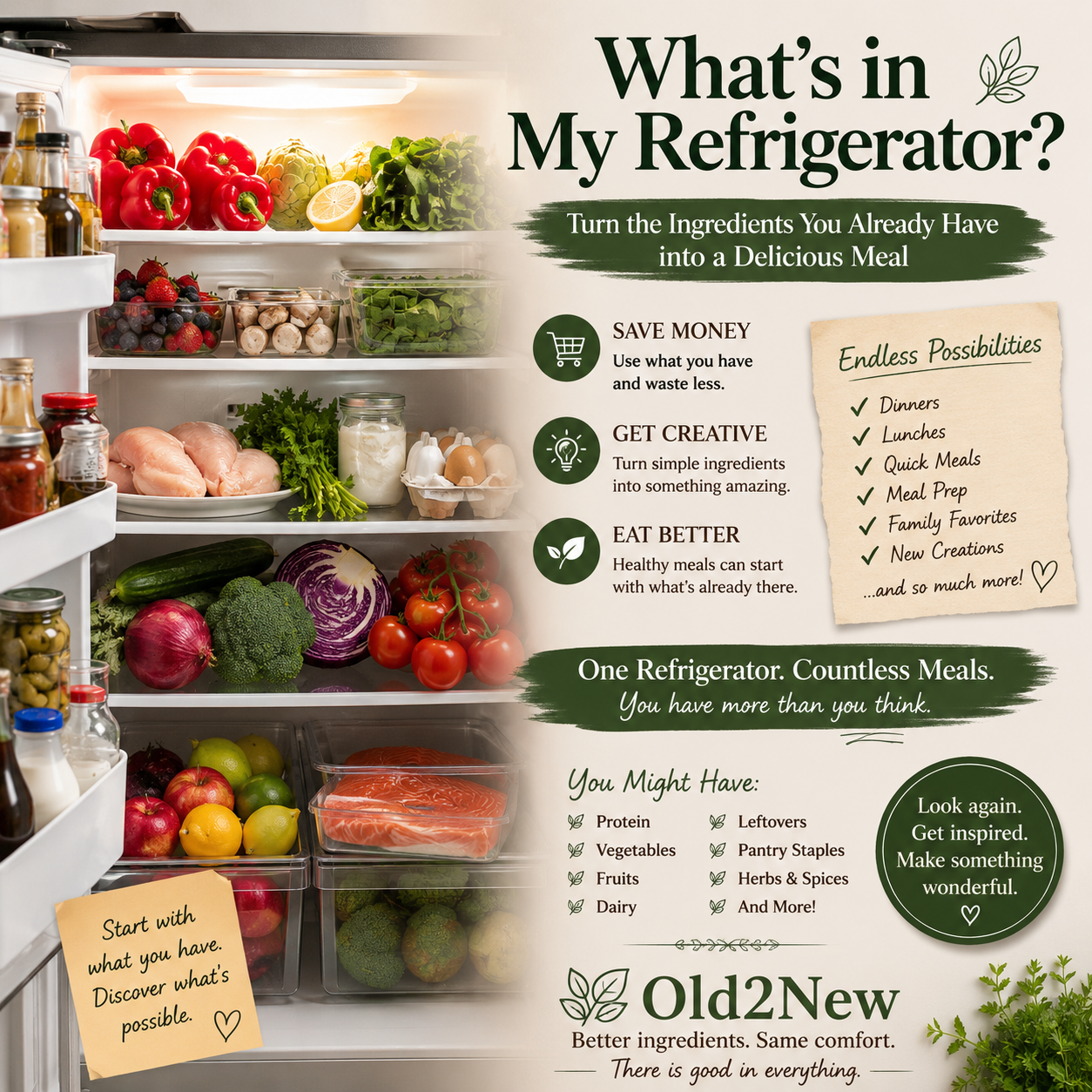
You open the refrigerator.
Chicken. Half an onion. Some spinach that needs to be used soon. A block of cheese. A lonely bell pepper. Eggs. Some leftover rice from two nights ago.
You stare for a moment.
Then comes the question: what can I actually make with this?
Most recipe websites don't help with this problem. They're built around the opposite approach — you search for a recipe, then go buy what it requires. The grocery list comes first. What's already in your kitchen is secondary.
Recipe transformation flips that around entirely.
Instead of asking "what recipe do I want?" you ask "what can I make with what I already have?" The ingredients you have become the starting point. The meal follows from there.
Your Refrigerator Is Already Full of Possibilities
Great meals don't always begin at the grocery store. Often the best dinner of the week is the one built from what was already there — the spinach that needed to be used, the chicken from two nights ago, the eggs that were about to be forgotten.
The challenge isn't usually a lack of ingredients. It's not being able to see past what those ingredients were the first time.
Leftover chicken isn't leftover chicken. It's the protein for tonight's tacos, or the base for a soup, or the filling for stuffed peppers. Cooked rice from Tuesday isn't a rerun — it's the foundation for fried rice, a grain bowl, or stuffed peppers. Eggs aren't just for breakfast; they're the binder in a frittata made from whatever vegetables need to go.
The ingredients are already there. The meal is the question.
How to Look at Your Refrigerator Differently
The shift from "I don't know what to make" to "I can make something good" is mostly a change in how you read what you see.
Start with the protein. Whatever protein is in the refrigerator — chicken, ground beef, eggs, beans, cottage cheese, canned fish — that's the anchor of the meal. Everything else builds around it.
Look at what needs to be used first. Spinach that's starting to wilt, a bell pepper that's been there a few days, half an onion — these are the ingredients that should drive the meal. They're also the ones most likely to add flavor and nutrition.
Check the pantry for what can pull it together. Broth, olive oil, garlic, canned tomatoes, soy sauce, pasta, rice, tortillas — these are the connective ingredients that turn protein and vegetables into a complete meal. You probably have more of them than you think.
Ask what format works. Soup, stir-fry, grain bowl, tacos, pasta, frittata, casserole — these formats work with almost any combination of ingredients. Pick the one that matches what you have.
What Everyday Refrigerator Ingredients Can Become
Chicken — tacos, soup, fried rice, pasta, grain bowls, stir-fry, wraps, casseroles, stuffed peppers, enchiladas. Add broth and you have soup. Add tortillas and you have tacos. Add pasta and a sauce base and you have a pasta dish.
Eggs — scrambled, fried, or poached over grain bowls or rice; folded into a frittata with whatever vegetables are there; stirred into fried rice; baked in a shakshuka with canned tomatoes and spices; used to bind a casserole or baked dish. Eggs work at any meal and go with almost everything.
Ground beef or turkey — tacos, pasta sauce, chili, stuffed peppers, meatballs, casseroles, grain bowls. Brown it with garlic and onion and it can go in almost any direction depending on what you season it with.
Spinach — wilted into pasta sauce, stirred into eggs, folded into a frittata, blended into a soup, layered into a casserole, or added raw to a grain bowl or wrap. Spinach disappears into cooked dishes and adds nutrients without changing the flavor.
Cottage cheese — blended into pasta sauces for protein and creaminess, used as a filling for stuffed peppers or lasagna, mixed into scrambled eggs, eaten with fruit, or blended into a dessert base. Cottage cheese is one of the most versatile refrigerator ingredients that most people underuse.
Bell peppers — roasted and added to grain bowls, stuffed with rice and protein and baked, sliced into stir-fries, added to pasta sauce, eaten raw with dip, or mixed into eggs. A bell pepper works in almost everything.
Leftover rice or grains — fried rice (day-old rice works better than fresh), grain bowls with whatever protein and vegetables are available, stuffed peppers, rice-based soup, or a simple side dressed with olive oil and herbs.
Cheese — melted over pasta or casseroles, stirred into eggs, used as a filling, or crumbled over grain bowls and salads. Cheese adds richness and protein to almost any dish.
The Same Ingredients, Completely Different Meals
Here's what's striking about ingredient-first cooking: the same collection of ingredients can become wildly different meals depending on how you combine them.
Take chicken, spinach, eggs, and rice.
Version 1: Scrambled eggs with spinach and shredded chicken over rice. Ready in ten minutes.
Version 2: Chicken fried rice with spinach and eggs. Day-old rice, high heat, soy sauce, ten minutes.
Version 3: Chicken and spinach stuffed into bell peppers over a rice base. Forty minutes in the oven.
Version 4: A soup with chicken, spinach, and rice in broth with garlic and herbs. Ready in twenty minutes.
Same four ingredients. Four completely different dinners. None of them require a trip to the store.
Ingredient-First Cooking Saves Money and Reduces Waste
Using what you have before buying more isn't just a creative exercise — it's financially meaningful and environmentally practical.
A third of all food produced globally is wasted, and most of it happens at the household level. Ingredients get bought, partially used, and forgotten until they go bad. The grocery budget pays for food that ends up in the trash.
A week of cooking from what's already in the refrigerator before buying more typically produces two outcomes: lower grocery spending and more interesting meals. The constraint forces creativity that recipe-first cooking rarely produces.
How Your Health Goals Fit In
Ingredient-first cooking and health-conscious cooking don't compete — they combine.
When you know what's in your refrigerator and you know your health goals, every meal becomes an opportunity to apply both at once. The chicken you're using can become a high-protein dish or a GLP-1 friendly one or a Mediterranean-inspired one — depending on what you add to it and how you prepare it.
Old2New is built around exactly this idea. The goal is to start with your ingredients and your goals — not someone else's shopping list — and find the meal that serves both.
Whether you're cooking for high protein, GLP-1 support, Mediterranean eating, blood sugar management, anti-inflammatory goals, or your own custom preferences, the transformation starts from what you have.
Where Old2New Is Headed
One refrigerator can hold hundreds of meal possibilities. The chicken, the eggs, the spinach that needs to go, the leftover rice — all of it is waiting to become something.
Old2New is built to help you see ingredients differently. Not as leftovers or random items, but as the starting point for meals you'll actually look forward to making. The transformation begins from what you already have — not from a shopping list someone else wrote.
Because every great meal starts with possibility.
The Bottom Line
Your next favorite meal might already be sitting in your refrigerator.
Recipe transformation isn't about finding the perfect recipe and buying what it requires. It's about discovering the potential hidden inside the ingredients you already own — and making something genuinely good from what's already there.
Open the refrigerator. Look again.
You probably have more possibilities than you think.
Better ingredients. Same comfort.
Frequently Asked Questions
How do I figure out what to cook with random ingredients?
Start with your protein (chicken, eggs, beans, ground meat), look at what vegetables need to be used, and check what pantry staples you have to pull it together (broth, pasta, rice, tortillas, olive oil, canned tomatoes). Then pick a format — soup, stir-fry, tacos, grain bowl, frittata — that works with what you have.
What meals can I make with just a few ingredients?
Fried rice (protein, rice, eggs, soy sauce, vegetables), frittata (eggs, whatever vegetables are there), tacos (any protein, tortillas, salsa), grain bowls (cooked grain, protein, vegetables, dressing), and pasta dishes (pasta, olive oil, garlic, any protein or vegetable) all work with minimal ingredients and whatever's on hand.
How do I use up vegetables before they go bad?
Soups and stir-fries are the most flexible formats — they work with almost any combination of vegetables. Roasting whatever's there with olive oil, salt, and pepper at high heat produces something worth eating from almost anything. Frittatas fold in vegetables naturally. Grain bowls can include whatever needs to go.
Is ingredient-first cooking harder than following a recipe?
It's different, not harder. Following a recipe is precise but requires specific ingredients. Ingredient-first cooking is flexible and creative — once you know a few formats (soup, stir-fry, grain bowl, tacos, pasta), you can work with almost anything. The more you do it, the faster it becomes.
How does Old2New help with ingredient-first cooking?
Old2New currently transforms recipes you bring to it, applying ingredient swaps based on your health goals. A future direction for Old2New is helping you start from the ingredients you have — describing what's in your refrigerator and getting meal ideas tailored to those ingredients and your goals.
How do I make ingredient-first meals healthier?
The same swaps apply regardless of where the meal idea comes from: Greek yogurt instead of sour cream or mayo, whole grain pasta or rice, more vegetables folded in, olive oil for sautéing, blended cottage cheese in creamy sauces. The format doesn't change the approach to making it better.
Continue Your Recipe Transformation Journey
- Stop Throwing Away Food — how to turn leftovers into meals worth eating
- What Can I Make with Chicken? — one ingredient, dozens of directions
- Healthy Ingredient Swaps That Actually Taste Good — the swaps that work in any dish
- How to Make a Recipe Healthier Without Losing the Flavor — the one-swap-at-a-time approach
- One Recipe, Four Goals — how the same dish transforms for different health goals
- 10 Healthy Ingredient Swaps That Actually Taste Good — a practical reference list
Old2New — There is good in everything.