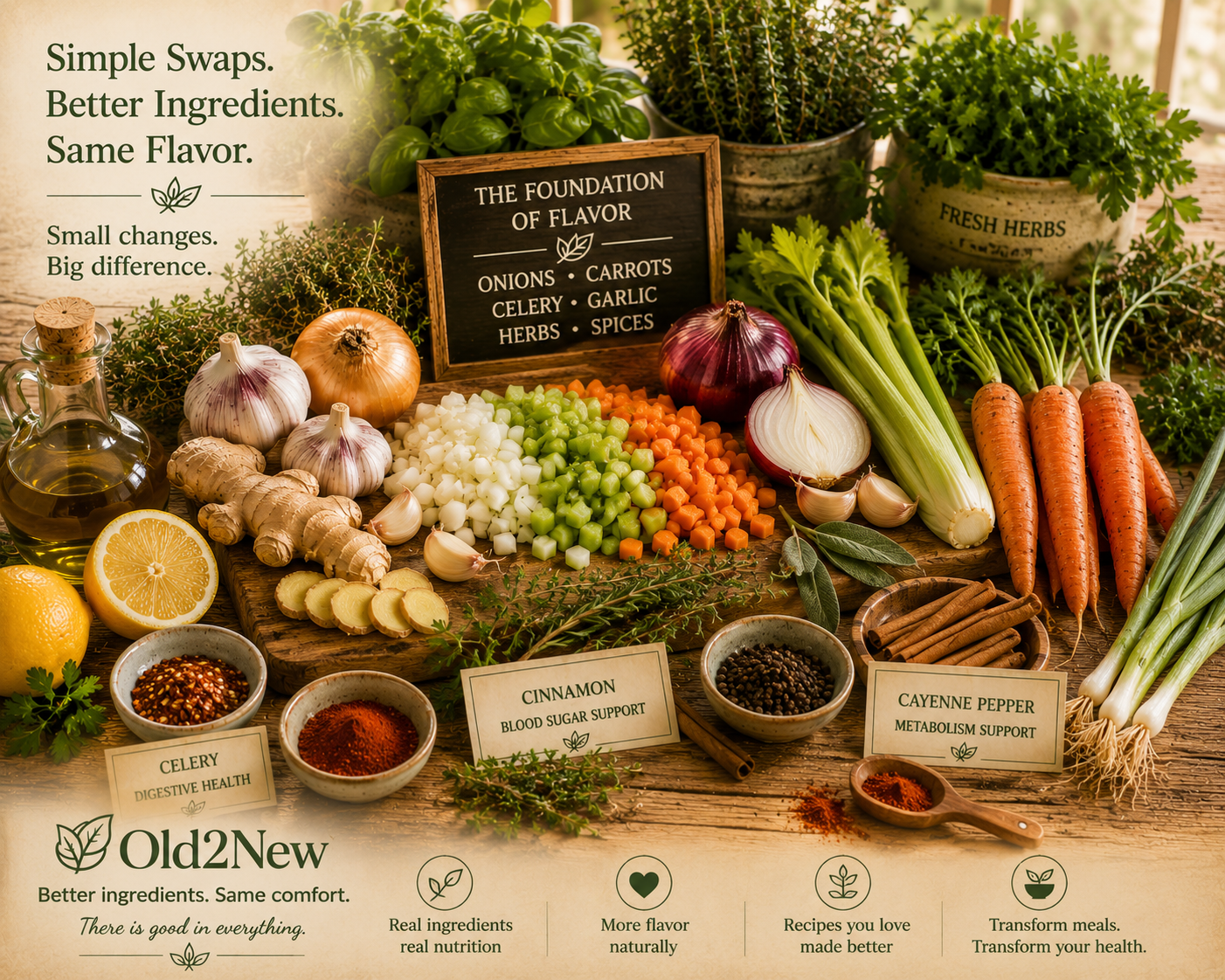
If you've ever looked at a favorite family recipe and thought how do I make this healthier without ruining it — you're asking exactly the right question.
Not "what should I eat instead." Not "how do I find a recipe that's already healthy." But: how do I take the thing I already want to make, and make it work better for me?
That's a different starting point than most healthy eating advice gives you — and it produces different results.
Making a recipe healthier almost never requires starting over. It usually requires a series of small ingredient decisions that improve the nutrition while preserving the flavors that made you love the dish in the first place. The lasagna stays lasagna. The chili stays chili. The cookies stay cookies. The ingredients inside them simply do more.
That's what recipe transformation is built around.
Start With the Recipe You Already Know
Most approaches to healthy eating begin with a list of approved foods and recipes built around those foods. The assumption is that you'll learn to love the new meals, or at least tolerate them.
Recipe transformation begins somewhere different: with your own recipe.
Not a nutritionist's version of it. Not a recipe from a health magazine that happens to share the same name. Your recipe — the one you've been making for years, the one your family asks for, the one you already know how to cook.
The goal isn't to replace it. The goal is to improve it — to find the version of that specific dish that works better for how you want to eat, while keeping everything that made it worth making in the first place.
That matters because it's the difference between change that lasts and change that doesn't. When the starting point is food you actually want to eat, the improvement is something you'll actually maintain.
Focus on One Change at a Time
The most common mistake people make when trying to improve a recipe is changing too many things at once.
If you replace five ingredients in the same dish on the same night, and the result isn't quite right, you have no idea which change caused the problem. You also lose the sense of the dish — it stops tasting like itself and becomes something unfamiliar.
Starting with one change at a time solves both problems.
One swap per recipe, or one swap per week — whichever feels more manageable. The change is small enough that you can evaluate it clearly. If it works, you keep it and it becomes your new normal. If it doesn't quite work, you try something different.
A few single swaps that consistently make a meaningful difference:
Whole grain pasta instead of refined pasta. Same dish, same sauce, same presentation. The texture is slightly different the first time and most people stop noticing after that. More fiber, more staying power.
Greek yogurt instead of sour cream. Works in tacos, baked potatoes, dips, soups, sauces, and baked goods. Nearly identical texture and tang. Significantly more protein. Most people can't taste the difference in the finished dish.
Lean ground turkey instead of higher-fat ground beef. Same texture in most cooked applications — chili, pasta sauce, tacos, meatballs, casseroles. Same seasoning. The dish behaves identically; the fat content shifts.
More vegetables added to soups, casseroles, and sauces. This is the least disruptive change and often the most effective. More vegetables means more fiber, more nutrients, and more volume without a dramatic change to what the dish tastes like.
Olive oil where it fits the recipe. In most savory cooked applications — sautéing, roasting, finishing — olive oil works as well as butter or vegetable oil and provides a different fat profile.
None of these changes require learning new techniques. They're just different choices about what goes into the dish you already know how to make.
Flavor Comes From More Than the Fat and Sugar
The most common fear about making recipes healthier is that the result won't taste as good. This fear is real — plenty of "healthy" recipes are legitimately less enjoyable than the originals, and that's usually because the wrong things were changed.
The mistake is assuming that fat and sugar are where all the flavor comes from.
They contribute to flavor. But in most dishes, the deeper flavor comes from:
- Aromatics — garlic, onion, shallots, and leeks, cooked until they release their flavor
- Fresh herbs — basil, parsley, cilantro, rosemary, thyme, and oregano add layers of flavor that no other ingredient replicates
- Spices and seasoning — paprika, cumin, chili powder, turmeric, black pepper, and dozens of others contribute complexity
- Slow cooking and roasting — time and heat develop flavors that no shortcut produces
- Acid — a squeeze of lemon juice or a splash of vinegar brightens a dish and makes everything taste more alive
When these elements are present and well-executed, the dish is satisfying even when the fat content is lower or the sugar is reduced. The flavor was never entirely dependent on the things you changed.
A lot of people discover that the transformed version of their recipe is actually more interesting than the original — not because it's healthier, but because paying attention to the recipe led to better cooking.
Every Recipe Can Be Transformed Differently
Making a recipe healthier isn't one-size-fits-all. The "healthier" version of your lasagna depends on what you're optimizing for — and that depends on you.
Someone focused on higher protein wants ingredient swaps that increase protein density throughout the dish: higher-protein pasta, cottage cheese in the filling, leaner meat in the sauce.
Someone following GLP-1 friendly eating wants swaps that create satiety with less volume: more protein, more fiber, slightly lighter components that feel complete in a smaller serving.
Someone following Mediterranean-style eating wants more olive oil, more vegetables, whole grains, and perhaps a seafood variation.
Someone managing blood sugar wants to pay attention to the carbohydrate quality — whole grains over refined, more fiber throughout, protein and fat balanced alongside the starchy components.
Someone avoiding gluten wants the same dish built entirely without wheat-based ingredients.
The transformation depends on the goal. What stays constant is the starting point — the recipe you already love — and the approach: thoughtful ingredient choices that move the dish in the direction you need, one swap at a time.
What Good Recipe Transformation Feels Like
The test of a good transformation is simple: does the dish still taste like itself?
If yes, the swap worked. If it no longer feels like the dish you were craving, something went wrong — either the wrong ingredient was changed, or too many things were changed at once.
Good transformations are ones you stop noticing. You make the dish with Greek yogurt instead of sour cream for the third time, and it's just how the dish tastes now. You've been using whole grain pasta for two months, and refined pasta would seem like a step backward.
The new version becomes your version. The recipe improves, the habit forms, and none of it required giving up the thing you wanted to eat.
The Bottom Line
You don't have to give up your favorite recipes. You don't have to start over with unfamiliar foods or learn to eat things you don't enjoy.
Making a recipe healthier is usually a matter of making better ingredient choices — starting with the dish you already love and finding the version of it that works better for how you want to eat.
One swap. One recipe. One better decision at a time.
The comfort stays. The ingredients get better.
Better ingredients. Same comfort.
Frequently Asked Questions
How do I make a recipe healthier without changing the taste?
Start with swaps that change the nutritional profile without changing the flavor profile. Greek yogurt for sour cream, whole grain pasta for refined, lean turkey for ground beef — these ingredients behave similarly in cooking. The dish tastes like the dish. The nutrition shifts.
What's the easiest way to make a recipe healthier?
Adding more vegetables is the least disruptive starting point — it increases fiber and nutrients without dramatically changing what the dish tastes like. After that, Greek yogurt for sour cream is the most universally applicable swap with the least noticeable difference.
Should I change everything in a recipe at once?
No — changing too many ingredients at once makes it hard to know what worked and what didn't, and often makes the dish taste unfamiliar. One swap at a time gives you clearer feedback and lets the dish stay recognizable while you gradually improve it.
Does making a recipe healthier make it taste worse?
A good swap shouldn't. The swaps worth making are the ones that behave similarly to the ingredients they replace — same texture, same function in the dish, close enough in flavor that you stop noticing the difference. If a swap makes the dish worse, it's not the right swap.
Can I make any recipe healthier?
Almost any recipe can be improved with at least one thoughtful swap. Some dishes adapt more easily than others, but the starting question is almost never "can this be improved?" — it's "where's the best place to start?"
How does Old2New help make recipes healthier?
Old2New takes the recipe you already love and identifies ingredient swaps based on your specific health goals — whether that's higher protein, GLP-1 friendly, Mediterranean, diabetic-friendly, anti-inflammatory, or your own custom preferences. The dish stays recognizable. The ingredients are chosen to serve your goals.
Continue Your Recipe Transformation Journey
- What Is Recipe Transformation? — the foundation the whole library builds on
- How to Make Comfort Food Healthier — the practical approach behind every transformation
- Healthy Ingredient Swaps That Actually Taste Good — the specific swaps and why they work
- One Recipe, Four Goals — how the same dish transforms for four different health goals
- Stop Throwing Away Food — how to turn leftovers into meals worth eating
- Healthy Desserts That Still Feel Like Dessert — because dessert deserves good ingredients too
Old2New — There is good in everything.