There's a moment most people recognize.
You're eating something — maybe it's pasta, maybe it's a bowl of mac and cheese, maybe it's the lasagna your mom made growing up — and somewhere in the middle of enjoying it, a thought creeps in: I probably shouldn't be eating this.
Recipe transformation exists to end that moment.
Not by taking the food away. Not by replacing it with something that vaguely resembles it. But by changing what's in it — ingredient by ingredient — so the dish you love still tastes like itself, just made differently.
Every transformation begins with the recipe you already love — not one you have to learn to love.
That's the whole idea. And it's simpler than most people expect.
What "Recipe Transformation" Actually Means
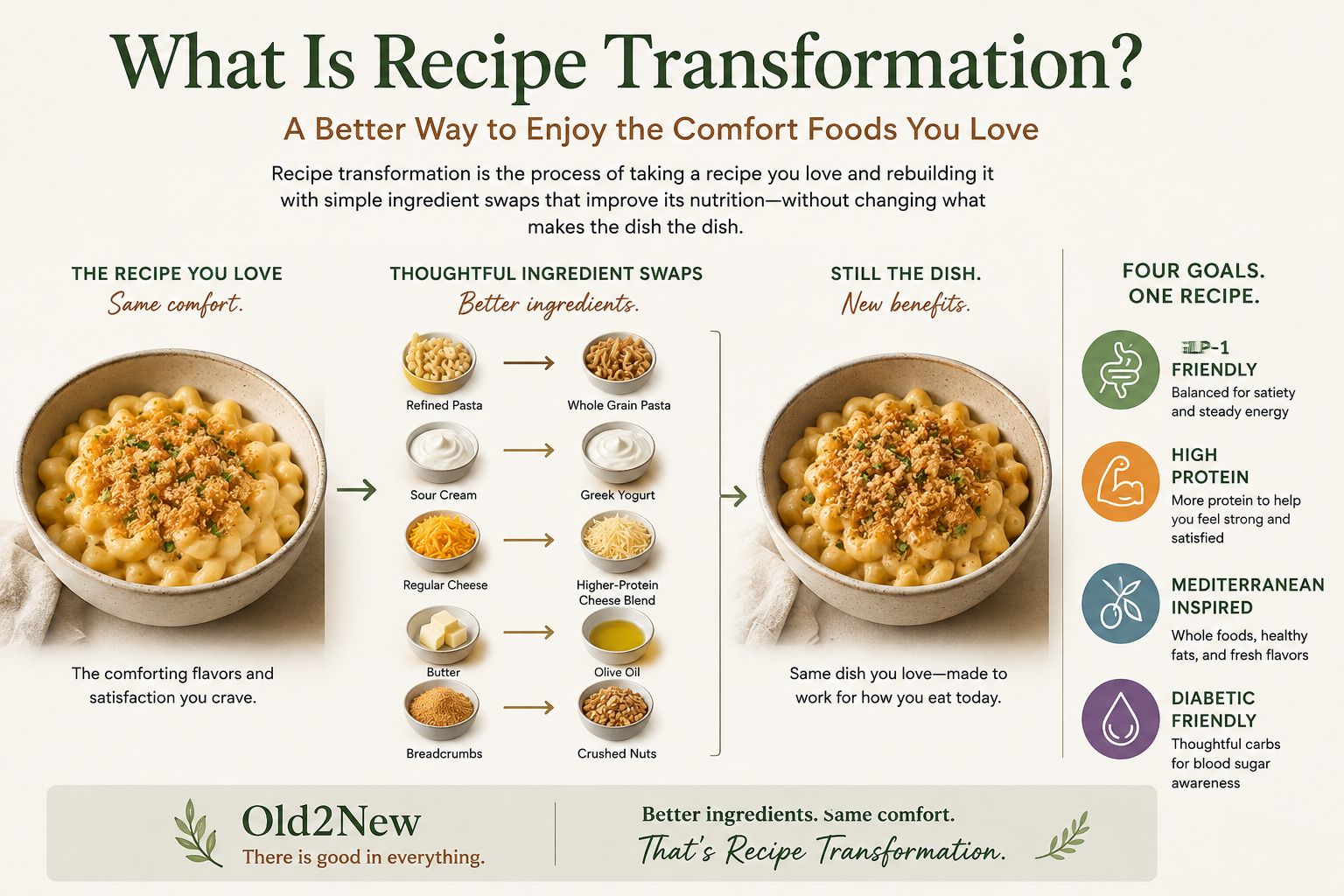
Recipe transformation is the process of taking an existing recipe and rebuilding it with ingredient swaps that change its nutritional profile without changing its identity.
A transformed recipe still is the dish. Mac and cheese is still mac and cheese. The goal isn't to make something that pretends to be mac and cheese while secretly being cauliflower. The goal is mac and cheese — with a few things swapped out that make it work better for how you're eating right now.
The key word is swap, not replace. Swapping implies something stays. The dish stays. The craving is still honored. What changes is the specific form of one or two ingredients — the type of pasta, the kind of cheese, the ratio of components — in ways that shift the nutrition without dismantling what makes the dish worth eating in the first place.
What a Transformation Looks Like
Here's a simple example. Take classic mac and cheese.
The original: Pasta · full-fat cheese sauce · butter · whole milk
The Old2New version: Whole grain pasta · higher-protein cheese blend · Greek yogurt in place of heavy cream · extra vegetables folded in
The dish is still mac and cheese. It still looks like mac and cheese. It still satisfies the same craving. But the ingredient choices behind it have shifted — in ways that support your health goals without asking you to give up the thing you wanted in the first place.
Same comfort. Different math.
What Gets Swapped — and Why
Recipe transformation focuses on a handful of ingredient categories where small changes produce meaningful results:
- Proteins — Swapping ground beef for ground turkey, or adding Greek yogurt where sour cream was, changes the protein density of a dish without changing its structure or flavor profile in any dramatic way.
- Grains and starches — Whole grain pasta, cauliflower rice, lentil-based noodles, and high-fiber tortillas all carry the same role in a dish as their traditional counterparts, with a different nutritional output.
- Fats and dairy — Full-fat sour cream, heavy cream, and butter all have lower-fat or higher-protein alternatives that behave similarly in cooking. Substituting them doesn't always change what you taste — but it changes what you're eating.
- Portions and ratios — Sometimes transformation isn't about changing an ingredient at all. It's about changing the ratio — more vegetable, less pasta; more sauce, less cheese — in a way that keeps the dish satisfying while shifting what it delivers.
None of these are tricks. They're decisions — made with intention rather than habit.
Why Comfort Food Specifically
Comfort food is the category where recipe transformation matters most, and it's not because comfort food is uniquely unhealthy. It's because comfort food is the category people are least willing to give up — and shouldn't have to.
Comfort food carries memory, identity, and emotion in a way that other food categories don't. A salad doesn't remind you of your grandmother's kitchen. A smoothie doesn't feel like a Sunday afternoon. Comfort food does. And that's why it's the last thing people want to see on a "foods to avoid" list — and the first thing they miss when they change how they eat.
Recipe transformation takes that seriously. The assumption isn't you need to stop eating this. The assumption is you're going to keep eating this — let's make it work for you.
How One Recipe Can Serve Four Different Goals
One of the most powerful ideas behind recipe transformation is that the same dish can be adapted in completely different directions depending on what you need from it:
- For GLP-1 users: Lower volume, higher satiety, softer textures that work with a changed appetite. The dish satisfies without requiring the same portion it once did.
- For high protein: Ingredient swaps that increase protein density across the whole meal — Greek yogurt, legume-based pasta, leaner proteins — without changing what the dish tastes like.
- For Mediterranean eating: More whole foods, healthy fats, and fiber. Less processed, more intentional — but still recognizably the dish you wanted.
- For managing blood sugar: Lower glycemic ingredients, more fiber, fewer refined carbohydrates — adapted for the way the dish needs to behave in your body, not just what it's made of.
This is what makes recipe transformation different from a diet. A diet picks one set of rules and applies them across everything. Recipe transformation starts with your goal and rebuilds the dish around it.
Who Recipe Transformation Is For
Recipe transformation is useful for anyone who has a reason to think more carefully about what they're eating but doesn't want to rebuild their entire relationship with food from scratch.
That includes:
- People on GLP-1 medications (like Ozempic, Wegovy, Mounjaro, or Zepbound), who often find their appetite and portion tolerance has shifted, and need versions of familiar foods that satisfy cravings with less volume.
- People focused on higher protein intake, who are looking to increase protein density across all their meals — including the comforting, familiar ones.
- People following Mediterranean-style eating patterns, who want to keep enjoying the foods they love while shifting toward more whole foods, healthy fats, and less processed content.
- People managing blood sugar, including those with Type 2 diabetes or insulin resistance, who need to be thoughtful about carbohydrates and glycemic impact without eliminating entire food categories from their lives.
What Recipe Transformation Is Not
It's not a diet. A diet tells you what you can and can't eat. Recipe transformation assumes you're going to eat what you want and helps you make a version that works better for your goals.
It's not about restriction. The goal is never to take something away. The goal is to find a version that keeps the dish and changes the details.
It's not calorie math. While transformed recipes often have different calorie profiles than their originals, transformation isn't about hitting a number. It's about making a dish work for how you're eating right now.
It's not pretending. If the swap makes the dish worse, it's not a good swap.
The Idea Behind Old2New
Old2New is an app built around recipe transformation.
You bring a dish — a recipe you already love, a meal you've been eating for years, a comfort food you're not willing to give up. Old2New rebuilds it, swapping ingredients based on your health goals while keeping the dish recognizable.
The name is the concept: old → new. Not old gone, new instead. Old transformed into new. The food you love, made to work for where you are now.
Every recipe that comes out of Old2New is still the dish it started as. It just has a few things changed — thoughtfully, with intention, and without apology.
Better ingredients. Same comfort.
Frequently Asked Questions
What is recipe transformation?
Recipe transformation is the process of rebuilding a recipe you already love using ingredient swaps that change its nutritional profile without changing the dish itself. The goal is to keep eating the foods you enjoy while making them work better for your health goals.
Is recipe transformation a diet?
No. A diet tells you what you can and can't eat. Recipe transformation starts with the food you already want and adapts it — so you're making better choices within the meals you love, not replacing them with ones you don't.
Can any recipe be transformed?
Almost any comfort food can be transformed in some meaningful way. There's almost always a swap that improves the nutritional profile without sacrificing what makes the dish worth eating.
Does the food still taste the same?
That's the goal. A good swap is one you wouldn't notice — or one that makes the dish taste just as good in a slightly different way. If a swap makes the dish worse, it's not the right swap.
Who is recipe transformation for?
Anyone who wants to keep eating the foods they love while being more intentional about what's in them — including people on GLP-1 medications, those focused on higher protein, people following Mediterranean-style eating, and anyone managing blood sugar.
What's the difference between recipe transformation and a healthy recipe?
A healthy recipe is designed from scratch to meet nutritional goals. Recipe transformation starts with an existing recipe you already love and adapts it. The starting point is your craving, not a nutrition target.
Is Old2New free to use?
Old2New offers a free trial. Subscription plans start at $14.99/month. Download Old2New on Google Play or try it at old2new.app.
Continue Your Recipe Transformation Journey
- How to Make Comfort Food Healthier — the practical how-to behind the concept
- Healthy Ingredient Swaps That Actually Taste Good — the specific swaps and why they work
- One Recipe, Four Goals — how the same dish transforms for GLP-1, high protein, Mediterranean, and diabetic-friendly eating
- Healthy Desserts That Still Feel Like Dessert — because dessert doesn't get left out
Old2New — There is good in everything.