There's a misconception that stops a lot of people before they even start.
The idea that eating healthier means giving up the foods you love. That to make a real change, you have to clear out your kitchen, learn new recipes, and start eating things that look nothing like what you actually want to eat.
That's not how it works. And it's not how lasting change happens.
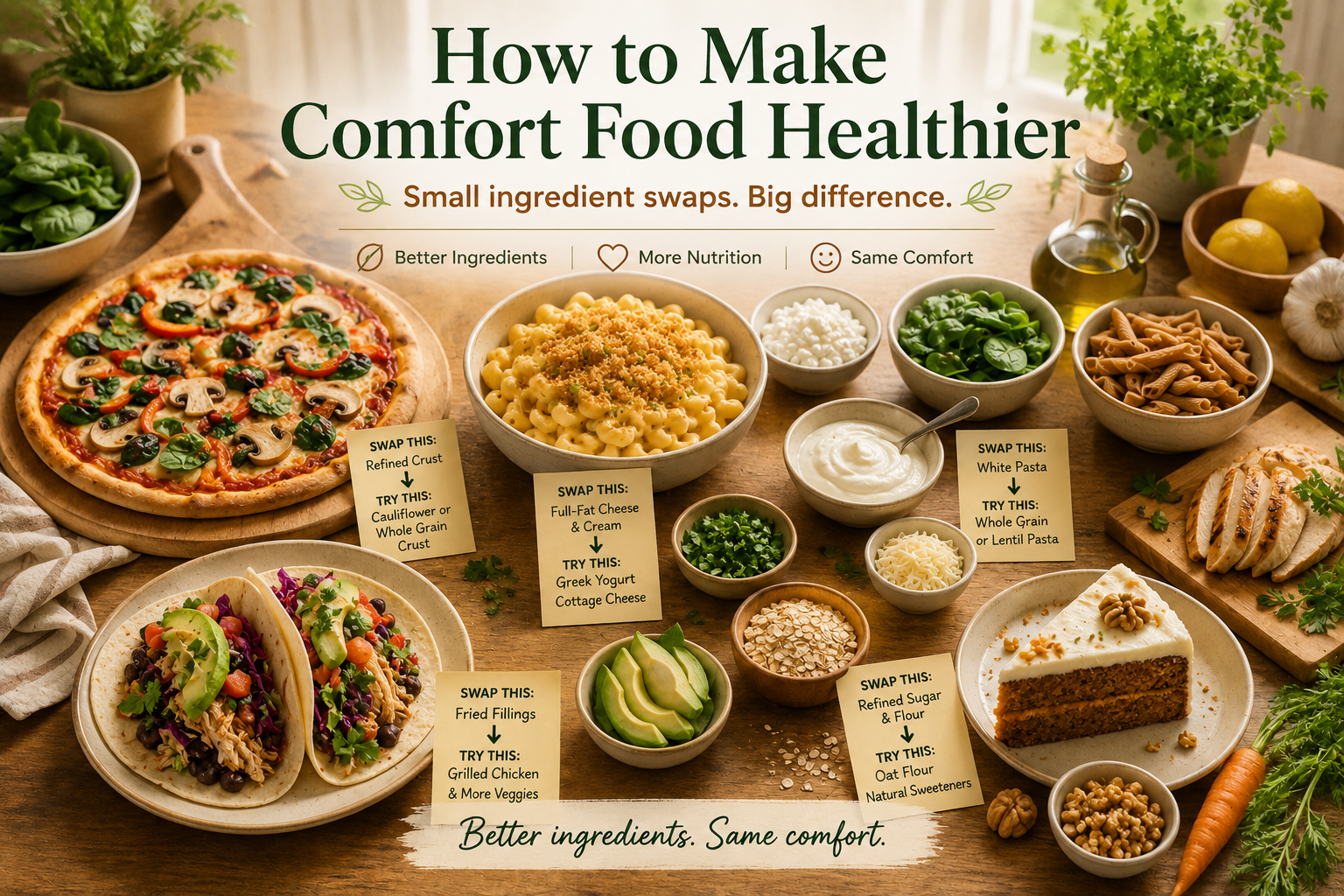
Making comfort food healthier isn't about replacing your favorite meals with foods you don't recognize. It's about making thoughtful ingredient choices that improve what's in the dish while keeping it familiar, satisfying, and worth eating.
One swap at a time. Starting with the recipe you already know.
Start With What You Already Love
The most effective place to start isn't a new recipe. It's an old one.
Think about the meals you make on repeat. The ones that feel like home. The ones you come back to when you're tired, or when it's cold outside, or when you just want something that actually tastes good.
Maybe that's:
- Mac and cheese
- Pizza
- Chicken Alfredo
- Chili
- Lasagna
- Brownies
- Carrot cake
You don't need to stop making any of these.
You just need to look at them differently — not as recipes to avoid, but as recipes to work with. Each one is a starting point. Each one already has the most important thing: you actually want to eat it.
That's where recipe transformation begins.
Think in Swaps, Not Sacrifices
The shift that makes healthy cooking sustainable isn't a new ingredient list. It's a new way of thinking about ingredients.
Instead of asking what do I have to give up, ask what can I swap.
The difference matters. Sacrifice has an ending — you can only hold out for so long. A swap just becomes the new normal. You stop noticing it after a while, because the dish still tastes like the dish.
Some swaps that work across a wide range of comfort foods:
Instead of sour cream → Greek yogurt. Same creamy texture, more protein, same tang. Works in dips, sauces, tacos, baked potatoes, and anywhere sour cream shows up.
Instead of refined pasta → whole grain or legume-based pasta. The dish looks identical. The texture is close enough that most people don't notice after the first time. More fiber, more staying power.
Instead of butter in sauces → olive oil. Not always interchangeable, but in many cooked applications it works well and brings its own flavor.
Instead of mayonnaise → avocado or Greek yogurt. Creamy, rich, satisfying — with a very different nutritional profile.
Instead of heavy cream in pasta sauces → blended cottage cheese. This one surprises people. When blended smooth, it creates a creamy, protein-rich sauce base that doesn't taste like cottage cheese at all.
Instead of ground beef → ground turkey or a beef-turkey blend. Lower fat, same texture in most applications, same seasoning.
Instead of breadcrumbs as a topping → crushed nuts or seeds. Adds crunch, healthy fats, and a slightly different — often better — texture.
None of these are compromises you'll resent. They're just different choices that get easier every time you make them.
Add Before You Remove
Here's a strategy that often works better than swapping: adding something before you take anything away.
Most comfort food recipes have room for more — more vegetables, more protein, more fiber — without losing anything that makes the dish good. Sometimes adding the right thing means you naturally use less of something else, not because you forced it, but because the dish is already satisfying.
Things you can add to almost any comfort food:
- Extra vegetables — spinach wilts into sauces invisibly, mushrooms add substance to meat-based dishes, zucchini and bell peppers work in almost everything
- Beans or lentils — in chili, soups, pasta dishes, and even baked goods they add fiber and protein without announcing themselves
- Fresh herbs — basil, parsley, cilantro, and dill brighten dishes and make them taste more alive
- Spinach or kale — both wilt down to almost nothing in cooked dishes, adding nutrients without changing the flavor profile
- Nuts or seeds — on top of salads, stirred into grain dishes, or used as a topping in place of croutons or breadcrumbs
The goal isn't to hide vegetables in food. It's to build dishes that are more complete — more satisfying in a way that lasts — without dismantling what made them worth eating in the first place.
Match the Recipe to Your Goal
One of the most important things to understand about making comfort food healthier is that "healthier" isn't one fixed destination. It looks different depending on what you're working toward.
If you're eating for GLP-1 support: The priority is often protein and portion satisfaction — foods that feel complete without requiring the same volume they once did. Swaps that increase protein density and add fiber tend to matter most here.
If your goal is higher protein: You're looking at every opportunity to increase lean protein — more Greek yogurt, more legume-based ingredients, leaner cuts of meat, protein-rich toppings — without making the dish feel like a nutrition project.
If you're following Mediterranean-style eating: The emphasis shifts toward whole foods, healthy fats, and fresh ingredients. More olive oil, more vegetables, more whole grains, more seafood. Less processed, not less flavorful.
If you're managing blood sugar: The focus is usually on fiber and lower glycemic ingredients — whole grains over refined, more vegetables to balance starchy components, portions that are structured to avoid spikes.
The same dish can be transformed in four completely different directions. That's not a complication — it's a feature. It means that whatever your goal is, the food you already love has a version that works for you.
There isn't one "perfect" recipe. There is a recipe that's perfect for your goals.
Small Changes Add Up
This is the part that's easy to underestimate.
One swap — Greek yogurt instead of sour cream — doesn't change your life. But making one thoughtful swap per week, consistently, for a year? That's 52 small decisions that become a completely different relationship with food.
Healthy eating doesn't happen because of one perfect meal. It happens because of hundreds of small, consistent choices that accumulate quietly over time until one day you realize the way you cook has changed — and you don't miss what came before.
The goal isn't to overhaul everything at once. It's to make one thing better today, and then one more thing next time. The dish stays recognizable. The habit forms without you having to force it.
That's how lasting change actually works.
The Old2New Approach
Old2New is built around exactly this idea.
You bring a recipe — something you already love, something you've been making for years, something you're not willing to give up. Old2New rebuilds it with ingredient swaps chosen around your specific goals, keeping the dish recognizable while making it work better for how you're eating right now.
Whether you're eating for GLP-1 support, higher protein, Mediterranean-style health, or blood sugar management — the starting point is always the same: the dish you already want.
Better ingredients. Same comfort.
Frequently Asked Questions
How do I make comfort food healthier without losing the flavor?
Start with swaps that change the nutritional profile without changing the flavor profile. Greek yogurt for sour cream, whole grain pasta for refined pasta, blended cottage cheese in cream sauces — these are ingredients that behave similarly in cooking. The dish tastes like the dish. The nutrition has shifted.
What's the easiest swap to start with?
Greek yogurt in place of sour cream is one of the most versatile starting points. It works in dips, sauces, tacos, soups, baked potatoes, and dressings. The texture is almost identical and most people can't taste the difference once it's in a dish.
Do I have to change the whole recipe at once?
No — and trying to change everything at once usually doesn't stick. Start with one swap. Make the dish the way you normally would, change one ingredient, and see how it feels. One change per recipe, or one change per week, is enough to build a genuinely different way of cooking over time.
Is it possible to make any comfort food healthier?
Almost always, yes. Some dishes are easier to transform than others, but there's almost always at least one ingredient that can be improved without changing what makes the dish worth eating. The starting question isn't "can this be transformed?" — it's "what's the best place to start?"
How is this different from just cooking healthy food?
Healthy recipes start from scratch with nutritional goals in mind. Recipe transformation starts with something you already love and improves it. The emotional starting point is completely different — and that matters, because it's much easier to stick with food you actually want to eat.
What if the swap makes it taste worse?
Then it's not the right swap. A good ingredient swap improves or maintains the flavor of the dish — if it makes the dish worse, it defeats the purpose. Part of what Old2New does is identify swaps that actually work, not just ones that look good on a nutrition label.
Continue Your Recipe Transformation Journey
- What Is Recipe Transformation? — the foundation this article builds on
- Healthy Ingredient Swaps That Actually Taste Good — a deeper look at the specific swaps and why they work
- One Recipe, Four Goals — how the same dish transforms for GLP-1, high protein, Mediterranean, and diabetic-friendly eating
- Healthy Desserts That Still Feel Like Dessert — because dessert is comfort food too
Old2New — There is good in everything.