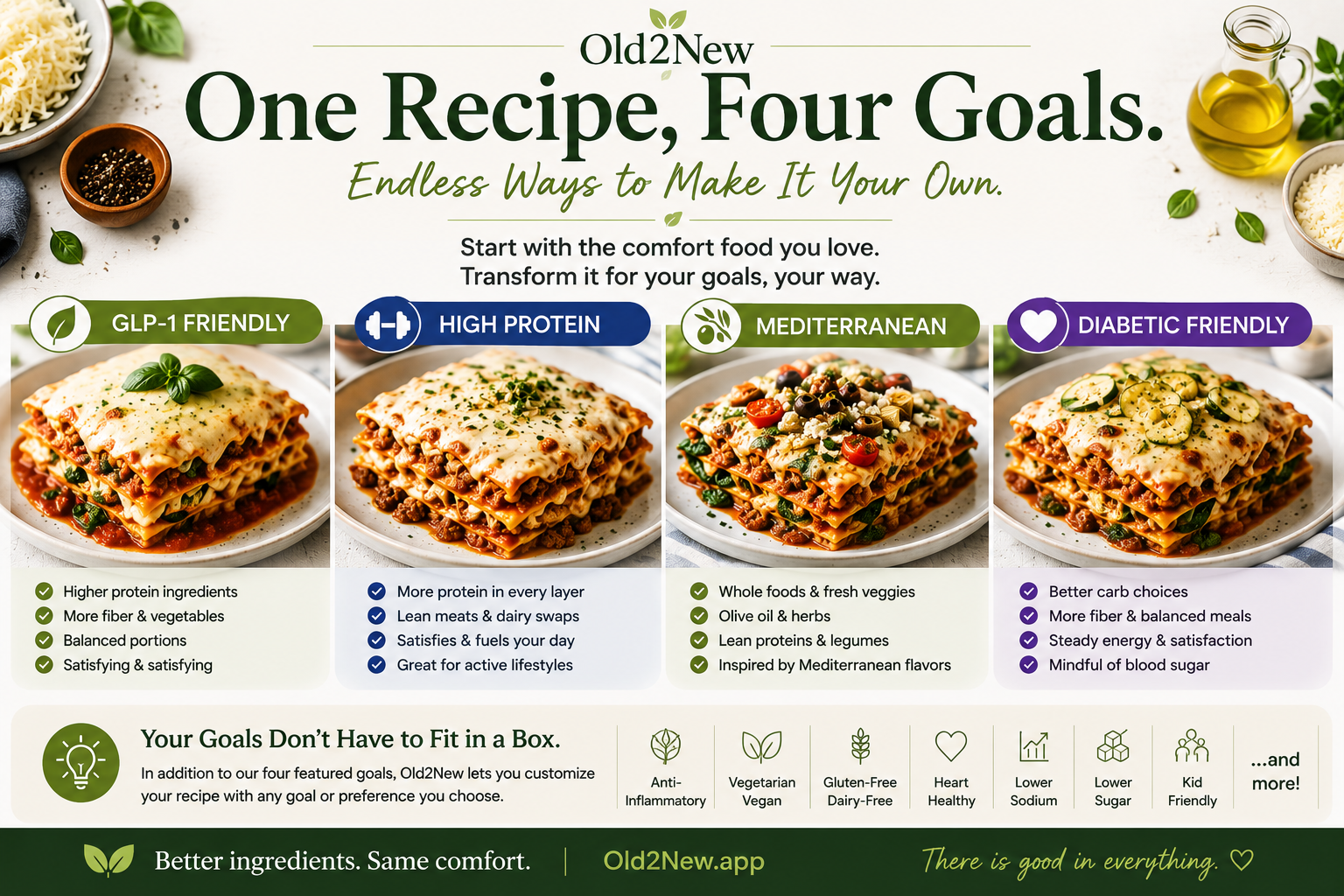
Healthy eating isn't one-size-fits-all.
Two people can start with the exact same recipe and have completely different goals. One person wants more protein. Another is following a Mediterranean-style eating pattern. Someone else is managing blood sugar, or looking for meals that work well while taking a GLP-1 medication.
The recipe doesn't have to change completely.
The goal changes.
That's what recipe transformation is actually about. Instead of asking whether a recipe is "healthy," Old2New asks a better question: healthy for whom?
The Same Recipe Can Take Different Paths
Imagine your favorite homemade lasagna.
It's still lasagna. It still has layers of sauce, cheese, and comforting flavor. But depending on your goals, the ingredients can be rebuilt in different directions while keeping everything that makes it recognizable.
The comfort stays. The ingredients evolve.
Here's what that looks like across four of the most common health goals.
GLP-1 Friendly
People using GLP-1 medications — like Ozempic, Wegovy, Mounjaro, or Zepbound — often find that their appetite and portion tolerance shift. Meals that once felt normal can feel too heavy. The challenge isn't eating less; it's finding versions of familiar foods that satisfy without overwhelming.
A GLP-1-friendly transformation focuses on:
- Higher protein ingredients that create satiety with less volume
- More fiber-rich vegetables that add substance and staying power
- Lighter sauces and components that don't sit heavily
- Balanced portions that feel complete without requiring the same quantity
The goal isn't to shrink the meal. It's to make every component of it work harder — so the dish still feels satisfying in a smaller serving.
High Protein
A high-protein transformation looks beyond simply adding more meat. Protein can come from many thoughtful ingredient choices throughout the entire recipe.
Sources Old2New draws from for high-protein transformations:
- Greek yogurt (in place of sour cream or as a sauce base)
- Cottage cheese blended into creamy sauces
- Lean poultry in place of higher-fat proteins
- Beans and legumes folded into the dish
- Higher-protein dairy (ricotta, certain cheeses)
- Legume-based pasta in place of refined pasta
Instead of changing one thing, a high-protein transformation looks at the full recipe and finds every opportunity to increase protein density — without making the dish feel like a nutrition project rather than a meal.
The lasagna is still lasagna. It just works harder.
Mediterranean Inspired
Mediterranean-style eating emphasizes whole foods, vegetables, healthy fats, herbs, legumes, and whole grains. It's less about restriction and more about shifting the composition of the dish — more of some things, less of others.
A Mediterranean-inspired transformation might include:
- Olive oil in place of butter where it fits
- Fresh herbs added throughout (basil, oregano, parsley)
- Whole grain pasta or grains in place of refined
- More vegetables layered into the dish
- Lean proteins, seafood, or plant-based protein
- Less processed dairy, more fresh ingredients
The result still feels familiar. The flavors are still warm and comforting. But the ingredient composition has shifted in a direction that aligns with one of the most studied eating patterns in the world.
Diabetic Friendly
A diabetic-friendly transformation focuses on improving the balance of a recipe without removing everything that makes it enjoyable. The goal isn't to eliminate carbohydrates — it's to choose them more carefully and balance them with protein and fiber so the dish has a gentler effect on blood sugar.
Changes a diabetic-friendly transformation might make:
- Whole grain or legume-based pasta instead of refined
- More vegetables to balance the carbohydrate load
- Higher fiber ingredients throughout
- Leaner proteins to improve the overall balance
- Smaller portions of starchy components, larger portions of vegetables and protein
The lasagna is still recognizably lasagna. The balance has simply shifted in a way that's more thoughtful about carbohydrate quality and overall composition.
Note: Everyone's health needs are different. Nutrition decisions — especially for managing a medical condition — should always be made with guidance from your healthcare provider.
But That's Only the Beginning
The four featured goals are the most common starting points. They're not the only options.
Old2New lets you describe what you're looking for — and the transformation adapts to fit. That means you can go beyond the four featured goals entirely:
- Anti-Inflammatory
- Heart Healthy
- Vegetarian or Vegan
- Gluten-Free
- Dairy-Free
- Lower Sodium
- Lower Sugar
- Higher Fiber
- Kid Friendly
And you can combine them. High Protein and Anti-Inflammatory. Mediterranean and Gluten-Free. Heart Healthy and Lower Sodium. Vegetarian and Higher Protein.
The recipe becomes personal — not generic.
Why Personalization Matters
Most recipe websites publish one "healthy" version of a recipe. One set of swaps, applied to everyone, regardless of what they actually need.
Old2New starts with your favorite recipe and transforms it around your goals. Two people can begin with the same comfort food and receive completely different ingredient suggestions — because they're working toward different things.
That's the difference between a healthy recipe and a recipe transformation.
No Two Kitchens Are Exactly Alike
Some families avoid dairy. Some need lower sodium. Some want to add more vegetables without changing the flavors their kids already love. Others are cooking for athletes, older adults, or people navigating specific health conditions.
Old2New doesn't ask everyone to eat the same way. It helps transform the recipe you already love around the way you want to eat.
Because the best recipe isn't the one everyone else is eating. It's the one that's made for you.
Start With the Food You Love
The best changes don't begin by giving up your favorite meals. They begin by improving them.
Whatever your goal — GLP-1 friendly, high protein, Mediterranean inspired, diabetic friendly, or something uniquely your own — the starting point is always the same: the dish you already love.
Better ingredients. Same comfort.
Frequently Asked Questions
Can the same recipe really be transformed four different ways?
Yes — and they'll all taste like the original dish. The structure and identity of the recipe stays intact. What changes is the specific ingredients chosen to support each goal. The same lasagna gets different pasta, different protein sources, different sauce components depending on whether the goal is GLP-1 support, higher protein, Mediterranean eating, or blood sugar management.
What is GLP-1 friendly eating?
GLP-1 friendly eating refers to food choices that work well for people taking GLP-1 medications like Ozempic, Wegovy, Mounjaro, or Zepbound. These medications often change appetite and portion tolerance, so GLP-1 friendly meals tend to emphasize protein, fiber, and ingredients that feel satisfying in smaller portions.
Is Mediterranean eating a diet?
Mediterranean eating is an eating pattern, not a strict diet. It emphasizes whole foods, vegetables, healthy fats (especially olive oil), whole grains, legumes, and lean proteins — particularly fish and seafood. It's associated with a broad range of health benefits and is one of the most studied eating patterns in the world.
What makes a recipe diabetic friendly?
A diabetic-friendly recipe focuses on carbohydrate quality rather than elimination — choosing whole grains over refined, adding fiber, balancing starchy components with protein and vegetables, and paying attention to how the overall composition of the meal affects blood sugar. It's about balance, not restriction.
Can I request something beyond the four main goals in Old2New?
Yes. The four featured goals are the most common starting points, but Old2New can transform recipes around almost any eating preference or health goal you describe — including anti-inflammatory, gluten-free, dairy-free, lower sodium, vegetarian, vegan, and more. You can also combine goals for a fully personalized transformation.
Does Old2New give medical or dietary advice?
Old2New provides recipe transformations based on general eating goals and ingredient swaps. It is not a substitute for medical or nutritional advice. If you're managing a health condition, always work with your healthcare provider on dietary decisions.
Continue Your Recipe Transformation Journey
- What Is Recipe Transformation? — the foundation the whole library builds on
- How to Make Comfort Food Healthier — the practical approach behind every transformation
- Healthy Ingredient Swaps That Actually Taste Good — the specific swaps and why they work
- Healthy Desserts That Still Feel Like Dessert — because dessert deserves good swaps too
Old2New — There is good in everything.