Most nutrition advice makes eating feel complicated.
Macros to track. Calories to count. Portions to weigh. Foods to avoid. Labels to analyze. By the time you've done all that, you're exhausted before you've taken a single bite.
There's a simpler way.
Building a balanced plate isn't about perfection or precise measurement. It's about having a mental framework — a way of looking at any meal and making a few better choices without turning dinner into a math problem.
Once you have the framework, it becomes automatic. You stop thinking about it and start just cooking.
Why Balance Matters
A balanced meal isn't just a nutritional ideal — it's the practical difference between a meal that satisfies you for three hours and one that leaves you looking for something else an hour later.
When a meal has protein, fiber, and healthy fat alongside carbohydrates, everything slows down. Digestion is steadier. Blood sugar rises more gradually. Satiety lasts longer. Energy is more consistent.
When a meal is primarily refined carbohydrates with little protein or fiber — think white pasta with a light sauce, or a bowl of cereal — the opposite happens. Blood sugar spikes, then drops, and hunger returns faster than it should.
Balance isn't about restriction. It's about building meals that actually work — that keep you satisfied, energized, and not thinking about food again thirty minutes after eating.
The Simple Framework
You don't need a nutrition degree to build a balanced plate. You need a rough mental picture of what should be on it.
Think of any meal in four parts:
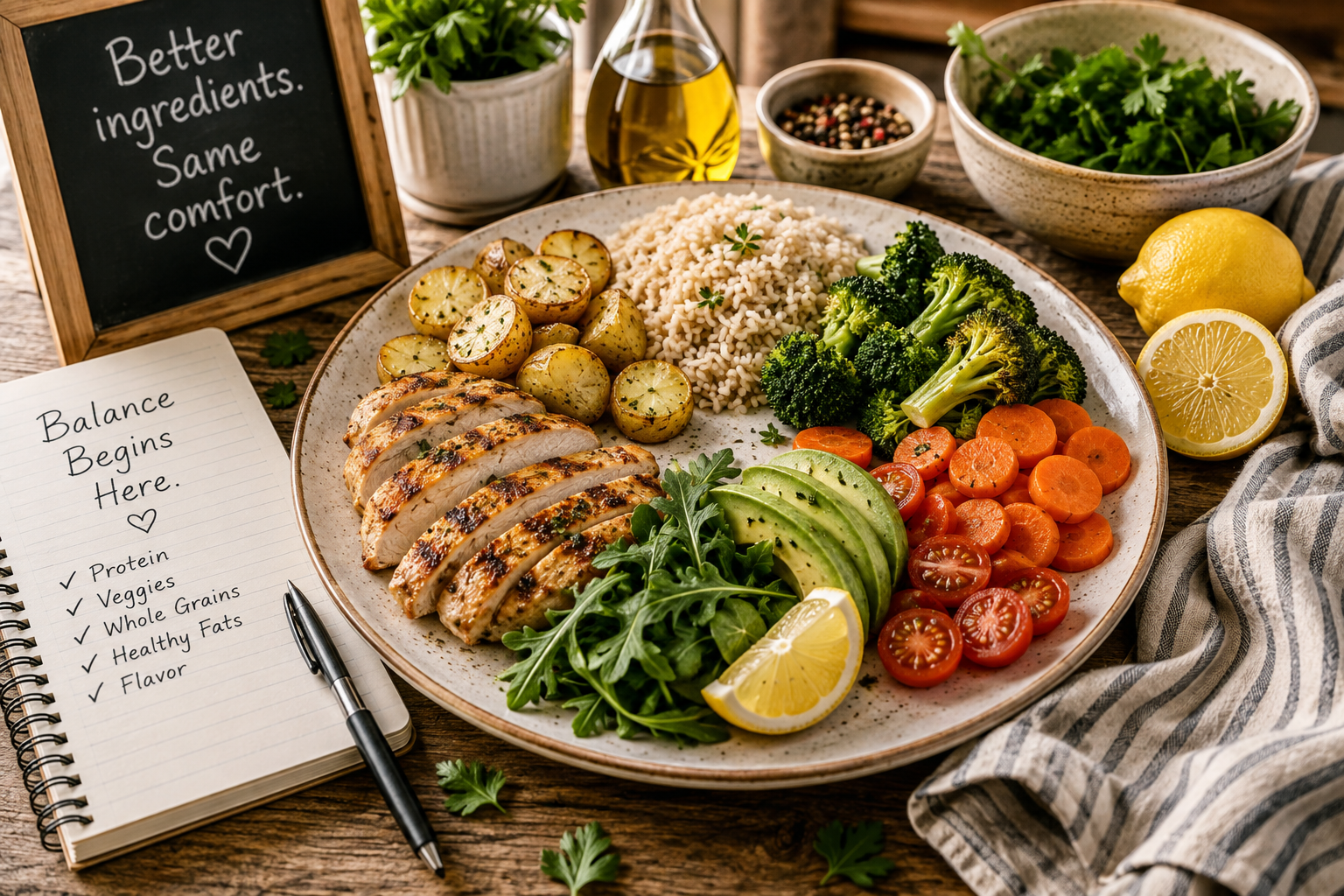
Half the plate: vegetables The largest portion of any meal should be vegetables — not because they're the most exciting ingredient, but because they add fiber, volume, and nutrients that make everything else on the plate work better. Roasted, sautéed, raw, in a soup, blended into a sauce — the form doesn't matter. The goal is that vegetables take up more real estate than anything else.
One quarter: lean protein Protein is what makes a meal satisfying beyond just being full. Chicken, fish, eggs, beans, lentils, Greek yogurt, cottage cheese, tofu — whatever form of protein works for the meal. Aim for a serving roughly the size of your palm.
One quarter: whole grain or complex carbohydrate Brown rice, whole grain pasta, quinoa, farro, sweet potato, whole grain bread — a carbohydrate that provides energy and additional fiber. This is the portion most people oversize. It's a quarter of the plate, not half.
A small amount: healthy fat Olive oil, avocado, nuts, seeds — fats that add flavor, help absorb fat-soluble nutrients, and contribute to satiety. These don't need their own section on the plate; they're usually incorporated into the cooking or added as a finishing element.
That's it. Half vegetables, quarter protein, quarter whole grain, a little healthy fat. No measuring required.
What This Looks Like in Real Meals
The framework sounds abstract until you apply it to actual food. Here's what it looks like in practice across a few different meals:
Pasta night: Whole grain pasta takes up one quarter of the bowl. Chicken or beans take up another quarter. The rest of the bowl is filled with roasted vegetables — zucchini, bell peppers, mushrooms, spinach — stirred into the sauce. A drizzle of olive oil to finish.
Taco night: Two corn tortillas (the grain component). Seasoned ground turkey or black beans (the protein). Loaded with shredded cabbage, sliced radishes, diced tomatoes, and salsa (the vegetables). Avocado and a spoonful of Greek yogurt on top (the healthy fat and extra protein).
Grain bowl: Brown rice or quinoa as the base — one quarter of the bowl. Roasted chicken or a poached egg as the protein. Roasted vegetables filling the rest. Olive oil and lemon dressing. A handful of pumpkin seeds on top.
Soup: A broth-based soup with beans or chicken as the protein, plenty of vegetables throughout, and a small amount of whole grain pasta or barley. Served with a slice of whole grain bread.
Breakfast: Two eggs (protein). A slice of whole grain toast (grain). Half an avocado (healthy fat). A handful of spinach wilted in the pan (vegetables). This is a complete, balanced breakfast in fifteen minutes.
In each case, the framework is the same. The specific ingredients are different. That flexibility is exactly what makes it sustainable.
The Vegetable Piece Is the Most Important
Of the four components, getting more vegetables on the plate has the most consistent impact on how balanced a meal actually is.
Vegetables add fiber, which slows digestion and moderates blood sugar response. They add volume, which contributes to feeling full without adding many calories. They add nutrients that improve overall health. And they make the protein and grain portions smaller by taking up more of the plate — which often means the meal is more balanced without anyone deliberately reducing anything.
The most practical way to increase vegetables isn't to eat salads. It's to add vegetables to the dishes you're already making:
- Spinach wilted into pasta sauce
- Mushrooms added to ground meat dishes
- Zucchini grated into meatballs or muffins
- Bell peppers and onions roasted alongside whatever protein is cooking
- Frozen vegetables stirred into soups and stews
The vegetables become part of the dish rather than an obligation alongside it. That's when they actually get eaten.
Adjusting the Framework for Your Goals
The basic framework is a useful starting point for almost everyone. From there, it adjusts to fit specific goals:
For higher protein: Keep the vegetable portion consistent, but increase the protein portion slightly and reduce the grain portion by the same amount. Add protein-rich ingredients throughout — Greek yogurt, beans, cottage cheese — rather than just eating a larger piece of chicken.
For GLP-1 friendly eating: Prioritize protein and fiber in every meal. The half-plate of vegetables and the protein quarter are the most important elements. Keep grains to a minimum and choose high-fiber options when you do include them.
For Mediterranean eating: The framework is essentially the Mediterranean approach — plenty of vegetables, lean protein, whole grains, olive oil. Emphasize legumes as the protein source several times per week. Add fresh herbs generously.
For blood sugar management: The vegetable portion is crucial — it adds fiber that moderates glycemic response. Choose whole grains over refined. Pair any carbohydrate with protein and fat. Keep the grain portion to a true quarter of the plate rather than allowing it to creep.
It Doesn't Have to Be Perfect
The balanced plate framework is a guide, not a rule.
Some meals will be heavier on protein. Some will be more grain-forward. Some will be mostly vegetables with very little starch. That's fine — balance over the course of a day or a week matters more than hitting the ideal ratio at every single meal.
The goal is for the framework to become a default lens — something you glance through when building a meal without thinking too hard about it. Over time, it shapes the way you cook naturally, and the meals that result are better for it without requiring constant effort.
How Old2New Applies the Balanced Plate
Recipe transformation is, in many ways, an application of the balanced plate framework.
When Old2New rebuilds a recipe around your health goals, it's making the same kinds of adjustments the framework suggests: more vegetables folded into the dish, protein increased throughout, whole grains chosen over refined, healthy fats incorporated rather than heavy processed ones.
The dish stays recognizable. The balance shifts in the direction that serves your goals.
Whether you're cooking for high protein, GLP-1 support, Mediterranean eating, or blood sugar management, the balanced plate is the underlying principle — and recipe transformation is how you apply it to the specific dishes you actually want to eat.
The Bottom Line
You don't need to count calories, track macros, or weigh portions to eat well. You need a mental picture of what a balanced meal looks like and the habit of building toward it.
Half vegetables. Quarter protein. Quarter whole grain. A little healthy fat.
That's the whole framework. Apply it to whatever you're cooking tonight and you're already most of the way there.
Better ingredients. Same comfort.
Frequently Asked Questions
What does a balanced plate look like?
A balanced plate is roughly half vegetables, one quarter lean protein, and one quarter whole grain or complex carbohydrate, with a small amount of healthy fat incorporated throughout or as a finishing element. The exact proportions don't need to be precise — it's a guide, not a formula.
Do I need to count calories to eat a balanced diet?
No. The balanced plate framework achieves most of the benefits of calorie counting without the effort. When half your plate is vegetables (which are naturally low in calories and high in fiber) and protein and whole grains take up the rest, portion sizes tend to fall into a reasonable range naturally.
How do I make my meals more balanced without changing everything?
Start with one adjustment per meal. The most impactful change is usually adding more vegetables — either as a side or incorporated into the dish itself. From there, check whether the protein is meaningful (not just a garnish) and whether the grain portion is taking up more than a quarter of the plate.
What counts as a serving of protein?
A rough guide is a portion roughly the size of your palm — about 3-4 ounces of meat or fish, or the equivalent in plant-based protein (one cup of beans, two eggs, half a cup of Greek yogurt or cottage cheese). The exact amount varies by individual goals and activity level.
Can comfort food fit into a balanced plate?
Yes — that's exactly what recipe transformation is for. Most comfort foods can be made with more vegetables, more protein, and better grain choices without losing what makes them comforting. The dish stays; the balance shifts.
How does Old2New help with building balanced meals?
Old2New takes the recipe you bring to it and applies ingredient swaps that move it toward better balance — more protein, more fiber, more vegetables, better grain choices — based on your specific health goals. The starting point is always the dish you already want to eat.
Continue Your Recipe Transformation Journey
- What Is Recipe Transformation? — the foundation the whole library builds on
- How to Make Comfort Food Healthier — applying balance to the meals you love
- Healthy Ingredient Swaps That Actually Taste Good — the specific swaps that improve balance
- High Protein Comfort Foods — how to add protein without changing the dish
- One Recipe, Four Goals — how balance shifts for different health goals
- How to Meal Prep Without Eating the Same Thing Every Day — building balanced meals in advance
Old2New — There is good in everything.