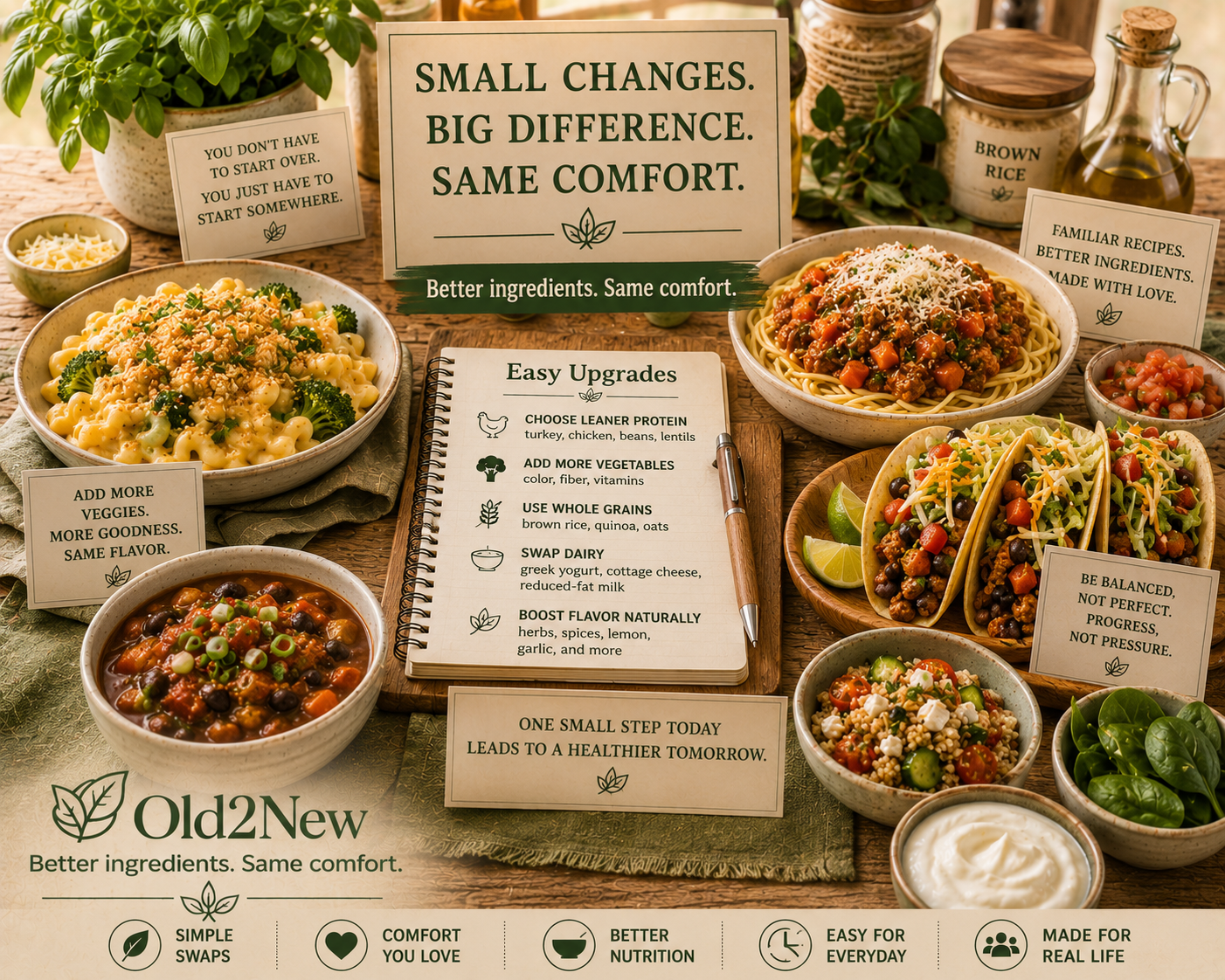
How to Make Your Favorite Recipes Healthier Without Starting Over
The most common mistake people make when they decide to eat better is believing they need to start completely over. New recipes. New ingredients. New cooking methods. A whole new relationship with food built from scratch on a Monday in January.
It rarely sticks — because it doesn't have to work that way.
The meals your family already loves are not the problem. The spaghetti, the tacos, the casserole, the chili — these are the meals that bring people to the table, that get requested again, that feel like home. Replacing them entirely doesn't make eating better sustainable. It just makes it feel like deprivation.
What actually works is transformation. Taking the meals you already make and making them just a little better, one ingredient at a time, until the version you're cooking now is genuinely more nourishing than the version you started with — and still recognizable as the same meal everyone sat down for.
That's what Old2New was built to do. Not replacement. Transformation.
Why Small Changes Matter More Than Big Overhauls
Lasting habits are built through consistent small improvements, not dramatic all-or-nothing overhauls. The research on behavior change is consistent on this point — small wins compound over time, while large changes tend to feel overwhelming and get abandoned.
The same principle applies to cooking. If you add spinach to your spaghetti sauce this week, that's a win. If you swap half the ground beef for lentils next month, that's another win built on the first one. If you replace sour cream with Greek yogurt in your taco bowls the month after, you've now transformed a recipe that looks similar to where it started but delivers significantly more protein, fiber, and nutrition with every serving.
None of those changes required starting over. None of them required a new recipe. Each one required asking one question: how can I make this a little better?
Start with the Recipes You Already Make
The best place to start is not a cookbook. It's your own kitchen, with the meals that are already on rotation.
Pick one recipe you make regularly — something your family actually eats and enjoys. Look at the ingredient list and ask a few simple questions:
Can I add another vegetable without changing what makes this dish itself? In most comfort foods, the answer is yes. Spinach goes into pasta sauce without anyone noticing. Grated carrot disappears into meatloaf and adds moisture. Diced mushrooms blend into taco filling and make it heartier. Chopped broccoli folds into mac and cheese and becomes part of the texture.
Could I use a leaner protein? Ground turkey works in most applications where ground beef is called for. Chicken thighs replace pork in many braises and slow cooker dishes. Canned salmon or tuna builds out a sandwich or casserole with more omega-3s and less saturated fat.
Is there a way to reduce added sugar without losing the flavor? In most baked goods, you can reduce the sugar by 20 to 25 percent without anyone noticing. Ripe fruit adds natural sweetness. Cinnamon and vanilla enhance the perception of sweetness without adding any. Roasting vegetables brings out their natural sugars and reduces the need for added sweeteners in sauces and glazes.
Can I swap part of the heavy cream or sour cream for something with more protein? Greek yogurt is the most direct swap — same creamy texture, significantly more protein, slightly more tang. Blended cottage cheese works in sauces and soups in a way that's nearly indistinguishable from cream.
You don't have to answer yes to every question. One improvement per recipe, consistently applied, adds up to a meaningfully different way of eating over time.
The Most Useful Ingredient Upgrades
These are the swaps that appear most often in recipe transformation — the ones that make the biggest difference with the least disruption to a familiar dish.
For protein: Lean ground turkey or chicken in place of higher-fat ground beef works in tacos, chili, pasta sauce, meatloaf, meatballs, and stuffed peppers. Lentils replace part of the ground meat in any of these dishes and add protein and fiber without changing the flavor significantly. Beans extend meat dishes further and add fiber that meat doesn't provide. Cottage cheese blended smooth works in pasta sauces, dips, and baked goods as a high-protein base.
For dairy: Greek yogurt replaces sour cream in toppings, dressings, and sauces with nearly identical texture and significantly more protein. Blended cottage cheese replaces heavy cream in pasta sauces, soups, and dips. Reduced-fat milk works in most baking and cooking applications where whole milk is called for. Sharp cheddar, used in smaller quantities than mild cheddar, delivers more flavor per gram and means less cheese goes further.
For grains: Whole wheat pasta has a slightly nuttier flavor that works particularly well with bold sauces — marinara, meat sauce, and pesto all pair well with it. Brown rice takes longer than white rice but can be cooked in batches and refrigerated all week. Quinoa can replace rice in stuffed peppers, grain bowls, and soups with a protein boost. Oats replace breadcrumbs in meatloaf and meatballs and add fiber without changing the texture.
For vegetables: The easiest addition to any comfort food is the vegetable that's most likely to disappear into the dish — spinach in sauces and soups, grated zucchini in baked goods and meatloaf, finely chopped mushrooms in ground meat dishes, riced cauliflower mixed into mashed potato or rice dishes. These additions add nutrition without asserting themselves as a separate ingredient that someone might object to.
Building Better Versions of the Classics
The most beloved comfort food dishes are also the most improvable — because they're already built on good bones. Here's how to think about transforming the ones that appear most often on family tables.
Mac and cheese starts with pasta and cheese sauce, which is already a complete flavor. Adding roasted broccoli or cauliflower folded in at the end adds fiber and vegetables without changing the character of the dish. Blending cottage cheese into the cheese sauce adds protein and makes it creamier. Using sharp cheddar means less cheese is needed for the same intensity of flavor.
Chili is one of the most naturally improvable dishes because it already welcomes additions. An extra can of black beans adds fiber and protein. Diced bell peppers and carrots cooked with the onion add vegetables early enough that they soften completely into the dish. A cup of cooked lentils stirred in at the end thickens the chili and adds even more protein. A scoop of Greek yogurt on top replaces sour cream without anyone noticing.
Lasagna layers beautifully with additional vegetables because the structure is built for layering. Spinach added to the ricotta mixture adds iron and fiber. Thinly sliced zucchini or eggplant layered between the noodles adds volume and vegetables without requiring extra noodles. Using part-skim ricotta and mozzarella delivers the same satisfaction with less saturated fat.
Tacos are one of the most naturally flexible meals because the toppings are infinitely customizable. Black beans added to the meat extend the filling and add fiber. Shredded cabbage in place of iceberg lettuce adds crunch and more nutrition. Greek yogurt in place of sour cream is one of the most seamless swaps in any recipe. Extra diced pepper and onion cooked into the meat make it go further and add vegetables without anyone feeling like they're missing the original.
Spaghetti sauce is where hidden vegetables work best because the sauce itself obscures texture and color. Grated carrot simmered into the sauce adds natural sweetness and reduces the need for added sugar. Finely chopped mushrooms add umami and make the sauce feel meatier. Spinach stirred in at the end wilts completely into the sauce within two minutes. Lentils cooked into the sauce replace part of the ground meat and add protein and fiber that's completely invisible in the finished dish.
Pizza is already built on a vegetable-friendly format. Loading toppings with roasted vegetables before adding the cheese means every slice delivers more nutrition. Using a whole grain or cauliflower crust changes the base. A thinner layer of high-quality cheese goes further than a thick layer of lower-quality cheese and lets the toppings be the star.
Don't Aim for Perfect
Healthy eating doesn't require perfection — and pursuing perfection is one of the most reliable ways to abandon the effort entirely. Some nights you'll cook from scratch with fresh ingredients and intentional swaps. Other nights you'll use convenience foods, order out, or heat up something from the freezer. Both fit into a balanced approach to eating.
The goal isn't to eat perfectly. The goal is to make today's meal just a little better than it would have been without any thought at all. That's a bar that's almost always achievable, and it compounds over time into a genuinely different way of eating that doesn't feel like sacrifice.
A meal that's 80 percent of where you want it to be and that you actually enjoy and repeat is worth infinitely more than a perfect meal you make once and never return to.
Shop Your Kitchen First
Before buying new ingredients, look at what you already have. Most kitchens contain the building blocks of better comfort food without any additional shopping — frozen vegetables that can go into soups and casseroles, a can of beans that extends taco night, a container of Greek yogurt that replaces sour cream, a bag of oats that replaces breadcrumbs in meatloaf, dried lentils that stretch a pasta sauce.
The transformation doesn't require a specialty grocery store or an expensive ingredient. It requires looking at what's already there and asking what it can do in a dish you already make.
Every Recipe Can Grow with You
Recipe transformation is not a destination — it's an ongoing practice. A recipe that gets made a hundred times over the years doesn't have to look the same at the hundredth time as it did at the first. It can grow as your knowledge grows, as your family's palate evolves, and as you discover which swaps work and which ones don't.
Maybe this month you add vegetables to a casserole. Next month you try whole grain pasta and find a brand your family actually likes. A few weeks after that you experiment with herbs and fresh garlic instead of relying on extra salt for flavor. Each step builds on the last. None of them require throwing out the recipe and starting from scratch.
The meal gets better. It stays familiar. And the people eating it — who might not know or care about the changes you made — keep coming back for more.
FAQ
Where should I start if I want to eat healthier but don't know what to change? Start with the one meal your family eats most often. Pick a single ingredient in that recipe and ask if there's a slightly better version of it — leaner protein, added vegetable, more fiber. Make that one change and repeat the meal as normal. Once that change feels natural, add another. The compounding effect of small consistent improvements is more powerful than any dramatic overhaul.
Will my family notice the changes? In most cases, no — particularly if you're adding vegetables that disappear into the dish (spinach in sauce, grated carrot in meatloaf, mushrooms in taco filling) or swapping ingredients with similar textures (Greek yogurt for sour cream, ground turkey for ground beef in a heavily spiced dish). The changes most likely to be noticed are texture changes in the base of the dish — whole wheat pasta has a different texture than white pasta, for example — which is why starting with additions rather than substitutions is usually the easier path.
Do I have to count calories or macros to eat better? No — and for most people, focusing on food quality and ingredient improvements rather than numbers produces better long-term results. Adding more vegetables, more fiber, more protein, and fewer heavily processed ingredients naturally improves the nutritional profile of meals without requiring any tracking. Old2New is built on this principle: transform the ingredients, and the numbers take care of themselves.
What's the single most impactful swap I can make? Replacing sour cream with Greek yogurt is one of the highest-impact, lowest-disruption swaps available — it appears in tacos, baked potatoes, soups, dips, and baked goods, it's nearly imperceptible in most applications, and it adds significant protein to every dish it touches. If you make only one change, that one is worth starting with.
Continue Your Recipe Transformation Journey
Making your favorite recipes healthier is an ongoing practice, not a single decision. These articles will help you build the foundation:
- What Is Recipe Transformation? — the philosophy behind every swap
- 10 Healthy Ingredient Swaps That Actually Taste Good — the most useful swaps in one place
- How to Make Comfort Food Healthier — the deeper guide to comfort food transformation
- Understanding GLP-1 Friendly Cooking — how to apply these principles to GLP-1 goals specifically
- High Protein Comfort Foods — how to add more protein to the meals you already love
Old2New — There is good in everything.