If you've been looking at healthier recipes lately, you've probably seen the phrase "GLP-1 Friendly."
But what does it actually mean when you're standing in your kitchen, trying to figure out what to cook?
A lot of people assume it means tiny portions, bland food, or giving up the meals they actually enjoy. The reality is much more practical than that.
GLP-1 friendly cooking isn't about restriction. It's about choosing ingredients and building meals that work with how your body — and your appetite — may be changing. Whether you're taking a GLP-1 medication or simply looking for meals that are filling, balanced, and satisfying without feeling heavy, the principles behind GLP-1 friendly cooking are useful for almost anyone.
What "GLP-1 Friendly" Actually Means
GLP-1 friendly recipes are built around ingredients that help you feel satisfied while giving your body something worth eating.
The focus isn't on eating less. It's on eating in a way that works harder — meals where every component contributes something meaningful, so a smaller serving still feels complete.
That generally means recipes that include:
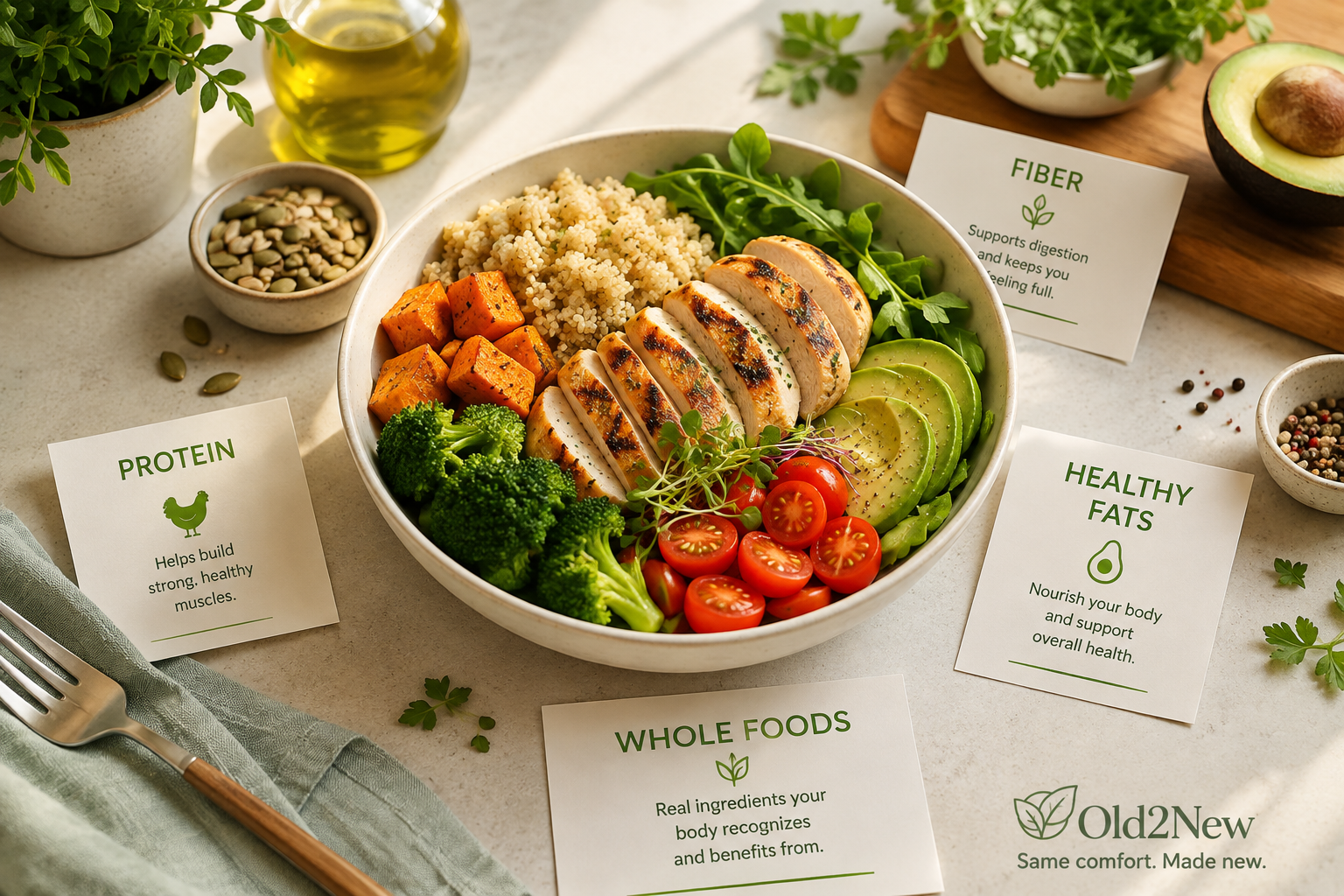
- Lean proteins that support satiety without being heavy
- High-fiber ingredients that add substance and staying power
- Whole grains instead of refined carbohydrates
- Healthy fats that contribute flavor and satisfaction
- Vegetables that add volume without adding heaviness
- Less added sugar
- Fewer highly processed ingredients
None of this requires learning a new way to cook. It mostly means making different choices about the specific ingredients inside the recipes you're already making.
It's About the Recipe — Not Just the Medication
One of the most common misconceptions about GLP-1 friendly cooking is that it only applies to people taking medication.
It doesn't.
A recipe built around lean protein, fiber, whole foods, and balanced ingredients is a good recipe for almost anyone. The principles that make a meal work well for someone whose appetite has shifted are the same principles that make a meal genuinely satisfying and nourishing for everyone else.
The phrase "GLP-1 friendly" describes a way of building meals — not a medical protocol. It's a useful shorthand for a set of cooking choices that prioritize satisfaction, nutrition, and balance over volume.
What Changes When Your Appetite Changes
For people taking GLP-1 medications, one of the most common experiences is a shift in appetite and portion tolerance. Foods that once felt normal can feel too heavy. Meals that used to be satisfying at a certain quantity might need to be approached differently.
This creates a specific challenge in the kitchen: how do you keep eating the foods you love when the way your body responds to them has changed?
The answer isn't to give up the foods. It's to rebuild them so that a smaller portion still delivers everything the dish is supposed to deliver — flavor, comfort, and satisfaction.
That's what GLP-1 friendly cooking is actually solving for.
Small Ingredient Swaps Make a Meaningful Difference
Most recipes don't need to be reinvented. They need to be adjusted.
A few thoughtful ingredient changes can shift the nutritional profile of a dish significantly — increasing protein, adding fiber, reducing refined carbohydrates — without changing what the dish tastes like or feels like to eat.
Some of the most useful swaps for GLP-1 friendly cooking:
Greek yogurt instead of sour cream. Same creamy texture, same tang, significantly more protein. Works in dips, sauces, tacos, baked potatoes, and anywhere sour cream appears.
Whole grain or protein pasta instead of refined pasta. The dish looks and behaves identically. The fiber and protein content shift meaningfully. Most people stop noticing the difference after the first few times.
Lean turkey or chicken instead of higher-fat ground beef. Lower fat content, same texture in most applications, same seasoning. The dish doesn't change — the ingredient does.
Blended cottage cheese in creamy sauces. When blended smooth, cottage cheese creates a rich, protein-dense base for pasta sauces, mac and cheese, and casseroles. Most people eating the finished dish can't identify it.
Olive oil in place of more heavily processed fats. Brings its own flavor, works well in most cooked applications, and provides a healthier fat profile.
The meal is still the meal. The ingredients simply work a little harder.
Protein First — Then Everything Else
If there's one principle that runs through most GLP-1 friendly cooking, it's prioritizing protein.
Protein is the most satiating macronutrient — it contributes more to feeling full and staying full than carbohydrates or fat do, especially in smaller portions. For someone whose appetite and portion tolerance has shifted, getting sufficient protein from a smaller serving matters more than it might have before.
This doesn't mean every meal needs to be a protein shake or a chicken breast. It means looking at each dish and asking: where can the protein be increased without changing what this dish fundamentally is?
Sometimes the answer is a swap (Greek yogurt for sour cream, cottage cheese in the sauce). Sometimes it's an addition (beans folded into a soup, lentils added to a pasta dish). Sometimes it's a ratio change — more protein, slightly less starch — that keeps the dish recognizable while shifting what it delivers.
Listen to Your Own Body
No two people respond to food — or to changes in appetite — in exactly the same way.
Some people on GLP-1 medications find they prefer smaller, more frequent meals. Others find that one well-balanced meal leaves them satisfied for a long time. Some do better with softer textures. Others have no texture changes at all.
The most useful thing GLP-1 friendly cooking can offer isn't a rigid set of rules. It's a flexible framework — a set of ingredient choices and cooking approaches that make it easier to find what works for your own body, rather than following someone else's meal plan.
Start with the dishes you already love. Make one or two ingredient changes. Pay attention to how the dish makes you feel. Adjust from there.
How Old2New Approaches GLP-1 Friendly Cooking
Old2New was built around recipe transformation — taking the meals you already love and rebuilding them with ingredient swaps based on your specific goals.
When you choose GLP-1 Friendly as your goal, Old2New looks at your entire recipe and identifies where protein can be increased, where fiber can be added, and where refined ingredients can be replaced with whole food alternatives — all while keeping the dish recognizable.
You can also combine goals. High Protein and GLP-1 Friendly. Mediterranean and GLP-1 Friendly. Or describe your own preferences entirely — anti-inflammatory, lower sodium, gluten-free, dairy-free, vegetarian, or any combination that fits how you're eating.
Every transformation starts with the recipe you already want to eat.
The Bottom Line
GLP-1 friendly cooking isn't about giving up comfort food.
It's about making thoughtful ingredient choices that support how your body is working right now — while keeping the meals you love recognizable, satisfying, and worth eating.
Healthy eating doesn't have to mean starting over. Sometimes it just means starting with the recipe you already love and making a few things work a little harder.
Better ingredients. Same comfort.
Frequently Asked Questions
What does GLP-1 friendly mean in cooking?
GLP-1 friendly cooking refers to meals built around ingredients that support satisfaction and nutrition — lean proteins, fiber-rich foods, whole grains, healthy fats, and less refined or processed content. The goal is meals that feel complete and satisfying, especially for people whose appetite or portion tolerance has shifted.
Do I have to be on a GLP-1 medication to eat GLP-1 friendly?
No. The cooking principles behind GLP-1 friendly meals — prioritizing protein, adding fiber, using whole food ingredients — are useful for anyone looking for balanced, satisfying meals. The phrase describes a way of building recipes, not a medical requirement.
What foods are GLP-1 friendly?
GLP-1 friendly foods tend to be high in protein and fiber, lower in refined carbohydrates and added sugar, and made from whole food ingredients. Greek yogurt, lean proteins, whole grains, legumes, vegetables, and healthy fats like olive oil are all common components of GLP-1 friendly cooking.
Can I still eat comfort food on GLP-1 medications?
Yes — and that's exactly what recipe transformation is for. Most comfort foods can be rebuilt with ingredient swaps that make them work better for how your appetite has changed, without giving up the dish itself. Mac and cheese, lasagna, pasta, tacos — all of these can be transformed without losing what makes them worth eating.
What is the most important thing to focus on in GLP-1 friendly cooking?
Protein is usually the most important starting point. Getting enough protein from a smaller portion helps with satiety and supports overall nutrition when appetite is reduced. After protein, fiber is the next priority — it adds substance and staying power without adding heaviness.
Is GLP-1 friendly cooking the same as low-calorie cooking?
No. GLP-1 friendly cooking focuses on the quality and composition of ingredients — more protein, more fiber, whole foods — rather than simply reducing calories. A GLP-1 friendly meal might have a similar calorie count to the original dish but a very different nutritional profile.
Continue Your Recipe Transformation Journey
- What Is Recipe Transformation? — the foundation the whole library builds on
- How to Make Comfort Food Healthier — the practical approach behind every transformation
- Healthy Ingredient Swaps That Actually Taste Good — the specific swaps and why they work
- One Recipe, Four Goals — how the same dish transforms for GLP-1, high protein, Mediterranean, and diabetic-friendly eating
Old2New — There is good in everything.