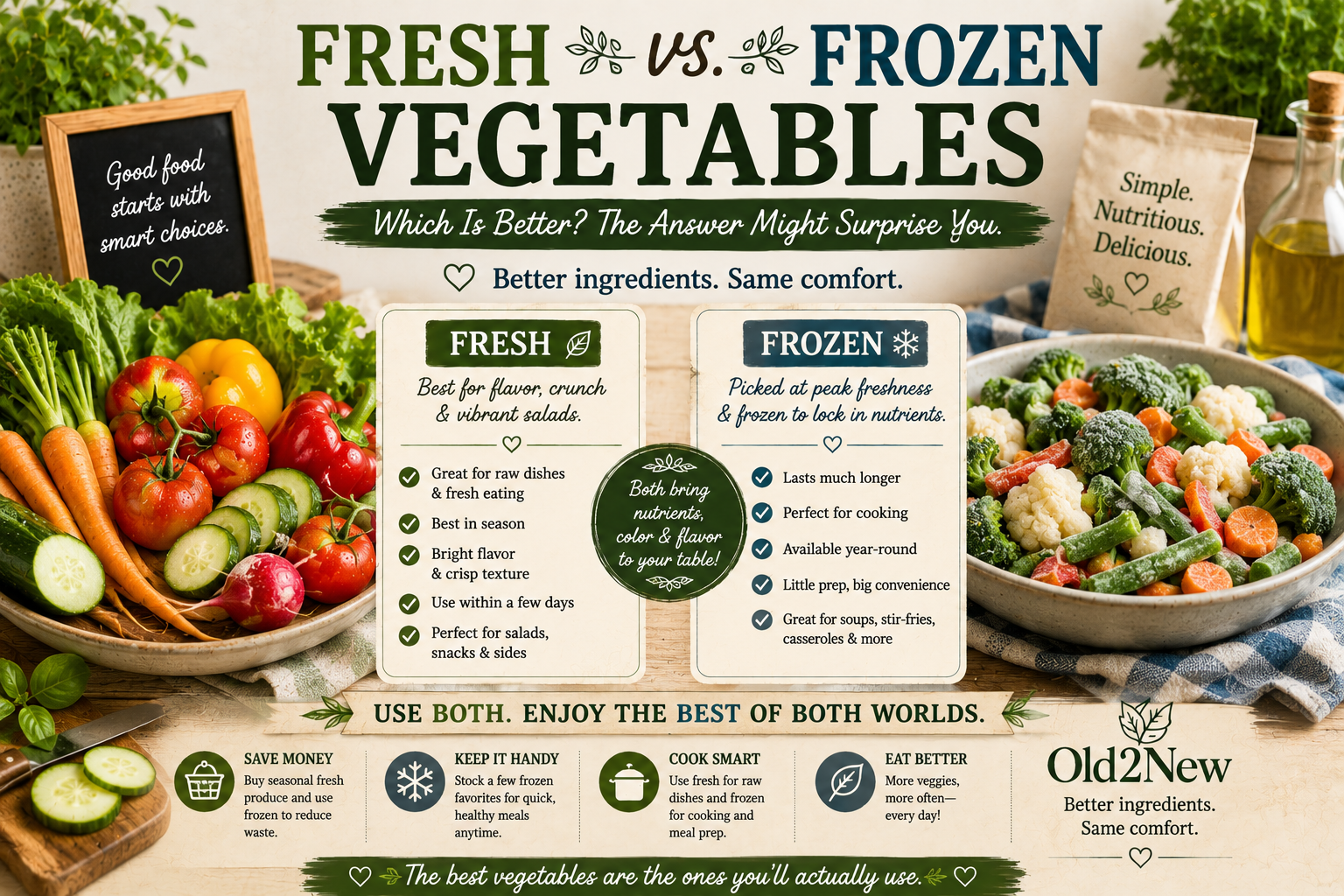
Fresh vs. Frozen Vegetables
The fresh vegetables in the produce section look more appealing. They're vibrant, they smell like the farmers market, and there's something satisfying about choosing them. A few aisles over, the bags of frozen broccoli and spinach look less exciting — industrial packaging, no visible produce, just the promise of what's inside.
The assumption most people carry is that fresh is better. It's not that simple — and in some applications, it's actually wrong.
Frozen vegetables are picked at peak ripeness and processed within hours of harvest. The nutrients are locked in at their highest concentration. A bag of frozen spinach that's been in the freezer for two months may actually be more nutritious than "fresh" spinach that was harvested a week ago, shipped across the country, sat in a warehouse, and then spent several more days on the produce shelf before you brought it home.
This doesn't mean frozen is always better. It means both have a place, and knowing when to use each one produces better cooking, less waste, and more reliable access to vegetables year-round.
The Good News: You Don't Have to Choose
Fresh and frozen vegetables both provide vitamins, minerals, fiber, color, and flavor. Neither is categorically superior to the other — the right choice depends on how and when you plan to use the vegetable, what's in season, what your budget allows, and how much time you have.
A kitchen that uses both intelligently — fresh for raw applications and peak-season cooking, frozen for cooked dishes, busy weeknights, and out-of-season needs — wastes less food, spends less money, and produces better meals more consistently than a kitchen committed exclusively to either approach.
When Fresh Is the Better Choice
Fresh vegetables are at their best in applications where texture and raw flavor are central to the dish — where the whole point is the crunch, the brightness, or the visual freshness of the vegetable.
Salads require fresh vegetables because frozen vegetables lose their structural integrity during the freeze-thaw process and become soft — which is exactly wrong for a salad that needs crispness. Lettuce, cucumber, tomatoes, bell peppers, radishes, and celery are all applications where fresh is clearly the right choice and frozen doesn't substitute well. Snack trays and vegetable platters have the same requirement — the appeal is the crunch and freshness of raw vegetables that frozen simply can't provide. Sandwiches and wraps benefit from the texture that fresh vegetables contribute. Fresh salsa is built on the texture and juice of raw tomatoes that cooked or frozen tomatoes don't replicate.
Fresh vegetables are also the better choice when you're featuring them as the star of a side dish where their appearance and texture are part of the appeal — a caprese salad, a simple sliced tomato with olive oil, or a display of grilled asparagus where the freshness is visible and central.
And fresh in-season vegetables are often simply better than their frozen counterparts in taste — a tomato at peak summer ripeness, a ear of corn from the farmers market, an asparagus bunch in spring — because the flavor is at its highest concentration and no processing has intervened between harvest and eating.
When Frozen Makes More Sense
Frozen vegetables are the better choice in all cooked applications where the texture change from freezing doesn't matter or where the cooking process would soften the vegetable anyway.
Soups, chili, stews, and casseroles are where frozen vegetables shine — they go directly from the freezer into the hot liquid and cook in minutes, and the dish doesn't distinguish between fresh and frozen in the finished product. A pot of vegetable soup made with frozen broccoli, frozen peas, and frozen corn tastes indistinguishable from one made with fresh equivalents that were properly cooked.
Stir fries and fried rice benefit from frozen vegetables because the high heat of the wok or pan quickly eliminates any texture difference, and the time saved by not washing, cutting, and blanching fresh vegetables makes the dish genuinely faster to prepare. Pasta dishes, omelets, quiche, and grain bowls are all applications where frozen spinach, peas, or mixed vegetables integrate completely into the finished dish without any detectable difference from fresh.
Sheet pan dinners with frozen vegetables work well when the vegetables are spread in a single layer and the oven temperature is high enough to evaporate the excess moisture that frozen vegetables release — 425°F rather than 375°F, with space between pieces, produces roasted results rather than steamed ones.
The Nutritional Reality
The nutritional comparison between fresh and frozen vegetables is more nuanced than the "fresh is best" assumption suggests. Most water-soluble vitamins (particularly vitamin C and folate) begin degrading in fresh produce from the moment it's harvested. The fresh broccoli in the produce section may have been harvested a week ago — and has been losing nutritional value every day since.
Frozen vegetables are blanched (briefly heated) and then flash-frozen within hours of harvest, which stops the enzymatic degradation that reduces nutritional content. Studies comparing fresh and frozen vegetables have found that frozen vegetables are often equal to or higher in nutritional value than their "fresh" counterparts that have been stored for several days.
The important caveat is that the blanching process before freezing does reduce some heat-sensitive vitamins. The comparison is really between fresh-harvested and frozen: truly fresh vegetables eaten the day they're harvested are more nutritious than frozen. But that's not the realistic comparison most people are making at the grocery store.
For practical purposes: both fresh and frozen vegetables are nutritious, both are significantly better than no vegetables, and the vegetable most worth having is the one that's most likely to actually be cooked and eaten.
Budget Considerations
Frozen vegetables consistently cost less than fresh, particularly for out-of-season produce. In winter, fresh broccoli and green beans cost more than their frozen counterparts and have been shipped from further away — which means higher price, potentially lower nutritional value, and less flavor. The frozen version is genuinely the better choice in that situation.
Buying frozen vegetables also eliminates the food waste cost that comes from fresh produce that goes bad before it's used — a significant expense that most people undercount when comparing fresh and frozen prices. A bag of frozen broccoli that costs $2 and produces zero waste is a better value than $3 fresh broccoli where half gets thrown away.
The smart approach is letting season and intended use guide the purchase: buy fresh in-season produce when it's at peak quality and price, and buy frozen for out-of-season vegetables and for applications where the quality difference is minimal.
Mixing Fresh and Frozen in the Same Kitchen
The most practical approach is maintaining both simultaneously — using each in the applications where it performs best.
Keep fresh: salad greens, tomatoes, cucumbers, bell peppers, and whatever is currently in season at a good price. Use these for raw applications, snacking, and cooking where freshness is important within the next two to three days.
Keep frozen: broccoli, spinach, mixed vegetables, peas, cauliflower, and green beans. Use these for soups, stir fries, casseroles, pasta dishes, and any weeknight when fresh produce has been depleted but dinner still needs to happen.
The combination means there's always something available for a vegetable-forward meal regardless of what's happened to the fresh produce during the week. The frozen backup isn't a compromise — it's a deliberate part of the kitchen's supply.
Vegetables That Freeze Best
Not all vegetables freeze equally well, which is why commercial frozen vegetable products focus on a specific set of vegetables that perform best through the freeze-thaw process.
Broccoli, cauliflower, Brussels sprouts, peas, corn, green beans, spinach, and mixed vegetable blends all freeze well because their structure tolerates the freezing process and they're primarily used in cooked applications where any texture change is irrelevant. These are the frozen vegetables worth keeping consistently stocked.
Vegetables that don't freeze as well: tomatoes become mushy when thawed (though they're excellent for cooking in sauces and soups), lettuce and delicate greens lose their structure entirely, cucumbers become watery, and potatoes change texture in ways that make them unsuitable for most applications when frozen raw (cooked potatoes freeze better).
Seasonal Fresh, Year-Round Frozen
The best rhythm for produce shopping is buying the seasonal fresh produce that's at peak flavor and lowest price during its season, supplementing with frozen vegetables for out-of-season needs and for cooked applications year-round.
In summer, fresh tomatoes, zucchini, corn, bell peppers, and berries are worth buying fresh — they're at peak quality, often locally sourced, and reasonably priced. In winter, those same vegetables are more expensive, less flavorful, and have traveled further — the frozen version is often a better choice in December than fresh.
Following the seasonal rhythm with fresh produce and filling in with frozen year-round produces better-tasting meals, lower grocery bills, and a more reliable supply of vegetables in the kitchen.
FAQ
Are frozen vegetables processed with additives or preservatives? Plain frozen vegetables typically contain one ingredient: the vegetable. The freezing process itself is the preservation method — no additives or preservatives are needed. The exception is some frozen vegetable mixes that include sauce or seasoning, which should be checked for sodium content. Plain frozen vegetables are as clean an ingredient as fresh.
Does the blanching process before freezing reduce nutritional value? Yes, slightly — blanching (brief heating before freezing) reduces some heat-sensitive vitamins, particularly vitamin C and some B vitamins. However, the degradation that occurs in fresh produce during the days between harvest and purchase often produces a greater nutritional reduction than the blanching process. For practical purposes, the nutritional difference between fresh and frozen is small in most comparisons.
Can I freeze fresh vegetables at home? Yes — most vegetables freeze well after blanching (briefly boiling or steaming, then cooling in ice water before freezing). This stops the enzymatic activity that causes deterioration. Vegetables that freeze well at home without blanching include corn, peas, and green beans. Most other vegetables benefit from blanching first. Spread on a sheet pan to freeze individually before transferring to bags, which prevents them from freezing into a solid block.
Is it worth buying organic frozen vegetables? Organic frozen vegetables are available and worth considering for vegetables in the Environmental Working Group's "Dirty Dozen" list of highest-pesticide-residue produce. For other vegetables, conventional frozen is a perfectly sound choice nutritionally. The decision depends on budget and personal preference rather than a clear nutritional difference between organic and conventional frozen produce.
Continue Your Recipe Transformation Journey
Understanding fresh versus frozen vegetables makes every other cooking decision easier. These guides will help you put both to use:
- Easy Ways to Add More Vegetables Without Anyone Noticing — where frozen vegetables shine as hidden additions
- Healthy Grocery Shopping on a Budget — how to balance fresh and frozen for maximum value
- Pantry Staples Every Home Cook Should Keep — the frozen staples worth always having
- Healthy Cooking Methods That Still Taste Amazing — how to get the most from both fresh and frozen vegetables
- Easy Sheet Pan Dinners — how to use frozen vegetables effectively in roasted preparations
Old2New — There is good in everything.