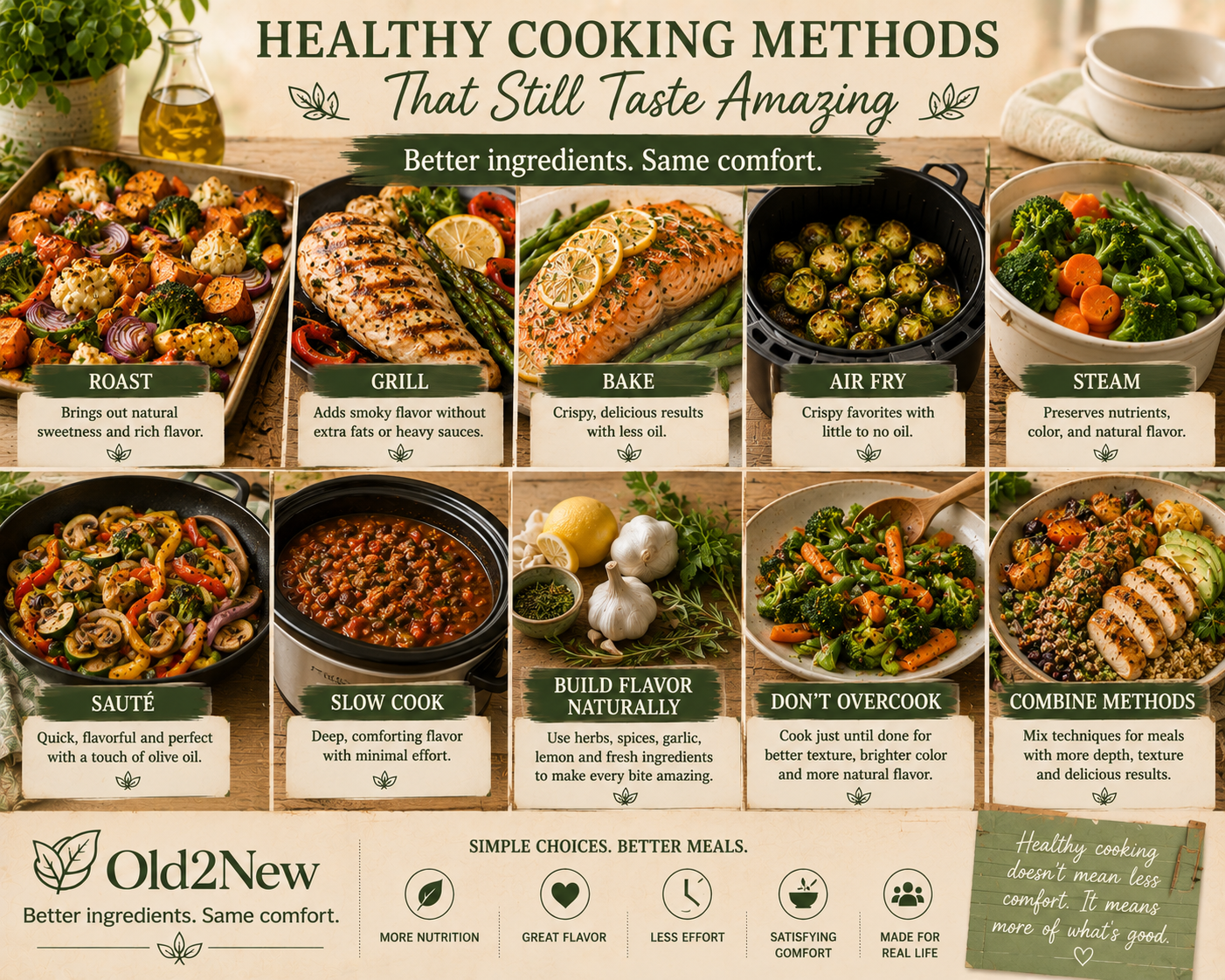
Healthy Cooking Methods That Still Taste Amazing
Most conversations about healthy eating focus entirely on ingredients — what to buy, what to swap, what to add or remove. That's useful, but it misses half the picture. The same ingredient prepared two different ways can taste completely different and have a completely different nutritional profile. Steamed broccoli and roasted broccoli are made from identical ingredients. One is tolerated. The other gets eaten off the sheet pan before dinner is ready.
How you cook something matters. Not just for nutrition — though that's real — but for flavor, texture, and whether the meal is something people actually want to eat again. A cooking method that brings out the natural sweetness of a carrot, creates a crispy edge on a piece of chicken, or develops deep savory flavor in a vegetable is doing more work than any sauce or seasoning could add after the fact.
The good news is that the cooking methods that tend to produce the best flavor are also among the most practical for everyday cooking. Here's how to think about each one and when to reach for it.
Why Cooking Method Matters
The way you prepare food influences flavor, texture, moisture, and how much added fat ends up in the finished dish. Deep frying surrounds food in oil and creates a crispy exterior, but it also adds significant fat that wouldn't otherwise be there. Boiling leaches water-soluble vitamins into the cooking water and can turn crisp vegetables into something soft and flavorless. Heavy sauces added after cooking add calories and sodium that cover rather than enhance the ingredient's natural flavor.
Healthier cooking methods — roasting, grilling, baking, air frying, steaming, and sautéing with a modest amount of good oil — work with the ingredient's natural properties rather than against them. They concentrate flavor through caramelization, preserve texture through controlled heat, and let the ingredient taste like what it actually is rather than like whatever was poured over it.
Roasting for Incredible Flavor
Roasting is arguably the single most transformative cooking method available in a home kitchen. It works through a process called the Maillard reaction — the same process that browns bread and sears meat — which creates hundreds of new flavor compounds when food is exposed to high, dry heat. The result is caramelized edges, concentrated sweetness, and a depth of flavor that no other method achieves with vegetables.
Broccoli roasted at 425°F with olive oil, garlic, and a pinch of salt until the edges are slightly charred is a fundamentally different ingredient than steamed broccoli. Cauliflower roasted until golden and nutty bears almost no resemblance to the raw or boiled version. Carrots roasted until their edges caramelize become sweet enough to eat as a side dish that competes with the main course. Brussels sprouts that have spent time in a hot oven with olive oil and salt lose every quality that made anyone dislike them and acquire a crispy, savory character that's genuinely craveable.
The technique is simple: cut into uniform pieces, toss with olive oil and seasoning, spread in a single layer on a sheet pan without crowding, and roast at 400°F to 425°F until golden. The crowding is the most common mistake — too many pieces on one pan traps steam and prevents browning. Use two pans if needed and give everything space. Flip once halfway through. Pull it when it looks more golden than you expect — the caramelization is the point.
Roasting works for almost every vegetable: broccoli, cauliflower, carrots, Brussels sprouts, sweet potatoes, bell peppers, onions, zucchini, mushrooms, tomatoes, asparagus, and green beans all respond beautifully to high heat and a drizzle of olive oil.
Grilling for Smoky Depth
Grilling adds a smokiness and char that no indoor cooking method quite replicates — and that flavor comes without requiring any heavy sauce to make food interesting. The heat of the grill creates the same caramelization as roasting but with the addition of smoke from the dripping juices, which builds a flavor complexity that feels indulgent without any particular addition.
Chicken grilled with olive oil, garlic, lemon, and fresh herbs doesn't need a cream sauce to be satisfying — the grill provides the depth of flavor that a sauce would otherwise supply. Salmon grilled until the skin is crispy and the flesh is just cooked through has a richness that baked salmon approaches but doesn't fully match. Shrimp grilled on skewers with garlic and citrus are done in three minutes and taste like a restaurant appetizer.
Vegetables on the grill — zucchini, bell peppers, corn, portobello mushrooms, asparagus — take on a smokiness and slight char that makes them genuinely exciting as a side dish. The goal isn't to avoid all char — a little char is where much of the flavor lives. The goal is enough heat to create those marks and that smoke without burning the food through.
For lean proteins like chicken breast and shrimp, the grill's speed is as valuable as its flavor. A chicken breast grills in 12 to 15 minutes. Shrimp grill in three to four minutes. Both can overcook quickly, which makes paying attention more important than any technique.
Baking Instead of Frying
Most fried foods are beloved for their crispy exterior, which the frying oil creates by rapidly heating the surface of the food and dehydrating it into a crust. That same crispiness is achievable in the oven — particularly at high temperatures — with a fraction of the added fat.
Chicken tenders baked at 425°F on a wire rack set in a sheet pan develop a genuinely crispy exterior because the air circulates underneath as well as over the top. Meatballs baked in the oven rather than pan-fried are more consistent in texture and require no attention during cooking. Fish baked with a breadcrumb crust delivers the crunch of fried fish with far less oil. Homemade fries cut thin, tossed with a modest amount of olive oil, and roasted at high temperature get crispy in a way that surprises most people expecting something soggy and disappointing.
Baking also produces better results for stuffed vegetables, casseroles, and any dish where the oven's even heat is more useful than a pan's direct heat. Chicken Parmesan baked instead of fried loses nothing essential about what makes it good — the sauce and cheese do the work, and the chicken comes out juicy rather than oily.
Air Frying for Weeknight Convenience
Air fryers produce results closer to deep frying than conventional oven baking because the circulating hot air cooks food from multiple angles simultaneously, creating a crispy exterior more efficiently than a standard oven. They also preheat in two to three minutes rather than 15 to 20, which makes them genuinely practical for weeknight cooking when speed matters.
Broccoli and cauliflower in the air fryer at 400°F for 10 to 12 minutes develop crispy edges that rival roasted versions without needing to preheat the oven. Chicken thighs and breasts come out with crispy skin and juicy interiors in under 25 minutes. Salmon fillets cook in eight to ten minutes with a slightly crispy exterior. Shrimp are done in six to eight minutes. Potatoes and sweet potatoes become genuinely crispy with a fraction of the oil required for deep frying.
The limitation of most air fryers is capacity — they work best in smaller batches, which makes them more suitable for one to two portions than for a family meal. For larger quantities, the oven is more practical. But for a quick weeknight portion of vegetables or protein, the air fryer is one of the most time-efficient tools in the kitchen.
Steaming to Preserve Freshness
Steaming is the gentlest cooking method — food cooks in the steam rising from simmering water below it, which preserves color, texture, and more of the water-soluble vitamins that leach out during boiling. It's particularly well-suited for vegetables where the goal is to cook them through while preserving their brightness and slight crunch.
Broccoli steamed until just bright green and barely tender — about four minutes over simmering water — retains a texture and color that boiling never achieves. Green beans steamed until crisp-tender stay vivid and snap when broken. Carrots steamed until just tender retain their color and sweetness in a way that boiling dilutes.
The key to making steamed vegetables genuinely good rather than just nutritionally sound is what happens after they come off the heat. A squeeze of fresh lemon, a drizzle of olive oil, a sprinkle of fresh herbs and garlic, or a light dusting of parmesan takes steamed vegetables from functional to something worth eating on their own. Steaming is the method; the finishing is the flavor.
Sautéing with Purpose
Sautéing in a modest amount of good olive oil over medium to medium-high heat develops flavor through caramelization and browning while using significantly less fat than deep frying or pan frying in large amounts of oil. The key is heat management — too low and the food steams in its own moisture rather than browning, too high and it burns before cooking through.
Mushrooms sautéed over medium-high heat in olive oil with garlic until deeply golden and slightly crispy at the edges are one of the most flavorful things in the kitchen. The moisture drives off and concentrates the umami, and the browning adds a depth of flavor that raw or steamed mushrooms don't have. Spinach wilted in olive oil with garlic takes two minutes and goes from a vegetable to a side dish. Onions cooked low and slow in olive oil for 40 minutes become deeply sweet and caramelized and build the flavor foundation of dozens of dishes.
For proteins, sautéing creates the browned exterior that develops flavor through the same Maillard reaction as roasting. Chicken breast sautéed in olive oil until golden on both sides before finishing in the oven develops a crust that baking alone doesn't achieve. Shrimp sautéed in olive oil, garlic, and red pepper flakes for three minutes are done and already deeply flavorful.
Slow Cooking for Deep Comfort
The slow cooker produces some of the most deeply comforting food possible because the long cooking time — six to eight hours on low — develops flavor in a way that fast cooking can't replicate. Collagen in meat dissolves into gelatin. Vegetables soften completely and absorb the surrounding flavors. Spices and aromatics have hours to meld into a unified flavor rather than sitting separate in the finished dish.
Chili cooked low and slow for eight hours tastes fundamentally different from the same chili made quickly on the stovetop — deeper, more unified, more complex. Chicken soup simmered all day develops a broth richness that a 30-minute version approaches but never fully achieves. Pot roast that has spent eight hours in broth with vegetables becomes something that falls apart at the touch of a fork and has absorbed the surrounding liquid completely.
The practical advantage is that the slow cooker requires almost no attention during the cooking time — the setup takes 15 minutes in the morning and dinner is ready when you return. For busy weeks, it's one of the most reliable tools for putting a genuinely satisfying, home-cooked meal on the table without active cooking time in the evening.
Building Flavor Naturally
The best thing about cooking methods that work with an ingredient's natural properties is that they reduce the need for heavy additions to create flavor. A roasted vegetable with olive oil, garlic, and lemon is already deeply flavorful without any sauce. A grilled chicken breast with fresh herbs and citrus doesn't need a cream sauce. A slow-cooked chili with good spices and time doesn't need extra salt to taste rich.
The flavoring tools worth reaching for first are garlic, fresh herbs, lemon and lime juice and zest, onion, vinegar, fresh tomatoes, spices, and citrus zest. These add layers of flavor that build on each other without adding significant calories, fat, or sodium. They make food taste more like itself — brighter, more defined, more complex — rather than masking it under something heavy.
The goal of a cooking method is to get the ingredient to its best possible version of itself. What you add after that is just a conversation with what's already there.
Combining Methods for Better Results
Some of the most satisfying meals use more than one cooking technique — and combining methods often produces results that neither technique achieves alone.
Grilling chicken and roasting vegetables together means both components are at their best version when they meet on the plate. Baking salmon while steaming broccoli means the proteins and vegetables finish at similar times without competing for oven space. Roasting vegetables before adding them to a soup concentrates their flavor and adds a depth that raw vegetables cooked in broth don't develop. Slow-cooking chili all day and finishing with fresh herbs right before serving adds brightness to something that's been building richness for hours.
The combination creates texture variety — something crispy alongside something tender, something bright alongside something rich — that makes a meal more interesting to eat than any single component would be on its own.
FAQ
Does cooking method affect nutritional content? Yes — some water-soluble vitamins (particularly vitamin C and B vitamins) leach into cooking water when vegetables are boiled, which is why steaming or roasting preserves more of these nutrients than boiling does. High heat doesn't destroy most minerals or fat-soluble vitamins (A, D, E, K). The differences between methods are meaningful but shouldn't override the more important choice of eating vegetables in the first place — a boiled carrot is nutritionally far better than no carrot.
Is air frying actually healthier than deep frying? Yes — air frying uses a fraction of the oil required for deep frying (typically a light spray or drizzle versus full submersion) and produces comparable crispiness for many foods. The reduction in added fat is significant for people managing fat intake, and the convenience makes it more likely to be used regularly, which has its own value.
What's the best method for cooking chicken without drying it out? A two-stage method works well for boneless chicken breast — sear in an oven-safe skillet over high heat until golden on both sides (about three minutes per side), then transfer the skillet to a 400°F oven for eight to ten minutes to finish. The sear creates flavor through browning and the oven finishes the cooking gently. Using a meat thermometer to pull the chicken at 165°F prevents overcooking. Bone-in chicken thighs are more forgiving than breast meat because of their higher fat content and are a good starting point for anyone who consistently overcooks chicken.
How do I get vegetables crispy in the oven? Three things: dry the vegetables thoroughly before tossing with oil (moisture creates steam and prevents browning), don't crowd the pan (crowded vegetables steam rather than roast), and use enough heat (400°F minimum, 425°F for most vegetables). Flip once halfway through and resist the urge to check too often — every time you open the oven you lose heat that the browning process needs.
Continue Your Recipe Transformation Journey
Cooking method is one of the most underrated tools in building better meals. These articles will help you put it to work:
- Easy Ways to Add More Vegetables Without Anyone Noticing — what to add and where it fits
- How to Make Your Favorite Recipes Healthier Without Starting Over — the bigger picture behind every improvement
- What Can I Make with Cauliflower? — a vegetable that transforms completely with the right cooking method
- What Can I Make with Carrots? — one of the best roasting vegetables in the kitchen
- How to Make Comfort Food Healthier — the complete guide to comfort food transformation
Old2New — There is good in everything.