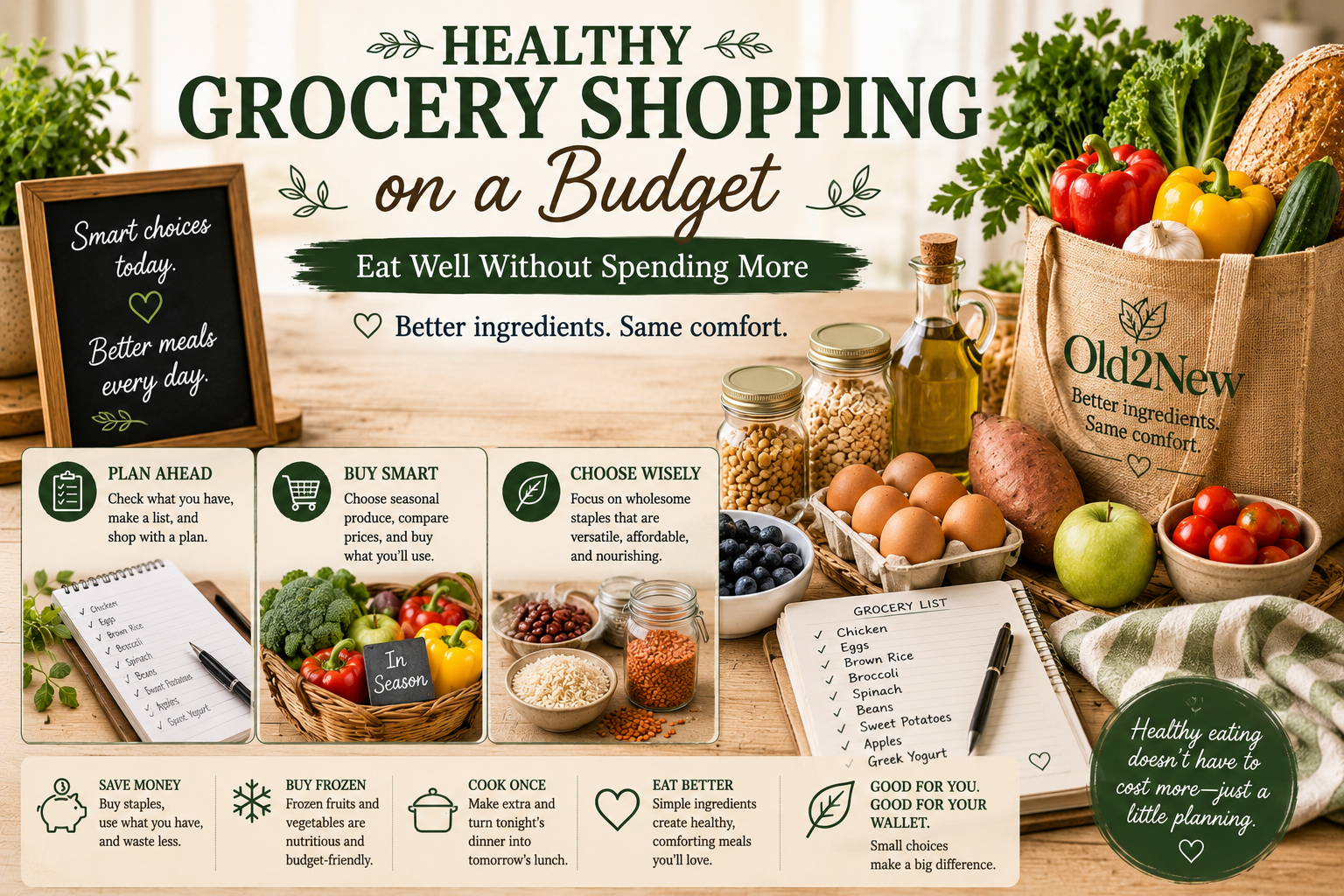
Healthy Grocery Shopping on a Budget
One of the most persistent myths about healthy eating is that it costs more. It doesn't have to — and the ingredients that form the foundation of the most nutritious, satisfying meals are often the least expensive things in the store.
Dried lentils, canned tomatoes, oats, eggs, brown rice, frozen vegetables, dried beans — these are some of the cheapest ingredients available and some of the most nutritionally dense. A pot of lentil soup made from pantry staples costs almost nothing per serving and is genuinely more nourishing than most things that cost ten times as much. A batch of overnight oats made with oats, Greek yogurt, and frozen berries is a week of breakfasts for a few dollars total.
The expensive version of healthy eating is the one built on specialty products, trendy superfoods, and premium convenience items. The practical version is built on the same staples that fed generations before us — whole grains, legumes, eggs, seasonal produce, and a few good pantry additions — and it fits most budgets without compromise.
Start with a Plan
The single most effective money-saving habit in grocery shopping is also the simplest: don't go to the store without knowing what you're buying and why. Unplanned grocery trips consistently produce higher spending, more impulse purchases, and more food waste from ingredients that don't get used.
Before the shopping trip, check the refrigerator for what needs to be used before it goes bad. Look through the pantry for what's already there that can anchor the week's meals. Check the freezer for proteins or vegetables that can contribute to dinners without additional purchase. Write down what's actually needed — not what might be useful or what looks appealing, but what's required for the specific meals planned for the week.
Building the week's meals around what's already in the kitchen before supplementing with fresh purchases is the most reliable way to reduce both spending and food waste simultaneously.
Make a Grocery List and Stick to It
A grocery list organized by store section is both faster to shop from and easier to stick to than a scattered list or no list at all. Moving through the store in a logical sequence (produce, then protein, then dairy, then pantry) reduces backtracking and the browsing time that leads to impulse additions.
The produce section is where the most budget decisions happen, which is why going there with specific vegetables in mind rather than browsing is particularly valuable. Knowing that this week's plan calls for broccoli, carrots, spinach, and tomatoes means picking those up without being drawn into additional purchases by whatever else looks appealing.
The discipline of the list isn't about rigidity — it's about preventing the accumulated small additions that turn a planned $80 trip into a $130 one. Every item not on the list is worth a moment of consideration: does this fit into the week's meals? Will it get used? Or does it just look good in the moment?
Buy Seasonal Produce
Seasonal produce costs less because the supply is abundant and the logistics are simpler — it doesn't need to travel as far or be stored as long before reaching the store. It also tastes better because it was harvested closer to peak ripeness rather than being picked early for transport.
In spring, asparagus, strawberries, spinach, and peas are at their most affordable and most flavorful. In summer, tomatoes, zucchini, bell peppers, corn, and berries are the best value in the produce section. In fall, apples, sweet potatoes, butternut squash, and cruciferous vegetables like Brussels sprouts and cauliflower are in season. In winter, carrots, broccoli, citrus, and cabbage are the produce staples with the best price-to-quality ratio.
Cooking around what's in season rather than buying the same ingredients year-round naturally reduces the produce budget and produces better-tasting meals — because in-season vegetables need less to make them good.
Don't Overlook Frozen Produce
Frozen fruits and vegetables are processed at peak ripeness and retain their nutritional value through the freezing process — in many cases, frozen produce is more nutritious than fresh produce that has been sitting in transit and storage for days. They're also significantly less expensive than out-of-season fresh produce and produce zero food waste because they keep in the freezer for months.
Frozen broccoli, spinach, mixed vegetables, peas, and cauliflower are the most practical freezer staples — they go directly from the freezer into soups, casseroles, stir fries, and pasta dishes without any defrosting or prep. Frozen berries are one of the best values in the frozen aisle — they go into smoothies, oatmeal, yogurt parfaits, and baked goods throughout the week at a fraction of the cost of fresh berries.
Building meals around a combination of fresh in-season produce and frozen staples produces the best balance of cost, nutrition, and variety.
Build Meals Around Affordable Staples
The most cost-effective healthy meals are built around the ingredients that provide the most nutrition per dollar — which are almost universally the least glamorous items in the store.
Dried beans and lentils are among the cheapest foods available and some of the most nutritionally complete — high in protein, fiber, and micronutrients, and versatile enough to go into dozens of different dishes. A bag of dried lentils costs a few dollars and makes enough food for ten to twelve servings of soup or chili. Brown rice and whole wheat pasta are similarly economical bases that go into countless meal combinations. Oats provide a week of breakfasts from a single bag. Eggs are the most cost-effective animal protein available — a dozen eggs provides twelve complete protein servings for a few dollars. Canned tomatoes and canned beans are pantry workhorses that anchor fast weeknight meals at minimal cost. Frozen vegetables extend any meal without significant additional expense.
These ingredients are not compromise choices — they're the ingredients that produce the most satisfying, nourishing meals consistently. The more central they are to the week's cooking, the lower the grocery bill and the higher the nutritional quality of the food.
Compare Unit Prices
The largest package is not always the best value, and the lowest shelf price is not always the lowest cost per use. Unit prices — the cost per ounce, pound, or serving listed on the shelf tag — provide the actual comparison that matters.
For pantry staples that get used regularly (oats, rice, pasta, beans, olive oil, canned tomatoes), buying a larger quantity usually produces a lower unit price and genuine savings over time. For fresh produce and proteins that might not get used before spoiling, the smaller quantity at a higher unit price may actually save money because it reduces waste.
The comparison is most useful in the pantry aisles where the difference between name brands and store brands — and between sizes — can be significant. Store brand oats, rice, pasta, beans, frozen vegetables, and canned tomatoes typically deliver the same quality as national brands at meaningfully lower prices. The savings on these staple items accumulate significantly over the course of a month.
Buy Only What You'll Use
Buying in bulk saves money only if the food gets used before it spoils. A large bag of salad greens at a low unit price is not a good value if half of it goes slimy before it's finished. A bulk package of chicken thighs is excellent value if they're portioned and frozen immediately; less so if they sit in the refrigerator until they need to be thrown out.
The question before any bulk purchase: will this get used before it spoils, and if not, can it be frozen? If both answers are no, the smaller package is the more economical choice even at a higher unit price.
This is where the connection between shopping and meal planning is most direct — a meal plan that specifies how a bulk purchase will be used across the week makes the purchase genuinely economical rather than aspirationally so.
Store Food Properly
Getting the maximum value from every grocery purchase means storing things in ways that extend their usable life as long as possible.
Fresh herbs keep for a week or more stored stems-down in a jar of water, loosely covered with a plastic bag in the refrigerator — the same way cut flowers are kept. Stored in the original bag, they wilt in a day or two. Leafy greens keep longer in an airtight container lined with a paper towel that absorbs excess moisture. Berries should be kept dry until ready to eat — washing them ahead of time accelerates mold. Onions and potatoes keep best in a cool, dark, dry place with good airflow, away from each other (they release gases that accelerate each other's spoilage). Bread that won't be finished within a few days freezes well and defrosts in the toaster directly.
These storage habits are the difference between a grocery trip that lasts a full week and one where produce is being thrown out by Thursday.
Don't Shop Hungry
The research on this is consistent: shopping while hungry leads to more impulse purchases, larger quantities, and higher spending — because everything looks appealing when you're hungry and the normal filters that prevent impulse additions are weakened. A small snack before a grocery trip is a genuinely effective strategy for staying on budget, not just a folk remedy.
It also helps to shop at consistent times when the store is less crowded — crowded stores create more opportunity to browse and linger in sections that weren't part of the plan.
Stretch Ingredients Across Multiple Meals
The most efficient grocery trips buy versatile ingredients that contribute to multiple different meals rather than single-use specialty items that serve only one recipe.
A rotisserie chicken becomes dinner tonight, chicken salad for lunch tomorrow, the base for chicken noodle soup on Thursday, and the protein in tacos on Friday — four meals from one purchase. A bag of spinach goes into omelets, pasta sauce, smoothies, salads, and soup over the course of a week. A bunch of broccoli roasts as a side dish tonight, goes into tomorrow's stir fry, and gets folded into a frittata on the weekend. Choosing ingredients with this multi-meal lens at the point of purchase produces more meals per dollar than buying specific ingredients for specific recipes.
FAQ
Is it actually cheaper to eat healthy? For most households, eating healthy whole foods is less expensive than the combination of processed convenience foods and takeout that it typically replaces. The comparison that makes healthy eating seem expensive is usually between whole foods and cheap fast food — a valid comparison for individual meals but not for the full week's food costs. A week of meals built on lentils, rice, eggs, seasonal vegetables, and oats costs significantly less than a week that includes significant processed and restaurant food.
What's the highest-impact thing I can do to reduce my grocery bill? Plan meals before shopping and build that plan around what's already in the kitchen. The combination of reduced impulse purchases, reduced food waste, and reduced redundant buying that comes from planned shopping typically produces more savings than any specific ingredient swap or coupon strategy.
Are store brands actually the same quality as name brands? For most pantry staples — oats, rice, pasta, canned tomatoes, canned beans, frozen vegetables, baking staples, and spices — store brand quality is indistinguishable from national brand quality in finished dishes. The processing and ingredients are typically the same; the difference is packaging and marketing. The categories where name brands sometimes justify the price difference are items where consistency and flavor have a significant impact on the final dish (olive oil and canned tomatoes being the most notable).
How do I reduce food waste to make my grocery budget go further? The most effective strategies: plan meals before shopping so purchases are intentional; store produce in ways that extend its life; use proteins and produce that are approaching the end of their fresh window first; freeze anything that won't be used before it spoils; and build one meal each week around using up whatever is left in the refrigerator before the next grocery trip.
Continue Your Recipe Transformation Journey
Smart grocery shopping is the foundation that makes everything else in healthy cooking more sustainable. These guides will help you build on it:
- Pantry Staples Every Home Cook Should Keep — the affordable staples worth always having
- Beginner's Guide to Meal Planning — how planning before shopping changes everything
- How to Cook Once and Eat Twice — how to stretch every purchase across multiple meals
- Stop Throwing Away Food — how reducing food waste extends the grocery budget
- What Can I Make with Lentils? — the most economical protein in the kitchen
Old2New — There is good in everything.