How to Read an Ingredient Label
Flip over almost any packaged food and you'll find an ingredient list. Sometimes it's three words. Sometimes it runs for three inches in tiny print. Neither tells you everything you need to know about the food — but both tell you more than the front of the package does.
Reading an ingredient label doesn't require a nutrition degree or a chemistry background. It requires knowing a few straightforward things about how the list is organized and what to look for. Once those basics are clear, ingredient labels become a useful tool for making informed choices rather than a source of anxiety or confusion.
This isn't about food fear. It's about knowing what you're buying so you can make choices that work for your kitchen, your family, and your goals — and then moving on with your day.
Ingredient List vs. Nutrition Facts
These are two different things on the same package, and they answer different questions.
The Nutrition Facts panel tells you quantitative information about the food: how many calories, how much protein, how much fiber, how much sodium, how much added sugar, and what percentage of various daily values a serving provides. It's a snapshot of the nutritional composition.
The ingredient list tells you what was actually used to make the food — what went into the recipe. It shows you the specific ingredients in descending order by weight, which tells you what the product is primarily made of and what's present in smaller amounts.
Looking at both gives you a more complete picture than relying on either alone. The front of the package, with its marketing claims and imagery, tells you what the manufacturer wants you to notice. The ingredient list and Nutrition Facts panel tell you what's actually in the food.
Start with the First Few Ingredients
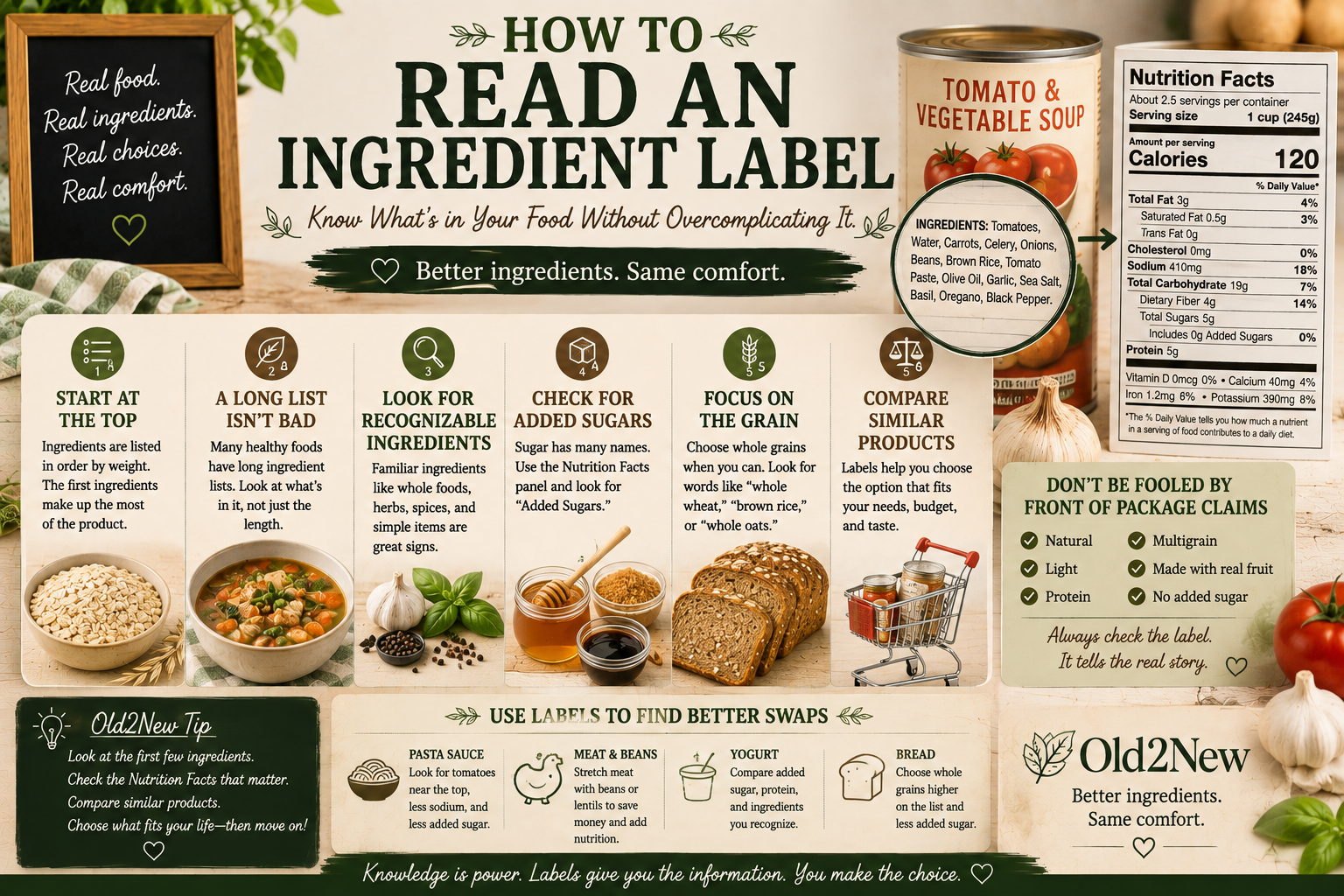
Ingredients are listed in descending order by weight, which means the first ingredients make up the largest portion of the product. This single fact makes the ingredient list significantly more useful than most people realize.
If you're buying bread marketed as "whole grain" or "wheat bread," checking whether whole wheat flour or a whole grain appears in the first one or two ingredients tells you more than the front label claim. A bread with "enriched flour" first and "whole wheat flour" fifth is primarily made from refined flour with a smaller addition of whole wheat — which is different from a bread where whole wheat flour is the first ingredient.
If you're buying a pasta sauce, seeing tomatoes first tells you the product is primarily tomato. Seeing water or oil first tells you the tomato is more diluted. If you're buying a granola bar, seeing oats first versus sugar first tells you something meaningful about what the bar is primarily made of.
You don't need to analyze every ingredient in the list. Reading the first three to five usually tells you most of what you need to know about what the food actually is.
A Long Ingredient List Isn't Automatically Bad
This is one of the most important misconceptions about ingredient lists to correct.
A long list of ingredients doesn't indicate a poor-quality product. Consider a vegetable soup containing tomatoes, water, kidney beans, carrots, celery, onions, garlic, chicken broth, brown rice, oregano, thyme, basil, black pepper, bay leaf, and parsley. That's 15 ingredients — and every one of them is a recognizable food.
Length alone tells you nothing about quality. What the ingredients actually are tells you something useful. A 5-ingredient product where three of those ingredients are sugar under different names is not automatically better than a 20-ingredient product where all 20 are recognizable foods.
And a Short Ingredient List Isn't Automatically Better
The opposite is equally true. Three ingredients doesn't make something the superior choice, and the "clean label" trend of minimizing ingredient counts has created some products that are simply marketing rather than nutritional improvement.
Some emulsifiers, thickeners, and preservatives with long chemical-sounding names are benign ingredients used in small amounts to maintain quality, extend shelf life, or achieve a texture that wouldn't otherwise be possible. Not every unfamiliar name represents something to avoid.
Ingredient lists are information — not a scorecard. They're most useful when compared across similar products to understand what you're getting for your money and what trade-offs you're making.
Look for Ingredients You Recognize — But Don't Fear Those You Don't
Recognizing ingredients makes comparing products easier and gives you a clearer sense of what you're buying. Seeing oats, tomatoes, olive oil, nuts, seeds, and herbs in an ingredient list provides quick context for what the food is built from.
But the "if you can't pronounce it, don't eat it" rule is an oversimplification that creates more anxiety than clarity. Some perfectly ordinary and benign food components have technical or scientific names. Ascorbic acid is vitamin C. Tocopherols are vitamin E. Lecithin is a naturally occurring fat found in eggs and soybeans, used as an emulsifier. Xanthan gum is a thickener derived from fermented sugar. None of these names indicates something harmful, but none of them sounds particularly familiar either.
A more useful approach: if you don't recognize an ingredient and you're curious, look it up. Knowledge is more useful than a pronunciation test.
Pay Attention to Added Sugars
Sugar appears under many different names in ingredient lists — and understanding this is genuinely useful for people trying to reduce their added sugar intake. Cane sugar, corn syrup, high-fructose corn syrup, brown rice syrup, honey, maple syrup, dextrose, fructose, maltose, evaporated cane juice, and molasses are all forms of added sugar that contribute to the added sugars total on the Nutrition Facts panel.
The most practical tool for understanding how much sugar is actually in a product is the "Added Sugars" line on the Nutrition Facts panel, which was added specifically to help consumers identify sugar added during processing separate from naturally occurring sugars in fruit or dairy.
Spotting sugar in the ingredient list tells you it's present. The Nutrition Facts panel tells you how much — which is usually more actionable information. A small amount of honey in a salad dressing is different from a product where three of the first five ingredients are different forms of sugar.
Context matters more than identifying a particular word in the ingredient list.
Check the Type of Grain
Products labeled "wheat," "multigrain," or "made with whole grains" aren't necessarily primarily made from whole grains. These claims can be made on products that contain only a small percentage of whole grain alongside a larger amount of refined flour.
When whole grains are important to you, look for specific whole grain ingredients near the top of the ingredient list: whole wheat flour, whole oats, brown rice, whole grain corn, whole rye, or oat bran. The word "whole" before the grain name indicates the entire grain kernel is present — bran, germ, and endosperm — which is where most of the fiber and nutritional value resides.
"Enriched flour" or "wheat flour" without "whole" in front of it indicates refined flour — a legitimate ingredient with a different nutritional profile than whole grain flour.
Watch Sodium in Everyday Foods
Sodium accumulates across the day from many sources, not just the salt shaker. Canned soups, pasta sauces, deli meats, frozen meals, seasoning mixes, bread, and condiments all contain varying amounts of sodium that contribute to total daily intake without tasting particularly salty.
The practical approach to sodium in ingredient labels is comparison: when choosing between two similar products that will serve the same purpose in a meal, the one with meaningfully less sodium is an easy upgrade that doesn't require changing what you're cooking. Two cans of beans for taco night, one with 400mg sodium per serving and one with 140mg — choosing the lower-sodium option is a simple swap that reduces sodium intake without changing dinner.
The ingredient label shows you that salt is present. The Nutrition Facts panel shows you how much — and that's the more useful number for comparison shopping.
Don't Let the Front of the Package Decide for You
The front of food packaging is designed to attract attention and convey the most positive impression of the product possible. Terms like "natural," "made with whole grains," "no artificial flavors," "light," "protein," "made with real fruit," and "no added sugar" are marketing statements that may be technically accurate but don't tell the full story of what the product contains.
"Natural" has no regulated definition in food labeling — it's essentially a marketing term. "Made with whole grains" can apply to a product where whole grains are present in very small quantities. "No added sugar" may be true while the product still contains significant sugar from other sources like fruit juice concentrate.
Turning the package around and reading the ingredient list and Nutrition Facts panel requires two extra seconds and provides more useful information than any front-of-package claim.
Compare Similar Products
Ingredient labels are most useful as a comparison tool — not as a way to evaluate a single product in isolation, but as a way to choose between two similar products that would serve the same purpose.
When choosing between two pasta sauces, two yogurts, two breads, or two granola bars, comparing the first few ingredients and one or two Nutrition Facts values (sodium, added sugars, protein, fiber — whatever matters most to you for this particular food) usually reveals a clear better choice without requiring a comprehensive analysis.
The comparison doesn't need to result in the "perfect" product. It needs to result in a choice that's slightly better for what you're using it for, made in the time it takes to flip two packages over.
Don't Try to Make Every Purchase Perfect
A grocery cart doesn't need to pass any test. Some foods are purchased for nutritional density. Some are purchased for convenience. Some are family traditions that have been on the table for decades. Some simply taste good and that's enough.
A balanced kitchen contains all of these things. An ingredient label is a tool for making informed choices, not a gatekeeper that determines which foods deserve to be in your cart. Reading one shouldn't produce guilt about another.
The goal is slightly better decisions made consistently over time — not perfection at every purchasing moment.
A Simple Approach for the Grocery Aisle
When standing in an aisle comparing two products, a quick four-step process covers most situations without turning shopping into homework:
Look at the first three to five ingredients — are these primarily the food you're looking for? Check the one or two Nutrition Facts values that matter most to you for this type of food (sodium for soup, added sugars for a breakfast cereal, protein for a yogurt). Compare the two products rather than evaluating either one in isolation. Choose the one that fits your needs, budget, and taste — and move on.
That process takes 30 seconds and produces genuinely better choices over the course of a week's shopping without requiring significant time or analysis.
FAQ
Does the order of ingredients always reflect their proportion in the product? Yes — ingredients are listed in descending order by weight as required by labeling regulations. The first ingredient makes up the largest portion by weight; the last ingredient is present in the smallest amount. This doesn't tell you exact percentages, but it tells you the relative ranking of ingredients and whether a named ingredient is a primary component or a minor addition.
What does "enriched" mean in flour? Enriched flour is refined (white) flour that has had some B vitamins and iron added back after they were removed during the milling process. It's a legitimate ingredient but nutritionally different from whole wheat flour, which retains the bran and germ that contain fiber, additional vitamins, and minerals that aren't added back during enrichment.
Is "no added sugar" the same as "sugar-free"? No. "No added sugar" means no sugar was added during processing, but the product may still contain naturally occurring sugars from fruit, dairy, or other ingredients. "Sugar-free" means the product contains less than 0.5 grams of sugar per serving. Both claims can be applied to products that still taste sweet — from naturally occurring sugars, sugar alcohols, or artificial sweeteners.
How do I know if a "whole grain" product actually contains significant whole grain? Look for a whole grain listed as the first or second ingredient. If whole wheat flour or whole oats appears after enriched flour or another refined grain, the product contains whole grain but is primarily made from refined flour. Products that display the Whole Grain Council stamp and carry it on the front label are required to meet specific whole grain content thresholds.
Continue Your Recipe Transformation Journey
Understanding ingredient labels makes every shopping decision more confident and more informed. These guides will help you apply that knowledge:
- How to Read a Nutrition Label — the companion guide to the Nutrition Facts panel
- Smart Grocery Swaps That Save Money — how to use labels to find better alternatives
- Healthy Grocery Shopping on a Budget — making informed choices within a budget
- Pantry Staples Every Home Cook Should Keep — the whole-food ingredients that need no label analysis
- 10 Healthy Ingredient Swaps — practical swaps informed by better label reading
Old2New — There is good in everything.