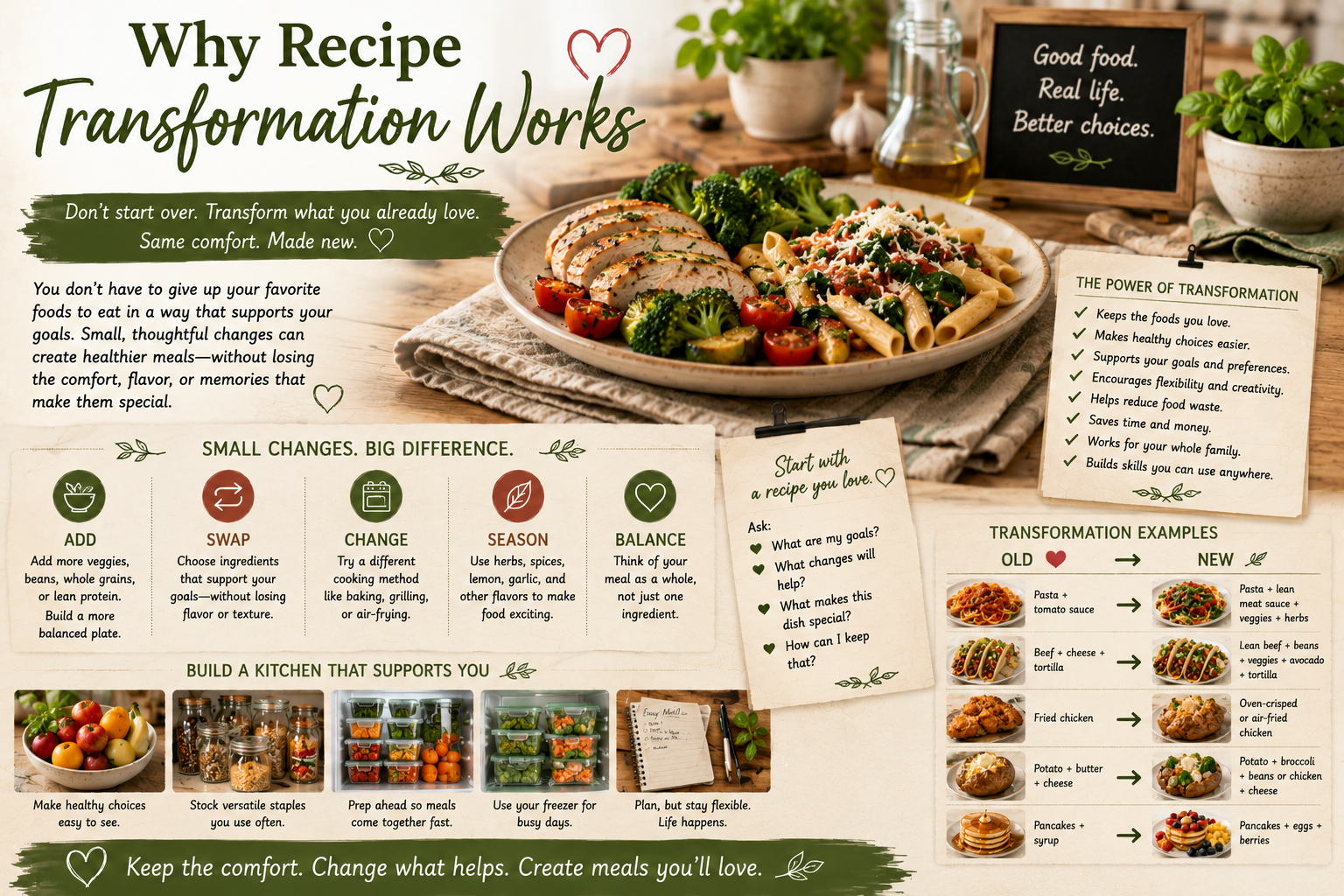
Why Recipe Transformation Works
Most of us don't need someone to teach us how to eat an entirely new collection of foods. We already have foods we love. Spaghetti. Tacos. Fried chicken. Meatloaf. Mac and cheese. Lasagna. Pizza. Chicken pot pie. Pancakes on Sunday morning. The recipes passed down through our families. The meals we make when everyone is finally home at the same time.
So when someone decides they want to eat differently, why does the first piece of advice so often sound like "stop eating all of that"? That's where things start to fall apart. Because changing the way we eat is hard enough. Changing our schedules, grocery lists, cooking techniques, favorite recipes, family traditions, and taste preferences all at once? That's a completely different challenge.
At Old2New, we believe there's another way. Don't start over. Transform what you already love. That's the idea behind recipe transformation — and there are some very practical reasons why it works.
What Is Recipe Transformation?
Recipe transformation is exactly what it sounds like. You start with an existing recipe. Then you look at the ingredients, the portions, the cooking method, the flavor, the texture, the nutritional balance, and most importantly the identity of the dish. Then you make thoughtful changes based on what you're trying to accomplish.
Maybe you want more protein, more vegetables, more fiber, less sodium, a different cooking method, or a version that fits a specific dietary approach. The important part is what happens next: the recipe should still be recognizable. If you transform chicken enchiladas and end up with a quinoa salad, something went terribly wrong.
Familiar Food Makes Change Easier
Imagine being told that starting tomorrow, you're going to eat completely different foods — new breakfasts, new lunches, new dinners, new ingredients, new cooking techniques, a new grocery list. And by the way, your family may not like any of it. That's not particularly motivating.
Now imagine something different: tomorrow night you're still having tacos. We're just going to make a few thoughtful changes. That feels much more manageable. Familiarity removes some of the friction from change. You already know how tacos work. You already know what spaghetti should taste like. You already know how your family likes meatloaf. We're not starting from zero — we're starting from experience.
Your Favorite Recipes Already Have a Foundation
Most recipes contain things worth keeping. That's why one of Old2New's core beliefs is: there is good in every ingredient. A recipe doesn't need to be treated like a problem to be solved.
Take tacos. You might already have protein, vegetables, carbohydrates, flavor, texture, and fresh toppings. Maybe the recipe only needs a small adjustment — add beans, use leaner meat, add more vegetables, adjust the sodium, change the cooking method. Or perhaps the tacos are already pretty well balanced. Not every ingredient needs replacing.
Small Changes Can Affect the Whole Recipe
This is one of the most powerful things about cooking. You don't always need ten substitutions. Sometimes one change influences the entire dish.
Consider fried chicken. The identity of the dish comes from tender chicken, seasoning, a crispy coating, and that beautiful crunch when you bite into it. So if your goal is a lighter version, you might change the cooking method rather than completely rebuilding the recipe. Maybe it's oven-crisped or air-fried. You preserve what makes fried chicken satisfying while changing one major part of how it's prepared. That's transformation.
The Best Swap Isn't Always the Most Obvious Swap
This matters. Suppose you're transforming lasagna. Someone might immediately think: replace the noodles, replace the cheese, replace the meat, replace everything. But at some point, what happens to the lasagna? A better transformation asks: where can we make changes without losing the dish?
Maybe we use leaner meat, add spinach and mushrooms to the sauce, and adjust the cheese blend. Perhaps the noodles stay exactly the same. The goal isn't to make the maximum number of substitutions — it's to make the right substitutions.
Recipe Identity Matters
Every dish has characteristics that make it what it is. Pizza needs to feel like pizza. Tacos should still be tacos. Meatloaf should slice like meatloaf. Mac and cheese needs that creamy, cheesy comfort. Chicken pot pie needs a savory filling and that unmistakable pot-pie experience. When transformation destroys those characteristics, the recipe may technically meet a nutritional goal — but it failed as food.
That's why Old2New starts with a simple rule: protect the identity of the dish.
Flavor Is Part of the Transformation
Healthy food has been unfairly associated with bland food for far too long. Seasoning doesn't disappear because you're making a recipe differently. Garlic, onion, herbs, spices, citrus, olive oil, peppers, tomatoes, and all the other ingredients that give recipes personality still belong in the dish. Sometimes reducing one ingredient means we need to strengthen flavor somewhere else. That's not cheating — that's cooking.
Texture Matters Too
Imagine fried chicken without crunch. Mac and cheese without creaminess. Pizza with a soggy crust. Meatloaf that crumbles into pieces. Texture is part of what makes familiar food comforting. So when an ingredient changes, we have to ask: what did that ingredient do for the recipe? Did it create moisture? Structure? Creaminess? Crispness? Replacing an ingredient without understanding its job can ruin the dish. Good recipe transformation considers function, not just nutrition.
Cooking Methods Can Be Powerful
Sometimes the ingredient isn't what needs changing — the method is. Instead of deep-frying, maybe something can be air-fried, oven-crisped, roasted, grilled, sautéed, or slow-cooked. The recipe can remain remarkably familiar while the preparation changes entirely. That's one reason cooking methods are such powerful transformation tools.
Adding Can Be More Powerful Than Removing
Traditional diet thinking often begins with "what should we take away?" Recipe transformation can begin somewhere else: "what could we add?" Add spinach to pasta. Add mushrooms to meat sauce. Add beans to tacos. Add vegetables to pizza. Add protein to breakfast. Add broccoli to a baked potato. Add herbs and spices when reducing sodium. Suddenly we're expanding the recipe instead of shrinking it. That feels very different.
Familiar Meals Make Family Cooking Easier
Recipe transformation isn't only about the person changing their eating habits — there's often an entire household involved. You may want to eat differently. Your spouse may not. Your kids may definitely not. Making completely separate dinners every night isn't realistic for most families. Transformation can help solve that.
Take taco night. Someone wants extra protein? Add more chicken or beans. Someone wants more vegetables? Load them up. Someone wants traditional tacos? Make them. Someone prefers a bowl? Skip the tortilla. One dinner. Multiple possibilities.
Transformation Helps Preserve Family Recipes
Some recipes are more than dinner — they're history. Grandma's meatloaf. Dad's chili. Your mother's Sunday sauce. The casserole your family has eaten every Christmas for thirty years. Those recipes carry memories. We don't want to erase that.
Sometimes the best transformation is very small. Maybe one ingredient changes. Maybe the cooking method changes. Maybe nothing inside the recipe changes and we simply build a different plate around it. Family recipes deserve respect. Transformation should preserve the story whenever possible.
You Learn Principles Instead of Rules
This may be one of the biggest advantages of recipe transformation. You're not memorizing a giant list of eat this, never eat that, use this ingredient, avoid that ingredient. Instead, you begin learning how food works. You start asking: what does this ingredient contribute? Could I add vegetables here? Could I add protein? Could the cooking method change? Would this swap preserve the texture? Does this recipe even need changing?
Those skills travel with you. Once you understand the principles, you can use them with hundreds of recipes.
Different Goals Can Transform the Same Recipe Differently
Let's say four people start with the exact same recipe: Chicken Alfredo. One person wants high protein. Another wants Mediterranean-style. Another wants lower sodium. Another wants GLP-1 friendly. The transformations may be different — and that's exactly the point. There isn't necessarily one universal "healthy Chicken Alfredo." There are different ways to transform the recipe depending on the person's goals and preferences.
Goals Can Also Work Together
Real people rarely fit into one dietary box. Someone might want high protein and lower sodium. Or Mediterranean-style and high protein. Or GLP-1 friendly and high protein. Recipe transformation allows us to look for changes that support multiple goals at once. Chicken, beans, vegetables, whole grains, herbs, and olive oil can, depending on the recipe, support several goals simultaneously. That's where transformation becomes much more useful than simply labeling a recipe "healthy."
But More Goals Aren't Always Better
We have to talk about this. Technically you could keep stacking preferences — high protein, lower sodium, lower carb, Mediterranean-style, GLP-1 friendly, dairy free, gluten free, plant forward. Eventually you're standing in the kitchen holding a bowl of seasoned sawdust. That's not the goal. The transformation still needs to create good food. Sometimes priorities have to be balanced, and sometimes preserving the dish means deciding which changes matter most.
Transformation Encourages Flexibility
Recipes aren't laws — they're starting points. Maybe you don't like mushrooms. Use another vegetable. Maybe your family hates cottage cheese. Don't use it. Maybe you prefer chicken thighs to chicken breast. That matters. Maybe you need a different ingredient because of an allergy or intolerance. Adapt. A useful recipe should be flexible enough to work in a real kitchen.
You Don't Need Specialty "Diet" Foods
Recipe transformation can often happen with ordinary ingredients. Chicken, eggs, beans, rice, potatoes, vegetables, fruit, pasta, yogurt, cheese, herbs, and spices. You don't necessarily need an entire pantry of specialty products. Sometimes the ingredients needed to transform tonight's dinner are already sitting in your refrigerator.
Transformation Can Reduce Food Waste
This is one of the quieter benefits. Recipe transformation isn't only "make this recipe healthier" — it can also be "what can I make with what I already have?" Leftover chicken? Turn it into tacos. Rice? Make a bowl. Roasted vegetables? Put them into eggs. Ground beef? Make stuffed potatoes. A few vegetables that need using? Add them to soup or pasta. When we learn to see ingredients as possibilities, leftovers stop looking like leftovers and become the beginning of another meal.
Transformation Can Save Money Too
If a recipe requires ten specialty ingredients you'll never use again, that's not especially practical. A better transformation looks for versatile ingredients — beans, eggs, frozen vegetables, rice, chicken, potatoes, Greek yogurt, herbs. Ingredients that can appear in several meals give you more value from your grocery budget. Good recipe transformation should work in a real household, not only in a perfect recipe photograph.
Not Every Recipe Needs Transforming
This might sound strange coming from Old2New. But it's important. Sometimes the right answer is: leave it alone. Grandma's Christmas cookies? Maybe those stay exactly as they are. The lasagna you make twice a year? Maybe you love every ingredient. Your birthday cake? Eat the cake.
Recipe transformation is a tool — not a requirement. Having the ability to change a recipe doesn't mean you have to change every recipe.
Transformation Works Because It Meets You Where You Are
That's really the heart of it. We don't begin with "here's what you should be eating instead." We begin with "what do you love eating now?" Then "what are you trying to accomplish?" And finally "how can we bring those two things closer together?"
That's a completely different conversation. You're not abandoning your food. You're teaching it some new tricks.
A Good Transformation Should Pass the Recognition Test
Here's a simple Old2New test. Put the transformed meal in front of someone who knows the original dish. Can they tell what it is? If we transformed meatloaf, does it look like meatloaf? If we transformed pizza, does it look like pizza? If the answer is "well, technically..." we may have gone too far. The dish should keep its identity.
A Good Transformation Should Also Pass the Second-Bite Test
This one may be even more important. After the first bite — do you want another one? A recipe can have beautiful nutrition and still fail the most basic requirement of food: you have to want to eat it. A transformation isn't successful simply because something was removed. It's successful when the new version supports your goal and remains satisfying enough to make again.
That's Why Recipe Transformation Works
It works because we're not asking people to abandon everything familiar. We're starting with foods they know, recipes they understand, flavors they enjoy, meals their families recognize, and traditions they want to preserve. Then we make purposeful changes. Sometimes we swap. Sometimes we add. Sometimes we change the cooking method. Sometimes we adjust the portions. Sometimes we build a different plate around the original dish. And sometimes we look at the recipe and say: "You know what? This one's fine." That's transformation too.
Because the goal was never to change food simply for the sake of changing it. The goal is to create more possibilities.
FAQ
How do I know which part of a recipe to change first? Start by identifying what the recipe does well and what it lacks relative to your goal. A recipe strong on flavor but low in protein gets a protein addition before anything else changes. A recipe that's heavy but otherwise well-loved gets a side dish or portion adjustment before any ingredient changes. Working from the recipe's strengths and addressing the most significant gap first produces better transformations than trying to improve everything simultaneously.
What if the transformed recipe still doesn't taste as good as the original? Go back and analyze what's different. Did a key flavor source get reduced without being replaced? Did a texture-providing ingredient disappear? Did the cooking method change in a way that affected the result? Often a small addition — a finishing squeeze of lemon, a sprinkle of parmesan, a final herb garnish — recovers what feels missing. If it can't be recovered, that particular swap may not be right for that particular recipe.
Is there a point where a recipe becomes too transformed? Yes — and Old2New calls that the "recipe identity test." When a transformed version can no longer be recognized as the original dish, the transformation has gone too far. The dish has become something else — possibly something good, but no longer the same meal. Resetting to fewer changes and protecting the elements that make the dish recognizable usually recovers both the identity and the enjoyment.
Continue Your Recipe Transformation Journey
Recipe transformation is the foundation of everything Old2New does. These guides will help you apply the principles to your own kitchen:
- What Is Recipe Transformation? — the starting point for every transformation
- How to Make Your Favorite Recipes Healthier Without Starting Over — the practical framework in action
- Easy Ways to Add More Vegetables Without Anyone Noticing — the addition approach applied to everyday cooking
- Eating Well Without Feeling Restricted — why transformation feels different from restriction
- Building a Family Recipe Binder — where both the original and the transformed versions live together
Old2New — There is good in everything.