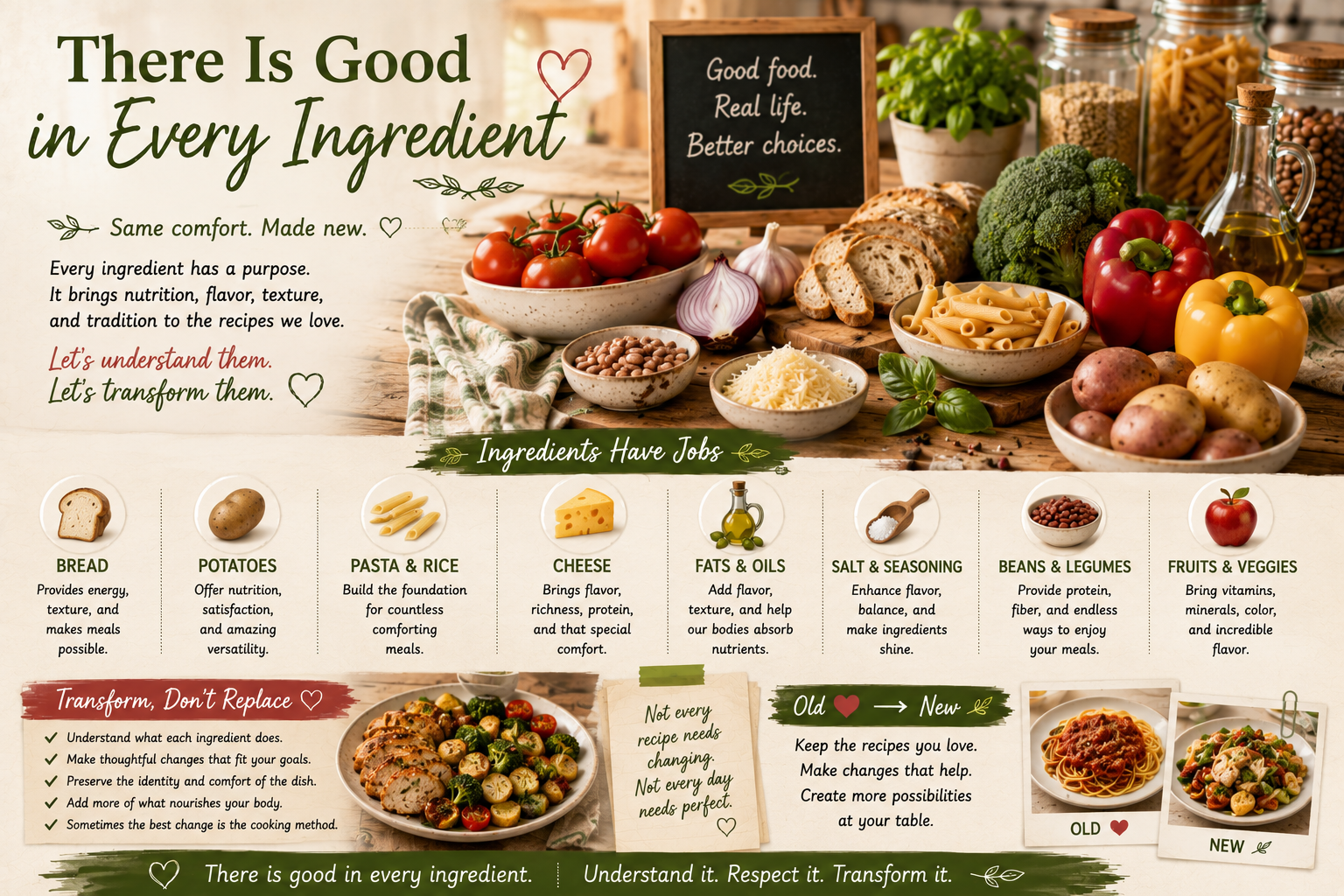
There Is Good in Every Ingredient
Somewhere along the way, food became very judgmental. Bread became bad. Potatoes became bad. Pasta became bad. Butter became bad. Then fat was bad. Then carbohydrates were bad. Then sugar was bad. Then certain oils were bad. Give the internet enough time and apparently everything in your kitchen will eventually be accused of something.
At Old2New, we look at food differently. We believe there is good in every ingredient. That doesn't mean every ingredient provides the same nutrition. It doesn't mean every ingredient works for every person, every health goal, or every recipe. And it certainly doesn't mean quantity doesn't matter. It means something much simpler: ingredients have purpose. They contribute nutrition, flavor, texture, structure, tradition, comfort, culture, and memories — sometimes several of those things at once.
So instead of immediately asking "what's wrong with this ingredient?" we like to ask: "what does this ingredient bring to the recipe?" That question changes everything.
Food Doesn't Need a Moral Score
Broccoli isn't morally superior to a potato. An apple hasn't achieved a higher level of personal development than a piece of bread. Food isn't good person food versus bad person food. Different foods simply bring different things to the table. Some provide more protein. Some provide carbohydrates. Some contain fiber. Some provide fats. Some contribute vitamins and minerals. Some make a sauce creamy. Some make bread rise. Some create the crispy coating on fried chicken. Some are there because Grandma put them in the recipe forty years ago and everyone would notice if they disappeared. That matters too.
Ingredients Have Jobs
This is one of the most important things to understand about recipe transformation. An ingredient isn't just a nutrition label — it has a job inside the recipe.
Consider flour. Flour can provide structure, thickness, a coating, chew, and tenderness. Depending on the recipe, removing flour could completely change the food. Now consider cheese. Cheese may provide flavor, protein, fat, saltiness, creaminess, structure, and that glorious cheese pull on pizza. If we replace cheese simply because another ingredient has fewer calories, we've ignored everything the cheese was doing.
Good recipe transformation asks: "What happens to the recipe if we change this?"
The Potato Has Been Through Enough
Can we talk about potatoes? Because potatoes have been blamed for an impressive number of things over the years. But a potato is an incredibly versatile ingredient that can become a baked potato, mashed potatoes, roasted potatoes, soup, breakfast hash, potato salad, fries, a side dish, or the base of a loaded meal. Potatoes naturally provide nutrients including potassium and vitamin C.
The potato isn't automatically the issue. What matters is what we're making with it. A loaded baked potato topped with chicken, broccoli, herbs, and cheese is a completely different eating experience from a giant restaurant serving of deep-fried potatoes. Same ingredient. Different recipe. Different preparation. Different meal. That's why judging an ingredient in isolation doesn't tell us very much.
Bread Didn't Do Anything to You
Bread has also had quite the public-relations problem. But bread has been part of human food traditions for thousands of years. It can provide carbohydrates and, depending on the type, fiber, protein, vitamins, and minerals. More importantly for cooking, bread does things. It makes sandwiches possible, and toast, and French toast, and stuffing, and breadcrumbs, and grilled cheese. That's a pretty impressive résumé.
Someone may choose a particular bread because it better fits their goals — whole grain, sourdough, lower sodium, higher fiber, or gluten-free when medically or personally necessary. The answer isn't always "remove the bread." Sometimes it's "what are we putting with it?"
Pasta Is More Than a Bowl of Carbohydrates
When Old2New looks at spaghetti, we don't see an ingredient that needs to be eliminated. We see a foundation. Start with pasta. Then add tomato sauce, lean ground beef or turkey, mushrooms, spinach, garlic, herbs, and parmesan. Suddenly we're not discussing whether pasta is good or bad. We're discussing dinner. That's a much more useful conversation.
Rice Is a Foundation Too
Rice appears in cuisines around the world for a reason. It's affordable, versatile, and comforting, and it pairs with an enormous variety of ingredients. Rice can become a grain bowl, a side dish, stir fry, soup, a burrito bowl, a casserole, a base for beans, or a companion to fish or chicken. The important question isn't "should rice exist?" — it's "what are we building with it?"
Fat Has a Job
Fat isn't simply something to remove from recipes. It contributes flavor, texture, satiety, and cooking performance, and it helps the body absorb certain fat-soluble vitamins. Different recipes may use olive oil, avocado, nuts, seeds, butter, cheese, or other fats. Depending on someone's goals, one option may make more sense than another, or the amount may change. But completely removing fat can dramatically change a recipe. Ever tried making something that's supposed to be rich and creamy after removing everything responsible for richness and creaminess? Transformation means understanding the ingredient before changing it.
Sugar Has a Job Too
Sugar is another ingredient that gets discussed almost entirely as something to eliminate. But in cooking and baking, sugar can contribute sweetness, browning, moisture, texture, structure, caramelization, and preservation. That doesn't mean every recipe needs a lot of added sugar — it means replacing sugar in a recipe isn't always as simple as removing it. In baking especially, changing sugar can affect the final product in several ways. A thoughtful transformation might reduce the amount, use fruit for part of the sweetness, adjust other ingredients, or leave the recipe alone when the food is something enjoyed occasionally. Because sometimes birthday cake is supposed to taste like birthday cake.
Salt Does More Than Make Food Salty
Salt enhances flavor, affects texture in some foods, and can help balance bitterness. In baking, it can influence how other flavors are perceived. Someone following a lower-sodium eating pattern may need to reduce sodium — that's a legitimate transformation goal. But simply removing salt without replacing flavor can leave a recipe disappointing. So perhaps we also increase garlic, herbs, spices, lemon, lime, onion, and other aromatics. Now we're not simply subtracting — we're rebuilding flavor.
Cheese Deserves a Seat at the Table
Cheese can provide protein, calcium, flavor, richness, texture, and satisfaction. If a recipe uses a large amount of cheese and someone's goals suggest changing that, there are options. Use a little less. Choose a stronger-flavored cheese so a smaller amount delivers more flavor. Combine cheeses. Use cheese strategically as a finishing ingredient. Or keep the cheese exactly where it is and transform something else.
Remember: the goal isn't to remove every ingredient with calories. The goal is to build a recipe that works better for what you're trying to accomplish.
Meat Isn't Automatically the Whole Meal
Chicken, beef, turkey, pork, and fish can provide protein and other nutrients — but they don't necessarily need to occupy the entire plate. Instead of a huge steak beside a tiny vegetable, we can build: beef alongside potatoes, vegetables, salad, and herbs and seasoning. Same ingredient. Different balance. We aren't declaring the beef bad. We're giving the rest of the meal some room to participate.
Beans Are Quietly Doing a Lot
Beans don't get nearly enough attention. They can provide protein, fiber, carbohydrates, minerals, texture, and volume — and they're incredibly versatile. Add them to tacos, chili, soup, rice, salads, bowls, and pasta dishes. You can even combine beans with meat. Ground beef with black beans in tacos, for example, isn't replacing the beef — it's building something around it. That little distinction represents a lot of what Old2New is about.
Vegetables Don't Need to Become the Entire Meal
We love vegetables. But we don't need to pretend cauliflower is secretly everything else. Cauliflower can be delicious as cauliflower. Broccoli can be broccoli. Zucchini can be zucchini. Vegetables don't always need to impersonate pizza crust, rice, pasta, bread, or potatoes. Sometimes those transformations work beautifully — if you love cauliflower rice, eat it. But if what you wanted was rice and the substitution leaves you disappointed, there may be another way to reach your goal. Maybe you keep the rice and add more vegetables with it. That's allowed.
Fruit Doesn't Need Permission Either
Fruit naturally contains sugar. It also contains water, fiber, vitamins, minerals, and a whole lot of flavor. An apple isn't nutritionally identical to candy simply because both contain sugar — context matters. The whole food matters. The whole meal matters. Fruit can become part of breakfast, snacks, desserts, salads, sauces, smoothies, and savory dishes. An ingredient is more than one number on a nutrition label.
Even the Ingredients We Change Still Have Value
Suppose Old2New transforms a recipe and replaces an ingredient. That does not mean the original ingredient was bad — it simply means another ingredient may work better for that particular goal. We might choose lower-sodium broth for someone trying to reduce sodium. That doesn't mean regular broth is evil. We might choose Greek yogurt in a recipe where we're trying to increase protein. That doesn't mean sour cream is forbidden. We might oven-crisp chicken instead of deep-frying it. That doesn't mean nobody should ever eat traditional fried chicken again. Transformation is contextual.
❤️ OLD → 🌿 NEW Isn't Good → Bad
When you see Old2New use OLD ❤️ → NEW 🌿, the heart is there for a reason. OLD is not bad. The original recipe deserves the heart. It's familiar. It's loved. It may carry family memories. It may taste incredible exactly as it is.
The NEW version isn't there to shame it — it's simply another possibility. That's why our comparison isn't bad → good. It's: what we love → a new way to enjoy it. That's Old2New.
Take Fried Chicken as an Example
Traditional fried chicken has characteristics people love: juicy chicken, seasoning, crispy coating, golden exterior, comfort, maybe family tradition. So when we transform it, we identify what needs protecting. The crunch matters. The seasoning matters. The chicken needs to stay juicy. Perhaps the cooking method changes — maybe we oven-crisp or air-fry it. But we're not going to turn fried chicken into a plain grilled chicken breast beside three leaves of lettuce. That's not transformation. That's a completely different dinner.
Take Mac and Cheese as an Example
What makes mac and cheese what it is? Pasta, creaminess, cheese, and comfort. If we remove all three, we've got a problem. Instead, perhaps we add broccoli and chicken, blend cottage cheese into part of the sauce, adjust portions, choose a different pasta if we genuinely enjoy it, or serve vegetables alongside it. The cheese stays because it's mac and cheese. The identity of the food matters.
Every Ingredient Exists in Context
Nutrition doesn't happen one ingredient at a time. We eat meals, recipes, snacks, and patterns of food over time. A tablespoon of parmesan inside a pasta dish exists alongside everything else in that dish. A tortilla exists alongside everything inside the taco. Butter on a potato exists alongside the potato and whatever else is on the plate. Context changes the conversation. That's why Old2New looks at the whole recipe.
Different Goals Change the Conversation
An ingredient that works beautifully for one person's goal may not work for another. Someone seeking more protein might choose one ingredient. Someone reducing sodium might choose another. Someone eating Mediterranean-style might make a different adjustment. Someone managing dietary needs under medical guidance may have specific requirements. Someone with allergies or intolerances may need substitutions for safety. There isn't always one universally "best" ingredient — there is the ingredient that makes sense for the recipe, the person, and the goal.
Goal Stacking Needs Balance
Old2New can look at multiple goals together — high protein and Mediterranean-style, high protein and lower sodium, GLP-1 friendly and high protein, or other combinations and custom preferences. That's powerful. But we don't want to keep removing ingredients simply because another goal was added. At some point, we have to protect the recipe.
High protein, lower sodium, lower carb, low fat, dairy free, gluten free, sugar free, everything free — and dinner becomes seasoned sawdust. The point of combining goals isn't to remove everything. It's to find ingredients that can work together intelligently.
Sometimes the Best Transformation Is an Addition
Instead of removing pasta, add chicken and vegetables. Instead of removing the potato, add broccoli and beans. Instead of removing the tortilla, add vegetables and lean protein. Instead of removing pancakes, add eggs and berries. Instead of shrinking the meal — build it.
Sometimes the Best Transformation Is the Cooking Method
Maybe the ingredients are already doing their jobs. Then we look at preparation. Deep-fried becomes oven-crisped. Heavy sautéing becomes roasting. Traditional frying becomes air-frying. Cooking methods can change how a recipe fits a goal while allowing most of the original ingredients to remain. We changed what helped. We didn't automatically change everything.
Sometimes the Best Transformation Is the Portion
Maybe Grandma's recipe is perfect. Don't touch it. Instead, perhaps the transformation happens on the plate. Keep Grandma's meatloaf. Serve it with mashed potatoes, green beans, and roasted carrots. The original recipe is completely intact. The meal around it changed. That's still transformation.
And Sometimes the Best Transformation Is Nothing
Sometimes an ingredient should stay exactly where it is. Sometimes the recipe doesn't need changing. Sometimes the food has cultural or emotional importance. Sometimes it's an occasional treat. Sometimes you simply love it. And that's enough.
Having a transformation tool doesn't mean everything needs to be transformed. Knowing when not to change something is part of making good choices too.
Stop Asking "Is This Ingredient Healthy?" — Ask Better Questions
Instead of "is cheese healthy?" ask: "what role does cheese play in this recipe, and how does it fit with my goal?" Instead of "are potatoes bad?" ask: "how am I preparing the potatoes, and what am I serving with them?" Instead of "can I eat pasta?" ask: "what could I build around my pasta?" Instead of "should I remove bread?" ask: "what kind of meal am I making?" Better questions lead to better transformations.
Respect the Ingredient Before You Replace It
Before changing something, ask what it contributes. Flavor? Texture? Structure? Nutrition? Moisture? Tradition? Comfort? If we understand that first, we can make a much smarter decision. Maybe we replace it. Maybe we reduce it. Maybe we combine it with something else. Maybe we change the cooking method. Maybe we add something. Maybe we leave it completely alone. That's thoughtful recipe transformation.
There Really Is Good in Every Ingredient
This philosophy isn't about pretending all foods are nutritionally identical — they're not. It's about refusing to reduce food to simply good or bad. Food is more interesting than that. Ingredients have histories, functions, flavors, nutrients, textures, traditions, and possibilities.
The potato can stay. The pasta can stay. The bread can stay. The cheese can stay. The vegetables can absolutely stay. And instead of constantly asking what needs to be removed, we can start discovering what these ingredients can become together. Because the goal isn't to create the most perfect plate in the world. It's to help people make food they enjoy while supporting the way they want to eat.
That's why we don't shame the original recipe. We honor it. We understand it. Then, when it makes sense, we make it new.
FAQ
What if an ingredient genuinely doesn't work for my health condition or dietary needs? Legitimate medical needs, allergies, intolerances, and dietary requirements should absolutely be respected — and recipe transformation can help work within those needs while preserving as much of the original dish as possible. "There is good in every ingredient" is a philosophy about how we approach food, not a prescription about what any individual must eat. Your healthcare provider and registered dietitian are the right guides for specific medical nutrition needs.
How do I know when to change an ingredient versus leaving it alone? Ask two questions: would changing this ingredient meaningfully support my goal, and would the recipe still be recognizable and satisfying without it? If the answer to the first is yes and the answer to the second is also yes, the swap is probably worth trying. If changing the ingredient would destroy what makes the dish special, look elsewhere in the recipe for the transformation opportunity.
What does it mean to "protect the identity of a dish"? Every dish has defining characteristics — the elements that make it recognizable as what it is. Mac and cheese needs creaminess and cheese. Fried chicken needs crunch. Pizza needs crust, sauce, and melted cheese. Meatloaf needs to slice like meatloaf. Protecting the identity means ensuring the transformed version is still recognizably the same dish — something you'd point to and say "that's mac and cheese" rather than "that used to be mac and cheese."
Continue Your Recipe Transformation Journey
Understanding ingredients is where every transformation begins. These guides will help you apply the philosophy:
- Why Recipe Transformation Works — the principles behind every Old2New transformation
- What Is Recipe Transformation? — where the Old2New approach begins
- How to Make Your Favorite Recipes Healthier Without Starting Over — the practical framework in action
- Eating Well Without Feeling Restricted — why transformation feels different from restriction
- Building a Family Recipe Binder — where all of these ingredients and their recipes live together
Old2New — There is good in everything.