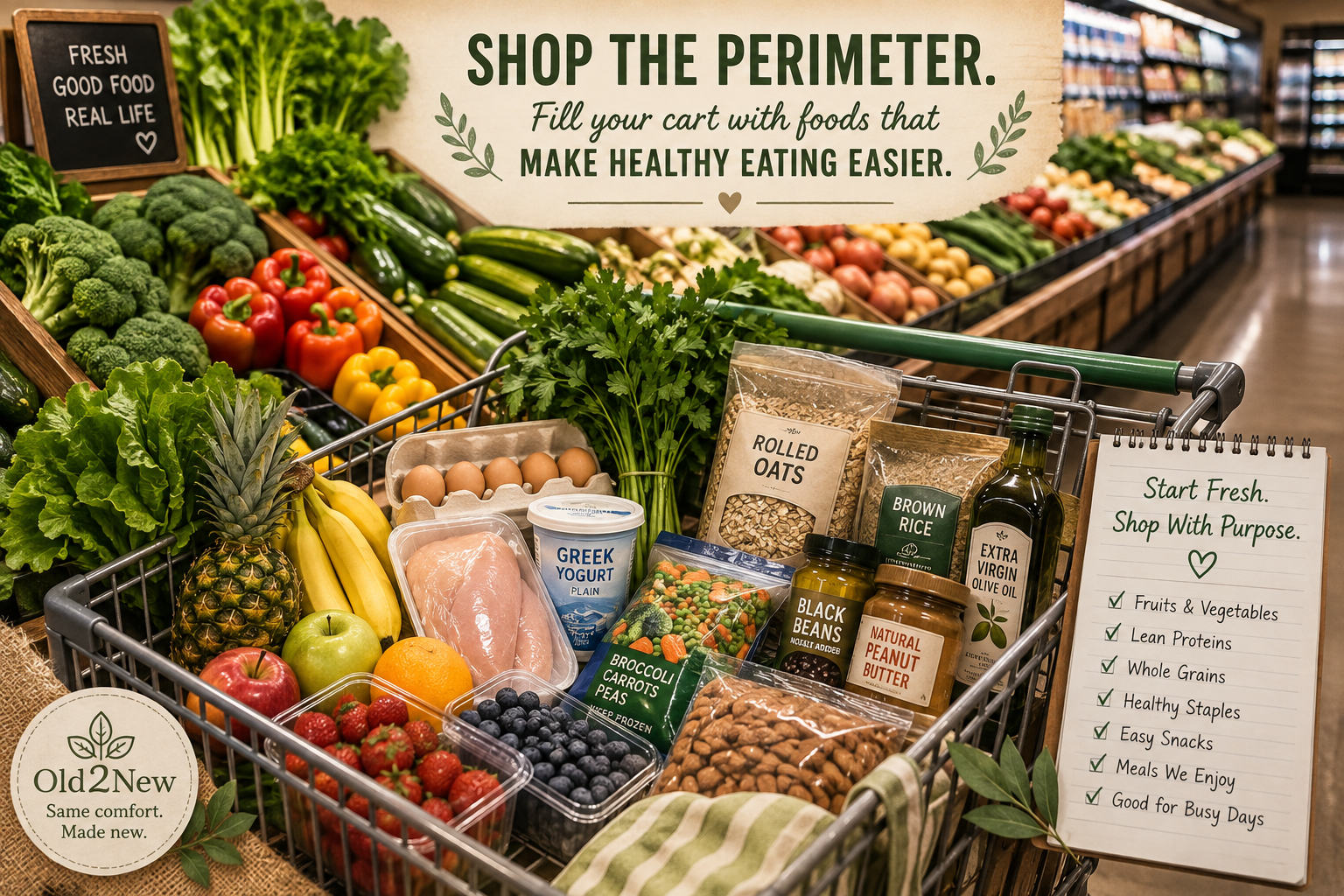
How to Shop the Perimeter of the Grocery Store
Walk into almost any grocery store and you'll notice the same pattern. The fresh produce is near the entrance. The meat and seafood counter runs along one wall. The dairy case lines the back. The eggs are somewhere in between. These departments — the ones built around refrigeration and freshness — tend to cluster around the outer edges of the store.
That's where the advice to "shop the perimeter" comes from. It's a simple mental shortcut that helps people fill their carts with more fresh, minimally processed food without needing to analyze every product in every aisle.
But the perimeter rule has an important caveat that's worth understanding before taking it too literally: the middle aisles aren't the enemy. Some of the most useful, most nutritious, and most practical ingredients in a healthy kitchen live there. Oats, lentils, canned tomatoes, olive oil, brown rice, whole grain pasta, nuts, spices — these are middle-aisle ingredients that build the pantry foundation for hundreds of different meals.
The real goal isn't to avoid the center of the store. It's to shop the whole store with a little more intention — starting at the perimeter to anchor the week's fresh ingredients, then moving through the aisles purposefully rather than impulsively.
Start in the Produce Section
The produce section is the best place to begin a grocery trip because fruits and vegetables are the most perishable, the most visually available for comparison, and the most useful for anchoring the week's meals around something fresh and seasonal.
The mistake most people make in the produce section is buying aspirationally rather than practically — filling the cart with vegetables based on what a healthy week looks like in theory rather than what will actually be cooked and eaten. A refrigerator full of produce that goes soft before it's used isn't a health achievement; it's food waste and money wasted.
The more useful approach is buying for the specific meals planned for the week, plus a small buffer of easy-to-use vegetables that can go into any dish. Think about what will realistically be cooked: if three dinners are planned, what vegetables do those three dinners need? What fresh fruit will be eaten as snacks? What raw vegetables will go into lunches? What needs to be used early in the week because it's most perishable, and what will hold until later?
A smaller cart of produce that gets used completely is more valuable than an impressive cart of produce that partially wilts. Seasonal produce — whatever is abundant and at peak quality during the current season — tends to be both the best tasting and the best value, which makes it the practical starting point.
Visit the Meat and Seafood Section
The protein choice anchors the week's dinners in a way that shapes everything else. Rather than buying protein for one specific meal, thinking about proteins that work across multiple applications produces more meals per dollar and more flexibility throughout the week.
Chicken thighs bought for a Sunday roast become shredded chicken for tacos on Tuesday and the protein in a grain bowl on Wednesday. A piece of salmon for Friday's dinner provides leftovers for Saturday's grain bowl. Ground turkey portioned for a pasta sauce on Thursday has enough left for taco night the following week.
Looking for proteins on sale and building that week's meal plan around what's priced well is one of the most effective budget strategies in grocery shopping. Chicken thighs are almost always less expensive than boneless breasts and often better for cooked applications — worth buying whenever the price difference is significant. Whole chickens provide the most meat per dollar of any chicken purchase and produce a carcass for stock. Ground turkey and lean ground beef are the most versatile proteins for meal prep because they go into so many different applications.
Seafood — particularly frozen shrimp and salmon fillets — is worth keeping in the cart even when fresh seafood is expensive, because the frozen versions perform as well as fresh in most cooked applications at a lower price.
Don't Skip Eggs and Dairy
Eggs are one of the most underrated grocery items in terms of value per dollar, nutritional density, and meal versatility. They work for breakfast, lunch, dinner, and snacks. They go into baked goods and meatballs. They top grain bowls and pasta. A dozen eggs provides twelve complete protein servings and costs a fraction of equivalent protein from other sources.
The dairy and refrigerated section provides several other high-value staples: Greek yogurt as the most protein-dense, versatile dairy product in the store; cottage cheese as a high-protein base that works in both sweet and savory applications; milk or a preferred dairy alternative for cooking, smoothies, and oatmeal; and cheese used judiciously for flavor. Sharp cheddar, parmesan, and feta are the strongest-flavored options that go furthest in small amounts — worth prioritizing over mild, larger-format cheeses where more is needed for the same flavor impact.
The refrigerated section also contains options like fresh pasta, pre-marinated proteins, and convenience items that are useful when time is short. These aren't failures of a healthy grocery strategy — they're practical tools for the days when cooking from scratch isn't realistic.
Head Into the Middle Aisles with Purpose
The middle aisles of the grocery store contain some of the most nutritious, most economical, and most practical ingredients available — they just require more attention than the fresh perimeter products because the packaging is designed to market rather than inform.
The pantry staples worth buying in the middle aisles: dried beans and lentils or canned equivalents; whole grains like brown rice, quinoa, oats, and whole grain pasta; canned tomatoes in all their forms — diced, crushed, paste, and sauce; low-sodium broth; canned tuna and salmon; nuts and seeds; natural nut butter; olive oil; vinegar; low-sodium soy sauce; herbs and spices. These ingredients form the foundation that turns whatever is fresh in the refrigerator into a complete meal.
The key to navigating the middle aisles productively is having a list and buying what's on it rather than browsing. Impulse additions in the center of the store tend to be the packaged convenience foods and specialty products that add cost without meaningfully improving the week's cooking. The staples that earn their place in the cart are the ones that appear across multiple meals and that never sit unused.
Remember the Frozen Section
The frozen section is often at the back or side of the store and frequently treated as an afterthought. It shouldn't be. Frozen vegetables, fruits, proteins, and grains are practical, economical, and nutritionally sound — and they contribute to meals throughout the month rather than expiring by Thursday.
Frozen broccoli, spinach, mixed vegetables, peas, and cauliflower go directly into soups, stir fries, casseroles, and pasta dishes from the freezer. Frozen berries go into smoothies, oatmeal, and baked goods regardless of season. Frozen shrimp and salmon are as nutritious as fresh and often significantly less expensive. Frozen whole grain bread and tortillas prevent food waste from fresh products going stale before they're finished.
A cart that includes a few frozen staples alongside the fresh perimeter purchases is a more practical, less wasteful, and less expensive cart than one built entirely around fresh ingredients that need to be used within the week.
Read the Ingredient List, Not Just the Front
Packaging is designed to create a positive impression before you turn it around. The front of a package with "natural," "multigrain," "made with real ingredients," or "protein" printed prominently tells you what the manufacturer wants you to notice. The ingredient list tells you what's actually in the product.
Turning packages around — checking the first few ingredients and one or two relevant Nutrition Facts values — takes seconds and produces meaningfully better purchasing decisions. The first few ingredients tell you what the product is primarily made of: if whole wheat is listed first, the bread is primarily whole wheat; if enriched flour is listed first with whole wheat appearing fourth, the bread is primarily refined flour. If sugar appears in the first three ingredients of something marketed as healthy, the marketing claim and the actual ingredient are in tension.
This habit doesn't require analyzing every product on every trip. It's most useful when comparing two similar products — two pasta sauces, two yogurts, two granola bars — where a quick comparison reveals a clear better choice without significant additional effort.
Shop for Meals, Not Aspirations
The single most expensive grocery mistake is buying food for the person you intend to be rather than the person you actually are and the schedule you actually have. This produces a cart full of unfamiliar ingredients, specialty health foods, and elaborate meal plans that collapse by Wednesday when nobody has time to make what was planned and the exotic grain sits unopened.
A more reliable approach is building the week's grocery trip around meals the household already enjoys, and looking for small improvements within those familiar meals rather than wholesale replacements. If spaghetti night is on the schedule, buy the ingredients for spaghetti — and consider whether whole wheat pasta or a leaner ground meat would be easy improvements. If taco night is staying, keep it and consider whether adding black beans would extend the filling or whether a Greek yogurt topping would replace the sour cream without anyone noticing.
The meals stay familiar. The specific ingredients improve over time. And the grocery cart reflects what will actually be cooked and eaten rather than what seemed like a good idea in the produce section on a Sunday afternoon.
A Simple Way to Evaluate the Cart
Before heading to the checkout, a quick scan of the cart answers the question of whether the week's eating is covered:
Is there a variety of vegetables and fruit for meals and snacks? Is there enough protein for the week's planned dinners, with some flexibility for lunches? Are there whole grains or other filling staples for building complete meals? Are there easy snack options that don't require cooking? Is there something convenient for the nights when cooking isn't realistic? And is there something that the household actually looks forward to eating, separate from anything nutritionally motivated?
If most of these are covered, the cart is ready. It doesn't need to be perfect — it needs to support a week of eating that's better than what happens without it.
The Perimeter Is a Starting Point, Not a Rule
Shopping the perimeter is a useful mental starting point for grocery trips — beginning with fresh ingredients before heading into the aisles to fill in pantry staples keeps the emphasis on fresh food while acknowledging that the middle aisles contain essential, nutritious ingredients.
But it's not a rule worth following rigidly. Beans come in cans. Oats come in containers. Rice comes in bags. Frozen vegetables come from the freezer aisle on the far side of the store. Olive oil and spices and canned tomatoes come from the center. A kitchen stocked with all of these — fresh perimeter purchases anchored by the pantry staples from the aisles — is a kitchen that can produce good food all week regardless of what happens between Sunday's grocery trip and Friday's dinner.
The goal is leaving with food that helps you make meals you enjoy at home, with ingredients that work a little harder for you. Start around the perimeter. Move through the aisles with intention. And fill the cart with food that fits real life, not just the ideal version of it.
FAQ
Is it true that grocery stores put unhealthy food in the middle aisles? The middle aisles contain a mix — plenty of highly processed packaged foods alongside essential pantry staples like beans, oats, pasta, canned tomatoes, olive oil, and spices. The perimeter strategy isn't really about avoiding unhealthy foods; it's about emphasizing fresh ingredients and not letting the processed packaged foods dominate the cart. Shopping the whole store with a list and a plan is more effective than trying to avoid specific areas.
How do I avoid impulse buying in the middle aisles? Having a specific list organized by store section before entering significantly reduces impulse additions. Shopping when not hungry helps — hunger amplifies the appeal of anything that looks convenient or indulgent. Moving through the store efficiently rather than browsing gives fewer opportunities for impulse additions. And keeping the list visible on a phone or notepad provides an anchor when something off-list starts looking appealing.
Is organic produce worth buying? For produce with thin skins that absorb pesticide residues more readily — strawberries, spinach, apples, grapes, cherries, peaches, tomatoes, celery, and bell peppers (the Environmental Working Group's "Dirty Dozen") — organic is worth considering when the budget allows. For produce with thick skins that provide a barrier — avocados, corn, pineapple, onions, and sweet potatoes — conventional is a reasonable choice. Frozen organic produce is often available at lower prices than fresh organic and is nutritionally equivalent.
Should I always bring a list? For most people, yes — a list consistently produces lower spending, less food waste, and better meal coverage than shopping without one. The list doesn't need to be exhaustive or perfectly organized, but having a written record of what's needed for the week's planned meals removes the decision-making from the store and reduces the browsing time that leads to additions that don't contribute to actual meals.
Continue Your Recipe Transformation Journey
Better grocery shopping habits make everything else in healthy cooking easier and more sustainable. These guides will help you build on them:
- Healthy Grocery Shopping on a Budget — the complete guide to budget-conscious shopping
- Smart Grocery Swaps That Save Money — how to find better alternatives throughout the store
- How to Read an Ingredient Label — how to navigate middle-aisle products confidently
- Pantry Staples Every Home Cook Should Keep — what to buy in the middle aisles
- Beginner's Guide to Meal Planning — how to plan before shopping to make every trip more effective
Old2New — There is good in everything.