How to Organize a Healthy Refrigerator
Open your refrigerator right now and ask yourself: can you see what you have? Not with the mental effort of remembering what went in last week — actually see it, at a glance, without moving things around?
If the answer is no — if there's a container of leftovers hidden behind the milk, three versions of the same condiment in the door, a bag of spinach disappearing into the back of the produce drawer, and several items whose contents and age are genuinely uncertain — then the refrigerator is working against your cooking rather than for it.
A well-organized refrigerator isn't about matching containers or the kind of aesthetically perfect arrangement that gets photographed for social media. It's about making food easy to see, easy to use, and hard to forget. Because the food you can see is the food you eat. The food you can't see goes to waste.
Organize for the Way You Actually Eat
There is no single correct way to organize a refrigerator. A family of five cooking dinner every night uses their refrigerator differently from someone cooking for one or two people. A household that meal preps on Sunday has different refrigerator needs from one that cooks fresh each night. A family with young children needs different accessibility than adults cooking only for themselves.
The useful starting point is observing what actually happens in your kitchen rather than copying a system designed for someone else's household. What foods do you reach for every day — the things that should be most accessible? What ingredients consistently get forgotten until they've gone bad — the things that need to be more visible? What's constantly getting buried or lost in the back? The answers to these questions should determine where things go.
An organizational system that doesn't fit the way a household actually eats won't be maintained, because it will constantly be inconvenient. Start with what would actually make the next week's cooking easier, and adjust from there.
Put Foods You Want to Eat at Eye Level
We eat what's convenient. This is a consistent behavioral truth that's worth designing around rather than fighting with willpower. The food at eye level in the refrigerator gets eaten. The food at the back of the bottom shelf gets forgotten.
Most refrigerators default to a layout where produce goes in the bottom drawers — out of sight, out of mind, and often past their peak by the time they're remembered. Reconsidering this placement and moving some ready-to-eat foods to eye level produces a noticeable change in what gets eaten throughout the week.
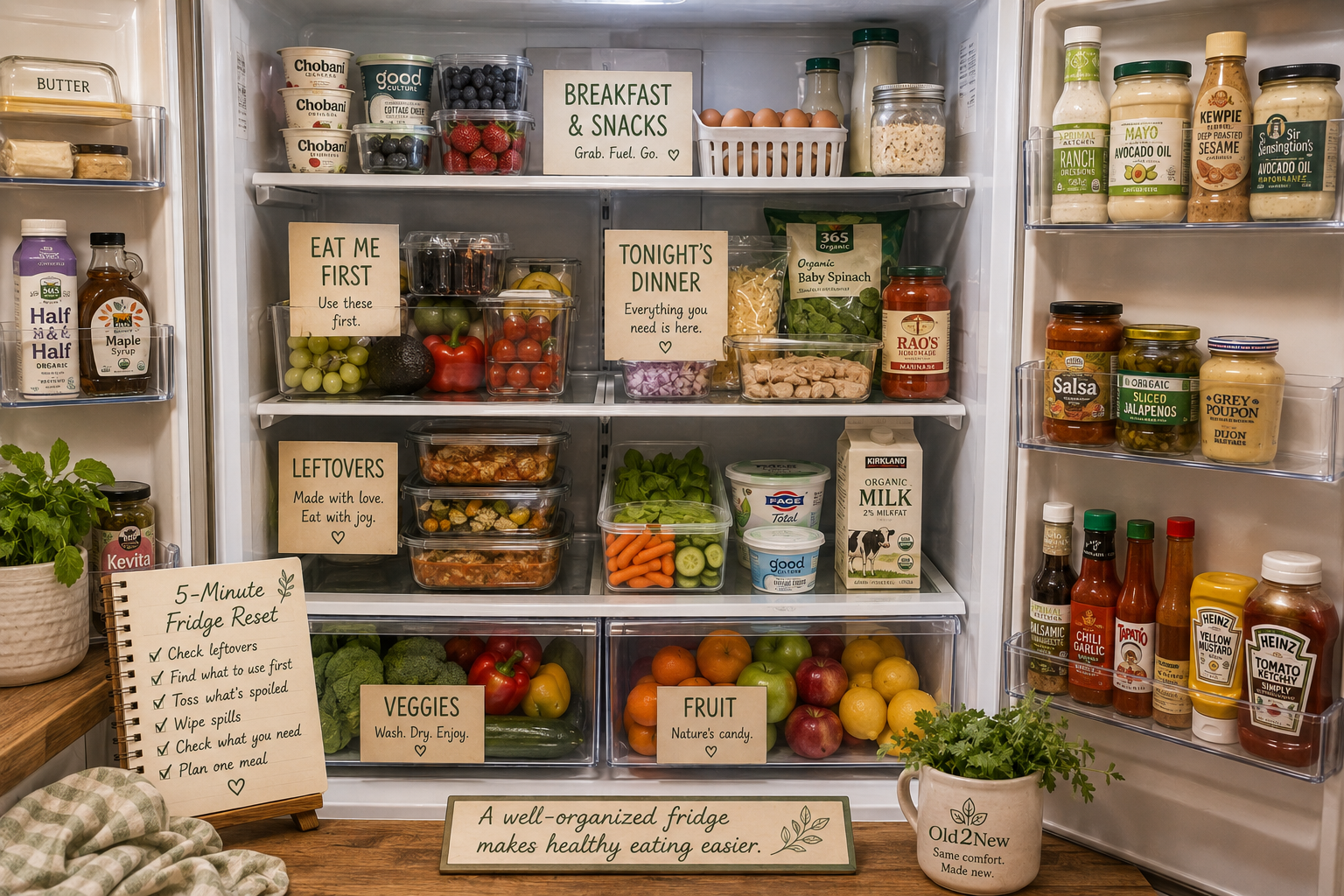
Ready-to-eat foods worth keeping at eye level: washed berries in a clear container, cut vegetables stored in water or a clear container, hard-boiled eggs in a small bowl, yogurt and cottage cheese at the front, hummus next to the vegetables, and prepared overnight oats or grab-and-go breakfast components. These are the foods most likely to become snacks and quick meals when they're visible — and most likely to be ignored and eventually discarded when they're not.
This doesn't require a full reorganization. Moving two or three items from less accessible areas to a visible shelf changes what gets eaten without any other change to shopping or cooking habits.
Create an "Eat Me First" Zone
This is one of the simplest food waste reduction strategies available and requires almost no effort to implement. Designate a small basket, container, or clear section of a refrigerator shelf as the "Eat Me First" area — the designated spot for food that needs to be used in the next day or two before it goes past its prime.
The half avocado with the pit out. The open container of hummus that's been in there since Tuesday. The handful of mushrooms that are fine today but borderline tomorrow. The leftover roasted chicken from Thursday. The berries that are perfect right now but won't be in two days. These go in the Eat Me First zone where they're visible and where the intention to use them is physically represented rather than just mentally noted.
Before opening anything new, checking this zone first produces meals from what's already there rather than letting it go to waste while something fresh is opened alongside it. The zone becomes the answer to "what should I make for lunch?" on days when there's no specific plan — whatever is in it needs to be used, and most of what ends up there is already most of the way to a complete meal.
Give Leftovers a Visible Home
Leftovers that get scattered across different shelves in whatever container was available tend to be forgotten. A clear container pushed to the back of the second shelf becomes invisible within two days and gets discovered a week later in a state that belongs in the trash.
Designating one specific shelf or area for prepared food and leftovers — and using clear containers rather than opaque ones — removes the uncertainty about what's there. If the leftovers shelf is always in the same place and everything on it is visible through the container, checking it takes seconds and using it becomes the path of least resistance for lunch or dinner.
Labeling leftovers with the date is the single habit with the highest return for the lowest effort. A small piece of tape and a marker on each container — "Turkey Chili, Aug 7" — removes the guesswork about whether something is from last Tuesday or the Tuesday before, which is what leads to either throwing away food that was perfectly fine or eating something that had been there too long. The label costs three seconds and prevents both outcomes.
Keep Meal Ingredients Together
For households that plan meals in advance, keeping ingredients for the same upcoming meal grouped together reduces the cognitive load of cooking and prevents the situation where one component of a planned dinner gets used for something else because it wasn't clearly associated with the upcoming meal.
The concept doesn't require elaborate organization — loosely grouping the ingredients for Tuesday's tacos on the same shelf section (the peppers, the chicken that's defrosting, the cheese, the salsa) means everything needed is in one place and nothing gets used for a different purpose because it looked available. For meal prep households, clear containers holding the components for specific lunches or dinners in a dedicated prep section provide the same benefit with more visible organization.
Use Produce Drawers with Intention
The produce drawer deserves a different relationship than the one most refrigerators have with it — which is essentially a place where vegetables go to be forgotten until they become soft enough to require disposal.
The humidity controls in most produce drawers (if present) can meaningfully extend storage life when used correctly: leafy greens and vegetables that wilt quickly (lettuce, spinach, herbs, broccoli, carrots) generally benefit from the high-humidity setting that prevents moisture loss. Fruits that emit ethylene gas as they ripen (apples, pears, peaches, grapes) do better in a lower-humidity drawer or separate from ethylene-sensitive vegetables because the gas accelerates spoilage in vegetables stored nearby.
Beyond the humidity settings, the more important principle is checking the produce drawers regularly — every day or two — so that anything approaching the end of its window moves to the Eat Me First zone rather than being discovered too late. Produce drawers that are checked regularly produce meals from what they contain; produce drawers that are opened only when something is actively needed produce waste.
Don't Wash Everything Immediately
The impulse to wash and prep all produce immediately after grocery shopping feels productive and can be genuinely helpful for some foods. For others, moisture introduced by washing accelerates spoilage and shortens the storage life of produce that would have kept longer left whole and dry.
Berries washed before storage mold significantly faster than berries stored dry and washed immediately before eating. Leafy greens stored with excess moisture deteriorate faster than those patted dry before refrigerating. Mushrooms washed in advance become slimy faster than those stored dry. Herbs stored wet rot faster than those stored with trimmed stems in water.
The useful principle is: prep the produce that being ready to eat will actually help you eat, and leave other produce in its best storage state until you're ready for it. Washing grapes and putting them in a bowl makes them into a snack; leaving them unwashed on a stem keeps them better longer. Cutting carrot sticks makes them into a snack; leaving a carrot whole keeps it better for a dish it will be cooked into. The prep decision should be driven by whether the convenience of having something ready actually affects whether it gets eaten.
Store Raw Proteins Safely
Organization has a food safety dimension that's worth addressing alongside the convenience and waste-reduction aspects. Raw meat, poultry, and seafood can contaminate other foods if their juices drip or spread — an important consideration when organizing shelf placement.
Raw proteins belong on the lowest shelf in the refrigerator where their juices can't drip onto foods below them. They should be stored in sealed containers or on a plate that contains any liquid rather than loosely wrapped. They should be kept clearly separated from ready-to-eat foods — cooked proteins, produce, dairy, leftovers — that will be consumed without additional cooking to destroy any contamination.
This doesn't require elaborate organization. It requires keeping raw proteins consistently in one designated lower shelf location and ensuring they're contained. The habit is simple; the food safety benefit is significant.
Use the Door Strategically
The refrigerator door is the warmest part of the refrigerator because it warms slightly with every opening and is furthest from the cooling element. Foods that require consistent cold storage — milk, eggs in some models, fresh proteins — are better kept on interior shelves rather than the door.
The door is well-suited for foods that tolerate temperature variation: condiments, mustard, hot sauce, salad dressings, pickles, jam, and other items with sufficient salt, sugar, or acid content to remain safe through the temperature fluctuations that come with frequent opening.
The door is also worth periodic attention because it accumulates items that don't get used — the specialty condiment bought for a specific recipe and then neglected, the three versions of the same dressing, the vinaigrette from six months ago. A quarterly door check that removes anything past its date or that hasn't been used in months keeps the door functional rather than a condiment museum.
Create a Quick-Access Breakfast or Snack Zone
For households where mornings are rushed or snacking needs to be as frictionless as possible, dedicating a small section of the refrigerator specifically to foods that get reached for at those moments removes the decision-making overhead that can lead to less intentional choices.
A designated breakfast zone might contain Greek yogurt, berries, overnight oats, cottage cheese, and hard-boiled eggs — everything needed for a quick morning meal without searching or deciding. A snack zone at eye level with hummus, cut vegetables, fruit, and cheese provides easy options that present themselves when the refrigerator is opened between meals.
The zone works because the decision is already made: when it's snack time or breakfast time, you go to the zone. What's there is what you eat. The organizational decision removes the moment-of-hunger decision, which is when the least intentional choices tend to happen.
The Weekly Five-Minute Reset
One habit that prevents the refrigerator from gradually deteriorating into disorganization is a brief weekly reset — not a deep clean, just a five-minute check and adjustment that happens on the same day each week, ideally before grocery shopping so it informs the list.
The reset covers: checking what leftovers are there and whether they're still good, looking at produce for anything approaching its window and moving it to the Eat Me First zone, removing anything genuinely past its prime, wiping up any spills or drips before they harden, and noting what's running low that needs to be replaced. This five minutes prevents the gradual accumulation of forgotten items that eventually requires a major clean-out, and it generates a more accurate grocery list because the current state of the refrigerator is fresh in mind when the list is written.
FAQ
How long do leftovers safely keep in the refrigerator? Most cooked foods keep safely for three to four days. Soups and stews keep for three to four days. Cooked grains keep for five to six days. Cooked proteins (chicken, beef, pork, fish) keep for three to four days. Cooked vegetables keep for three to five days. The date label on leftover containers removes the guesswork — if something was made Monday and it's Friday, four days have passed and the decision is clear.
Should eggs be stored on the door or on a shelf? In the US, where eggs are washed before sale (which removes the protective coating), eggs are best stored on an interior shelf where the temperature is most consistent. In countries where eggs are not washed and retain their protective bloom, room temperature storage is traditional. Most US refrigerators place eggs in the door as a design choice, but an interior shelf is the better option for consistent temperature.
How do I prevent the produce drawer from becoming a waste zone? Check it every day or two — the habit of opening the produce drawer during meal prep to see what's there (rather than only when actively looking for something specific) is the most effective prevention. Moving anything approaching its end to the Eat Me First zone rather than leaving it in the drawer ensures it gets used or consciously discarded rather than forgotten. Keeping the drawer organized enough that everything is visible also helps — if items are buried, they don't get considered.
What's the most important thing to store at eye level? Whatever your household is most likely to eat if it's visible and doesn't require preparation. For most households, this means ready-to-eat snack items (washed fruit, cut vegetables, yogurt, hard-boiled eggs) and the components of the most common quick meals (leftovers, cooked proteins, prepared grains). The goal is making the path of least resistance at snack time and quick dinner time point toward food you're already happy with.
Continue Your Recipe Transformation Journey
An organized refrigerator is the foundation that makes everything else in healthy cooking more reliable. These guides will help you keep it stocked and used well:
- Buying Produce Without Waste — how to buy the right amount so less goes forgotten
- How to Use Leftovers Creatively — how to turn what's in the refrigerator into new meals
- Beginner's Guide to Meal Planning — how planning ahead reduces refrigerator chaos
- Healthy Snacks to Keep at Home — what to keep visible and ready to eat
- Pantry Staples Every Home Cook Should Keep — what goes alongside the refrigerator to complete any meal
Old2New — There is good in everything.