Buying Produce Without Waste
The produce section has a way of inspiring good intentions that don't survive contact with a busy week. Into the cart go the spinach, the berries, the bunch of fresh herbs, the three avocados, the cucumbers, and the bag of oranges. The cart looks like health. Then life happens — a few nights of takeout, a dinner out, unexpected plans — and by the following Sunday you're standing over the trash holding a container of fuzzy berries and wondering exactly when that cucumber became a structural hazard.
Buying more produce is not the same as eating more produce. The gap between what goes into the cart and what actually gets eaten is where most food waste happens — and closing it doesn't require more discipline or better intentions. It requires a different approach to the shopping itself.
The goal is a refrigerator where the food gets eaten — not a refrigerator that looks impressive when you open it.
Start with What You Already Have
Before making a grocery list or going anywhere near a store, spend two minutes looking through the refrigerator. Really looking — moving things around, checking the produce drawers, seeing what's hiding behind the milk and the leftovers from Tuesday.
The half bag of carrots, the lonely bell pepper, the handful of wilting spinach, the three apples that got pushed to the back — these are ingredients that were already paid for and deserve a meal before more of the same is purchased. Building at least one upcoming meal around what's already in the refrigerator before buying more is the single most effective food waste reduction strategy available, and it costs nothing beyond two minutes of attention.
A refrigerator check before grocery shopping also prevents the common accumulation problem — buying a third bag of onions because the first two were invisible at the back of the produce drawer.
Shop for the Week You're Actually Having
The most important mental shift in reducing produce waste is shopping for the real week ahead rather than the idealized version of it. The idealized week has fresh cooking every night, elaborate salads at lunch, and beautiful seasonal produce used in creative ways. The real week has two nights of leftovers, one dinner out, one night of takeout, and three actual cooking opportunities.
If the shopping trip buys for seven nights of elaborate cooking but the week only produces three, four nights of produce sits in the refrigerator past its peak. Not because of lack of willpower — because the mismatch between what was bought and what was realistic was built in at the moment of purchase.
Shopping honestly means counting actual cooking nights, accounting for meals out and planned leftovers, and buying produce proportional to those real opportunities rather than aspirational ones. A smaller cart of produce that gets used completely is worth more than a larger cart that produces impressive photos and significant Thursday waste.
Give Every Piece of Produce a Job
Before putting produce in the cart, the most useful question is: what am I going to use this for? The broccoli that has a specific Tuesday dinner it belongs to gets eaten. The broccoli that went into the cart because broccoli is healthy and it looked good sits in the produce drawer until it yellows.
This doesn't require planning every meal before shopping. It requires having a general sense of where each piece of produce is going — which dinners it's for, which snacks it will contribute to, which lunches it will appear in. Produce with a purpose gets eaten. Produce without one becomes compost.
The related question for fresh herbs is particularly worth asking: is there a specific dish this week where these herbs will be used, or is this purchase based on the hope that fresh herbs will happen? Fresh herbs are wonderful and worth buying when there's a plan for them. They're expensive compost when bought speculatively.
Stagger Ripeness
Not everything purchased at the grocery store needs to be perfectly ripe immediately. For fruits and some vegetables that continue ripening after harvest — avocados, bananas, pears, peaches, mangoes, tomatoes — buying at different stages of ripeness means they don't all peak at the same moment and create a consumption crisis.
Two avocados bought hard and two bought soft means something is ready today and something will be ready in three to four days. Three bananas bought yellow-green and two bought ripe means the ripe ones go into this week's breakfast and the others are ready later. A flat of peaches at different stages ripens sequentially rather than all at once, giving a week's worth of perfectly ripe peaches rather than two days of everything simultaneously ready.
This staggering approach turns one purchase into a supply that lasts the full week rather than a single peak followed by waste.
Know Which Produce Needs to Be Used First
Not all produce has the same urgency. Some ingredients last days; others last weeks. Understanding which is which allows meal planning to sequence from most perishable to most durable throughout the week — using what will spoil soonest at the beginning and saving what holds longer for later.
The produce that needs to be used earliest: berries (two to three days after washing, longer unwashed), leafy greens (three to five days), fresh herbs (four to seven days stored in water), ripe avocados (one to two days once soft), mushrooms (three to five days), and ripe stone fruits (two to three days at peak). These go into the Monday and Tuesday meals, or into smoothies and salads early in the week.
The produce with more patience: apples (two to four weeks refrigerated), oranges and citrus (two to four weeks), carrots (three to five weeks), cabbage (four to eight weeks), potatoes (weeks to months in a cool dark place), onions (weeks to months stored properly), and winter squash (weeks to months). These can wait for later in the week or into the following week without loss.
Planning Monday's dinner around the berries and spinach rather than the carrots and cabbage turns perishability sequence into a natural meal planning tool.
Make Produce Easy to See
The refrigerator produce drawer is a convenient place for produce to become invisible. Out of sight genuinely means out of mind — the spinach that can't be seen from the refrigerator opening doesn't get remembered until it has become something unrecognizable in the back corner.
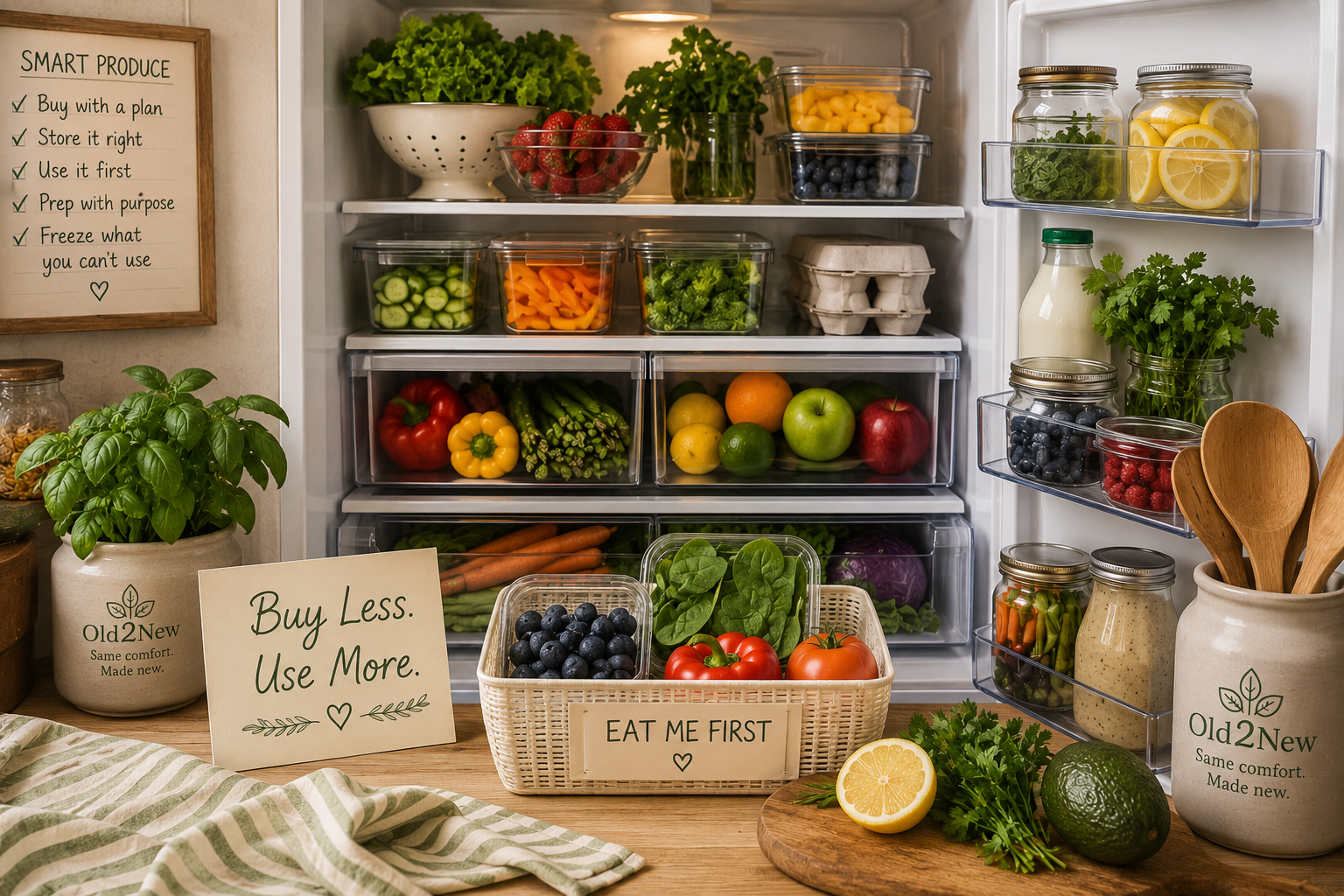
Moving toward visibility at the front of the refrigerator is worth the effort: washed berries in a clear container at eye level, apples in a bowl on the counter, ready-to-eat carrot sticks in a glass of water at the front of the refrigerator, avocados left on the counter where they can be monitored. Anything approaching the end of its useful window deserves to be moved forward to the most visible shelf where it will be encountered naturally when the refrigerator is opened.
A small designated container labeled "use first" — the designated spot for produce that needs to be used today or tomorrow — removes the searching step from finding what to build dinner around. The container tells you where to start.
Prep Strategically, Not Comprehensively
Some produce lasts longer when stored whole and unwashed, and the reflex to wash and cut everything immediately after grocery shopping can actually accelerate spoilage in some cases. Berries washed too early mold faster. Herbs stored dry last longer than herbs washed and stored wet. Lettuce keeps longer in its original state than once torn.
The more useful prep principle is: remove the obstacle that would otherwise prevent eating something. If whole grapes never get washed when it's time to eat them, wash and store them ready to eat. If cutting a melon is what prevents it from being eaten at lunch, cut it on Sunday and store it ready to go. If chopping vegetables is what makes a salad not happen on Tuesday, do the chopping Monday evening.
Prep the things that becoming convenient will actually help you eat. Leave the rest as-is when storage life benefits from it.
Choose Ingredients That Work in Multiple Meals
The most waste-resistant grocery strategy buys ingredients that appear in multiple different meals rather than single-use specialty items bought for one recipe and then unused.
Bell peppers are a useful example — they go into eggs, tacos, pasta sauce, grain bowls, stir fries, and raw snack plates. Buying a bag of bell peppers provides a vegetable component for four or five different meals rather than one specific dish. Spinach goes into omelets, pasta, soups, salads, grain bowls, and smoothies — a bag of spinach used across the week's cooking disappears naturally rather than going forgotten.
Choosing versatile ingredients over single-purpose ones at the point of purchase structurally reduces waste because the purchase has more opportunities to be used, more meals it can contribute to, and less dependence on any single planned recipe actually happening.
Have a Rescue Plan for Aging Produce
Produce doesn't have to look perfect to be usable, and the difference between produce that's past its visual peak and produce that's genuinely spoiled is large enough to matter for most of what ends up in household trash cans.
Soft berries are perfect for oatmeal, smoothies, compote, or muffins — the texture that makes them unappealing fresh actually works better blended or cooked. Very ripe bananas are more flavorful for baking than fresh ones — the natural sweetness concentrates as they ripen, which is exactly what banana bread needs. Wilting spinach is still excellent cooked into eggs, pasta, or soup where the texture change is irrelevant. Soft tomatoes simmer into sauce with better flavor than under-ripe ones. Vegetables that have lost their crispness often roast beautifully — the lower moisture content promotes better caramelization than fresh vegetables would achieve.
The rescue reflex — looking at aging produce as an ingredient to use rather than a problem to solve — converts most pre-trash produce into something genuinely good rather than something endured out of obligation.
Use the Freezer Before the Trash
When produce is heading toward the end of its usable window and the week doesn't have room for it, the freezer extends the timeline by weeks or months. The question worth asking before throwing anything away is: can this be frozen?
Bananas peel and freeze whole — from frozen they blend into smoothies or defrost for baking. Berries freeze on a sheet pan individually and transfer to a bag — from frozen they go into smoothies, oatmeal, and baking year-round. Chopped peppers freeze in portions useful for stir fries and pasta sauce. Spinach and most leafy greens freeze for cooked applications where texture doesn't matter. Fresh herbs freeze chopped and flat or in olive oil ice cubes. Tomatoes freeze whole and go into sauce when thawed — the texture changes but the flavor concentrates.
The goal of freezing isn't preserving the exact fresh experience. It's preserving the ingredient for a future meal where it will be used and enjoyed rather than discarded unused.
When Frozen or Canned Beats Fresh
For households that routinely discard the same fresh produce repeatedly, the honest answer is sometimes to stop buying that produce fresh. A bag of frozen broccoli that produces zero waste because only what's needed goes into the pan is a better choice than fresh broccoli that gets partially used and partially discarded week after week.
This isn't a compromise — it's the right tool for the situation. Frozen vegetables are nutritionally equivalent to fresh in most cooked applications, cost less, produce no waste, and are available whenever they're needed rather than expiring on the day the plan changed. For produce that consistently goes to waste in its fresh form, the freezer section offers a waste-free alternative that costs less and performs identically in cooked dishes.
FAQ
How do I keep fresh herbs from wilting so quickly? Store fresh herbs like fresh flowers — trim the stems and place them in a jar with an inch of water, then loosely cover with a plastic bag and refrigerate. This method keeps parsley, cilantro, and dill fresh for one to two weeks. Basil is the exception — it's sensitive to cold and does better at room temperature with stems in water, away from direct sunlight. Thyme and rosemary keep well rolled in a slightly damp paper towel inside a bag in the refrigerator.
What's the best way to store berries so they last longer? The main enemies of berries are moisture and crushing. Store unwashed and uncovered (or loosely covered) in the refrigerator on a paper towel to absorb excess moisture. Wash only immediately before eating. Spreading them in a single layer rather than piling them prevents crushing, which is where mold spreads from. Checking the container and removing any damaged berries immediately prevents one from accelerating spoilage in the rest.
Should I store tomatoes in the refrigerator? Not until they're fully ripe. Refrigeration halts the ripening process and negatively affects the texture and flavor of tomatoes — the cold converts the starch to sugar in ways that make the flesh mealy and the flavor flat. Store unripe and ripe tomatoes at room temperature, stem side down, out of direct sunlight. Once fully ripe and if they won't be used within a day or two, refrigeration can extend them — but let them come back to room temperature before eating for the best flavor.
How do I know if produce is spoiled vs. just past its prime? Signs of genuine spoilage that indicate food safety concerns: visible mold, an off or fermented smell, slimy texture throughout (not just the surface), or significant discoloration that goes deep into the flesh. Signs of produce that's past its visual peak but still safe and usable: soft texture without mold or smell, browning at the surface only, wilting without any sign of rot, or a slightly less vibrant color. Soft berries without mold are still good for smoothies. Wilted spinach without any rot is fine cooked. A brown spot on an apple can be cut away with the surrounding flesh still perfectly usable.
Continue Your Recipe Transformation Journey
Buying produce without waste is one of the most impactful habits for making healthy cooking more sustainable and more economical. These guides build on it:
- Beginner's Guide to Meal Planning — how planning ahead prevents produce waste
- How to Use Leftovers Creatively — how to rescue aging produce into new meals
- Healthy Freezer Staples — how to use the freezer as a produce-saving tool
- Fresh vs. Frozen Vegetables — when frozen is the less wasteful choice
- Seasonal Produce Guide — how buying in season naturally reduces waste
Old2New — There is good in everything.