How to Organize Your Pantry
Open your pantry and take an honest look. Can you tell what you have? Or are there three open bags of the same grain at different stages of emptiness, a can of beans hiding behind the cereal, spices you forgot you owned, and something in the back that you're not entirely sure is still safe to eat?
A disorganized pantry costs money — ingredients get purchased again because they were invisible at the point of grocery shopping, food goes unused because it was forgotten, and meal planning operates on an inaccurate picture of what's available. The less visible a pantry item is, the less likely it is to be used and the more likely it is to be eventually discarded.
A well-organized pantry doesn't need to look like a home makeover show. It doesn't require matching containers, color-coded labels, or woven baskets from a specialty store. It simply needs to help you answer one question when you walk into the kitchen at 6pm on a Tuesday: what can I make with what I already have? That question — answered quickly and accurately — is the difference between a home-cooked dinner and takeout on nights when cooking would have been possible.
Start by Taking Inventory
Before buying any organizational supplies, figure out what's actually there. This step is frequently skipped in favor of going directly to the purchases, which produces a beautifully organized pantry containing the same forgotten items in nicer containers.
Working through the pantry shelf by shelf rather than emptying everything at once makes the task less overwhelming and more likely to be completed. Look for: duplicate ingredients (the second bag of quinoa that was bought because the first was invisible); open packages that need to be combined or used soon; items approaching their best-by dates that should move to the front; ingredients used frequently that should be in the most accessible location; and items that have been there so long they're no longer likely to be used by anyone in the household.
The inventory step often reveals that the pantry doesn't need more groceries — it needs meals built around what's already there. A can of chickpeas, a box of pasta, a jar of tomato sauce, and a can of diced tomatoes is already a complete dinner. Discovering these connections before shopping prevents the pattern of buying fresh ingredients for specific recipes while the pantry accumulates overlooked staples.
Group Similar Foods Together
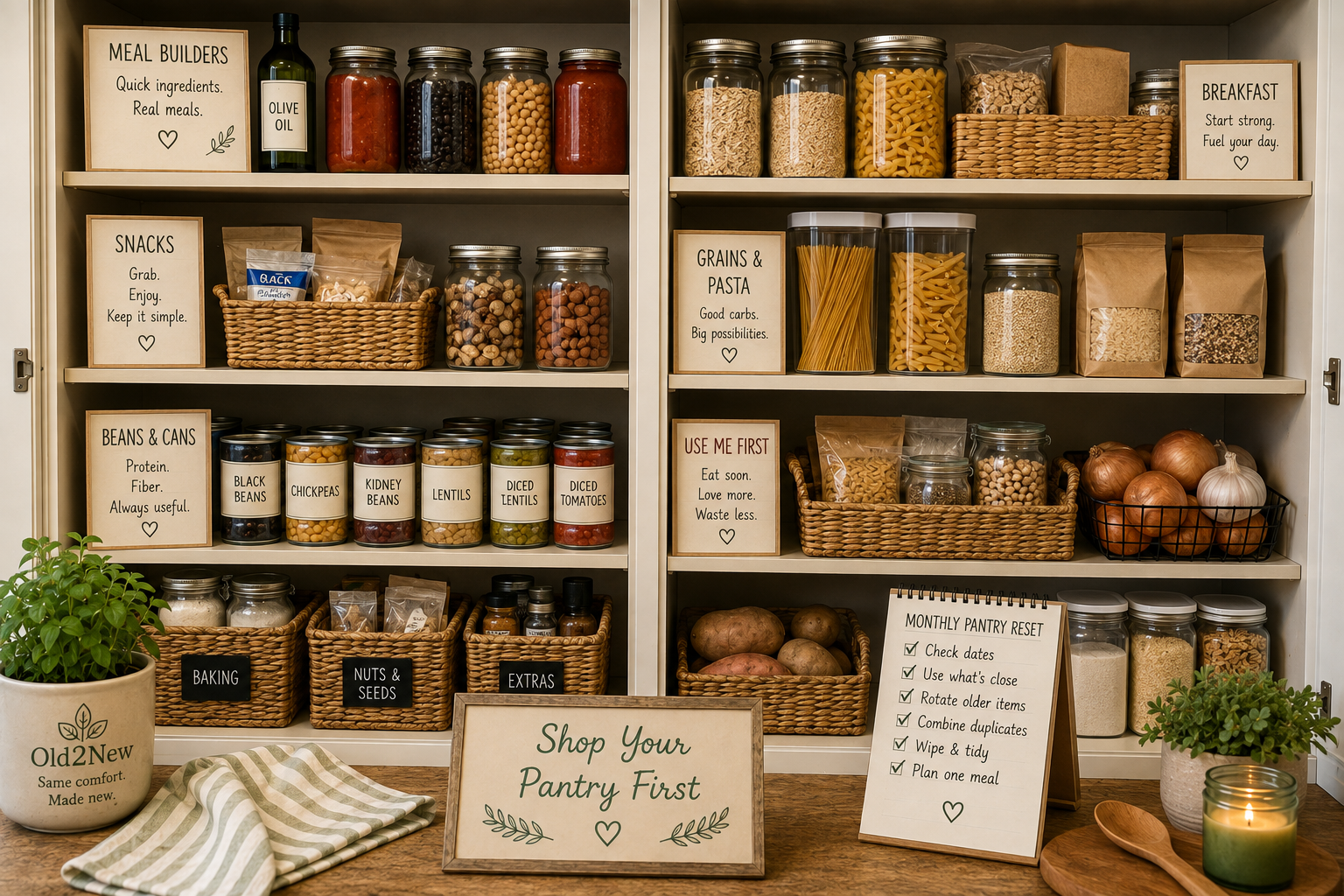
The most practical pantry organization principle is simple: similar foods live together. This means pasta, rice, and whole grains share one area. Canned beans and legumes share another. Baking ingredients occupy a designated section. Herbs and spices are grouped together where they can be found without hunting. Oils, vinegars, and sauces have their own zone.
The specific categories don't need to be elaborate or precisely defined. The important thing is that when you're cooking pasta, you know where to look for it, and it's there rather than scattered across three different shelves. When you need cumin, the spices are together in one place rather than distributed throughout the pantry based on when they were last used.
The categorization also makes grocery shopping more accurate — when you can see all the canned tomatoes together, you can tell whether you need more without the uncertainty that comes from remembering how many you have and where they are.
Put Everyday Foods at Eye Level
The pantry equivalent of the refrigerator eye-level principle: what's most visible gets used most. The shelf that's easiest to reach — typically between waist and eye level — should hold the ingredients used most frequently. For most households that cook regularly, this means the whole grains, pasta, canned beans, canned tomatoes, oats, nuts, peanut butter, and olive oil that appear in meals week after week.
Ingredients used occasionally or seasonally — the specialty flour bought for a holiday baking project, the rice variety used for one specific dish, the jar of tahini that goes through slowly — can live on higher or lower shelves where they're accessible but not occupying the prime real estate.
The pantry should reflect actual cooking habits rather than an idealized version of what the pantry is supposed to look like. If your household makes tacos twice a week, taco-related pantry staples (black beans, salsa, seasonings, tortillas if shelf-stable) belong at eye level where they can be reached quickly. If oatmeal is the default breakfast, the oats belong at the front of the most accessible shelf.
Create a "Use Me First" Zone
The pantry equivalent of the refrigerator's Eat Me First area: a designated spot for items that need to be used before they're forgotten or before they pass their best-by date.
A small basket or a designated section of one shelf works well. Into it go: open packages that need to be finished (the half bag of rice, the partially used box of pasta, the half-empty can of coconut milk transferred to a sealed container), items approaching their best-by dates, and small amounts remaining in bags that should be incorporated into the next relevant meal rather than getting pushed to the back.
Checking this zone before opening a new package of any ingredient produces meals from what needs to be used while it's still at its best, rather than the pattern of opening a new package while a nearly-finished one sits forgotten in the pantry for months.
Stock Ingredients That Work in Multiple Meals
The most valuable pantry ingredients are the ones that contribute to multiple different meals rather than serving only one specific recipe. An ingredient that appears in four dinners a week earns its pantry space many times over; an ingredient bought for a single recipe and then neglected costs more than the purchase price in wasted potential.
Canned tomatoes in their various forms — diced, crushed, paste, sauce — are the clearest example: they go into pasta sauce, chili, soup, stew, shakshuka, braised chicken, taco filling, and casseroles. One pantry staple with dozens of applications. Oats go into breakfast, overnight oats, granola, muffins, energy bites, and as a breadcrumb substitute in meatloaf and meatballs. Beans go into soups, salads, tacos, grain bowls, dips, and casseroles. Brown rice goes into every rice-based application and serves as the base for grain bowls and stir fries.
When evaluating whether to stock something, the useful question is: how many different meals can this ingredient contribute to for this household? The higher the number, the more valuable the pantry position.
Keep Meal Builders Visible
The concept of a "meal builder" — a collection of pantry staples that can become a complete dinner with minimal additional ingredients — is what makes a pantry genuinely useful rather than just a storage space.
A pasta night builder: pasta, canned tomatoes, olive oil, Italian seasoning, and whatever protein is in the refrigerator or can be added from the pantry (canned tuna, canned beans, leftover chicken). A taco night builder: canned beans, salsa, cumin, chili powder, and tortillas, completed by whatever fresh toppings are available. A soup night builder: low-sodium broth, canned tomatoes, dried lentils or canned beans, and any available vegetables. A quick grain bowl: cooked grains (or a packet of quick-cooking grains), canned beans, olive oil, and lemon, completed with fresh vegetables from the refrigerator.
Keeping these builder groups visible and accessible — either grouped by meal type if the pantry space allows, or simply stocked and organized enough that they can be assembled quickly — means dinner doesn't always require a grocery trip. The pantry itself can be the starting point for a complete meal most nights of the week.
Use Clear Containers Where They Actually Help
Clear containers are useful when the benefit is genuine visibility — when being able to see the contents (and the amount remaining) produces better decisions than the original packaging would. For foods bought in bulk or in bags that obscure their contents and don't seal well, a clear airtight container improves both visibility and storage life: oats, rice, flour, nuts, seeds, and dried pasta all benefit from this approach.
But transferring every grocery item into a matching container system is an organizational investment that isn't always worth the time, cost, or ongoing effort. The pasta in its original box is visible, has the cooking instructions printed on it, and doesn't need a more aesthetic home unless the box is a specific problem for storage. The can of tomatoes doesn't need to be decanted into a jar. The spice bottles are already containers — organizing them so they're visible and grouped is the practical intervention, not replacing them.
The useful question before any organizational purchase is: will this actually make the pantry more functional for how we cook, or is this just making it look more organized? Function is the criterion.
Keep Labels Informative
When food is transferred into containers that don't make the contents obvious, labeling with the ingredient name and (for items that will be stored for a long time) the best-by date prevents the scenario of discovering a beautiful glass jar six months later with no memory of what it contains.
Labels don't need to be elaborate — a piece of masking tape and a marker works as well as a label maker. The standard to meet is: someone other than the person who filled the container can identify what's in it without opening it. That standard is usually met by the ingredient name and nothing else, unless the container holds something that might be confused for something similar.
Rotate Older Food Forward
The principle of first in, first out — moving newer purchases to the back and older ones to the front — is the simple habit that prevents pantry items from aging into the back of shelves where they won't be discovered until they've been there far too long.
When a new can of tomatoes arrives, it goes behind the one already there. When a new bag of oats is opened, it goes behind the partially used one already in the container. This doesn't require significant effort — it's a 10-second habit at the moment of putting groceries away — but its effect over time is that the oldest items are always the most accessible and the most likely to be used before their best-by dates.
Create a Quick-Meal Section
Some days cooking from scratch is realistic and satisfying. Other days it isn't, and those are the nights when having a designated quick-meal section in the pantry prevents the decision from defaulting to takeout.
A small section stocked with the fastest-to-prepare pantry options — whole grain pasta and a quality jarred tomato sauce, a can of beans and tortillas for tacos, an instant grain packet and canned fish, a box of soup — provides a home-cooked alternative for the nights when cooking is the right choice but starting from scratch isn't.
This section isn't a failure of healthy eating aspirations. It's a practical acknowledgment that some nights require speed and simplicity, and that having good options available for those nights is better than the alternative.
Monthly Ten-Minute Pantry Reset
One brief monthly habit prevents the gradual deterioration of pantry organization and the accumulation of forgotten items that eventually requires a major overhaul. A ten-minute reset — done on the same day each month, perhaps before the grocery trip that follows — covers the essential maintenance without requiring dedicated reorganization time.
The ten minutes covers: checking for open packages that should be combined or moved to the Use Me First zone, looking at best-by dates on anything that's been there for a while, moving older items forward, combining duplicate partially-used packages of the same ingredient, wiping up any spills or crumbs, and identifying one upcoming meal that uses something already in the pantry before the next grocery trip buys more.
Ten minutes monthly prevents a situation that requires an hour to fix. The maintenance investment is worth the ongoing organizational dividend.
FAQ
How do I know when to throw something away versus when it's still usable? Best-by and use-by dates are quality indicators, not safety cutoffs for most pantry items. Canned goods past their best-by date are typically safe and usable, though quality may have declined. Dried grains, pasta, and beans are safe well past their dates but may take slightly longer to cook as they age. Oils can go rancid (they'll smell off when that happens) before the printed date in warm storage conditions. Spices don't spoil but lose potency over time — smell them; if the aroma is faint, the flavor impact will be minimal. When in doubt about any pantry item, smell and visual inspection are the useful guides.
Do I need to buy special containers to organize a pantry? No. While clear airtight containers are genuinely useful for bulk dry goods that don't come in resealable packaging, a well-organized pantry doesn't require a container investment. Grouping similar foods on the same shelf, rotating older items forward, and keeping frequently used ingredients most accessible are organizational improvements that cost nothing and produce most of the benefit.
How do I get my household to maintain the organization? The most sustainable pantry organization is the simplest one — if the system is intuitive enough that putting something away in the right place is as easy as putting it anywhere, it tends to stay organized. Complicated systems with many specific locations that must be memorized don't survive regular household use. The principle of similar-things-together, oldest-in-front, and most-used-at-eye-level is simple enough to follow naturally once the initial organization is in place.
Continue Your Recipe Transformation Journey
An organized pantry is the foundation that makes healthy cooking faster, less wasteful, and more reliable. These guides will help you keep it well stocked and well used:
- Pantry Staples Every Home Cook Should Keep — what belongs in a well-stocked pantry
- Pantry Staples That Last for Months — the long-lasting ingredients worth always having
- How to Organize a Healthy Refrigerator — the companion guide for refrigerator organization
- How to Use Leftovers Creatively — how pantry staples complete leftover-based meals
- Beginner's Guide to Meal Planning — how pantry visibility improves weekly meal planning
Old2New — There is good in everything.